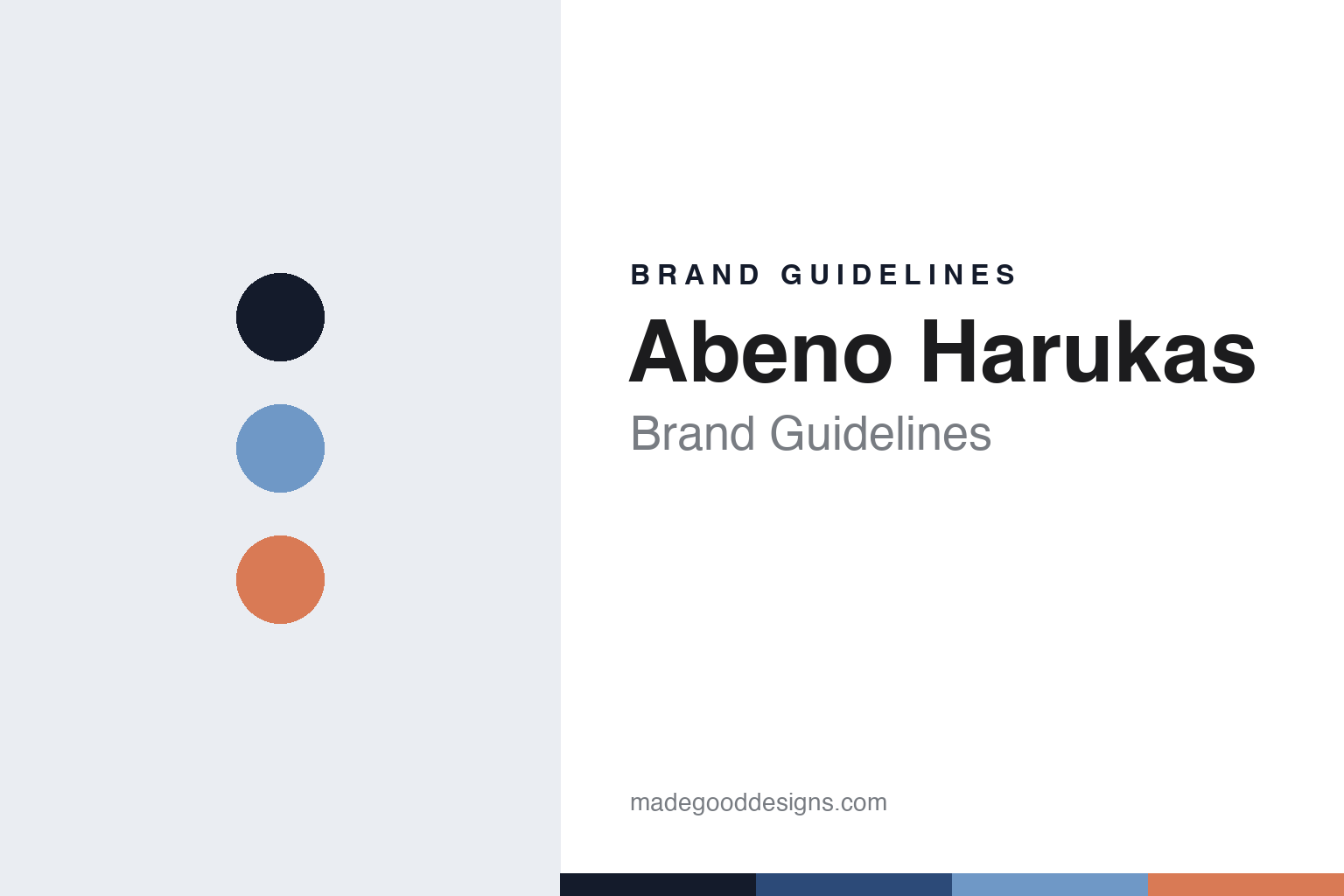
Abeno Harukas Brand Guidelines
The Osaka station tower whose name means to brighten and clear up.
Aa
Two constants: a dusk navy, clear-sky blue and sunrise coral palette and a rounded sans register. Abstract homage — not an Abeno Harukas asset; no logo, character or building image is reproduced.
A station at 300 metres
A railway terminal rebuilt as a tower.
Abeno Harukas is a 300-metre tower in Abeno Ward, Osaka, built directly above Ōsaka Abenobashi Station, the terminal of the Kintetsu Minami Osaka Line. It opened in full on 7 March 2014, and English Wikipedia lists it as the tallest building in Japan from 2014 until 2023, when Azabudai Hills Mori JP Tower in Tokyo passed it. Nippon.com, writing in September 2019, described it as Japan’s first building to reach 300 metres, ahead of Yokohama’s Landmark Tower at 296 metres. Japanese Wikipedia, in 2026, calls it the second-tallest building in Japan and the country’s tallest station building.
The tower replaced the older main building of the Abenobashi Terminal Building, which housed the Kintetsu Department Store’s main Abeno branch. The project website gives the sequence: planning began in autumn 2006, the rebuilding plan was announced in August 2007, demolition of the old building’s western part started in March 2009 and foundation work in January 2010. Work above ground began in February 2011, the name was chosen in August 2011, and the steel frame reached 300 metres in August 2012. According to Nippon.com, the first plans did not aim for a record height; they were revised after height rules around Osaka International (Itami) Airport were eased in March 2007. Japanese Wikipedia says the earlier plan had been for a tower of about 270 metres.
The building was developed by the railway company Kintetsu. In April 2015, when the Kintetsu group moved to a holding-company structure under Kintetsu Group Holdings, Kintetsu Real Estate took over the railway’s property business, including the running of Abeno Harukas, Japanese Wikipedia says. The project website now names Kintetsu Real Estate as the proprietor.
Inside, the tower stacks many uses on one site. The project website lists the station on the basement and ground floors; the Kintetsu Department Store Main Store Abeno Harukas from the second basement to the 14th floor; the Abeno Harukas Art Museum on the 16th; offices on the 17th, 18th and 21st to 36th floors; the 360-room Osaka Marriott Miyako Hotel on the 19th and 20th, the 38th to 55th and the 57th floors; and the observatory on the 58th to 60th.
Colour
Takenaka, Pelli and Harukas 300.
The design work was shared. The project website credits the licensed architects’ office of Takenaka Corporation in Osaka with design supervision and César Pelli, representing Pelli Clarke Pelli Architects, with supervision of the exterior design. It was built by a consortium of Takenaka, Okumura, Obayashi, Dai Nippon Construction and Zenitaka. Japanese Wikipedia describes the tower as fully clad in a glass curtain wall, with glass from Asahi Glass (now AGC) and curtain-wall products from LIXIL, and stepped back in three stages, with planting on the roof of each step.
The name is meant to be read. The project website explains that “Harukas” comes from an old Japanese word meaning “to brighten, to clear up”; Japanese Wikipedia traces the verb, harukasu, to a passage in the Heian-period Tales of Ise, and says alternatives such as “Osaka”, “Tennōji” and “Kamigata” were considered before “Abeno” was chosen for the first half of the name.
The observatory has gone by more than one name. Nippon.com called it the Osaka Harukas Observatory, or “Harukas 300”, in 2019; English Wikipedia uses “Harukas 300”, and the official English pages call it the Abeno Harukas Observatory. Visitors buy tickets on the 16th floor and ride an elevator to the 60th floor, 288 metres above the ground, in about 50 seconds, with lighting that the operator says is designed around the idea of a flight. The 60th floor is an indoor gallery glazed from floor to ceiling; Nippon.com gave its corridor as 175 metres long. The 59th floor holds the souvenir shop, and the 58th is an open-roofed wood deck with a café, set in a three-storey atrium. On a clear day, the operator says, the view reaches Kyoto, Kobe and the Rokko mountains, the Akashi-Kaikyō Bridge and Kansai International Airport.
On 16 May 2015, about 14 months after the grand opening, the observatory recorded its three-millionth visitor, according to Japanese Wikipedia. Each night, on the hour, the lights around the observatory run in a moving sequence, the operator says.
Typography
Towers, decks and their owners.
Observation towers and decks across Asia-Pacific and the Gulf are owned and run by a wide mix of businesses: railway groups, broadcasters, property developers and listed leisure companies. Some are broadcasting towers in their own right; others are decks at the top of office or mixed-use buildings. This guide looks at how each one presents itself, in plain terms and with dates where sources give them.
The names, logos and mascots are usually published by the operators themselves. Tokyo Skytree, for example, introduced a mascot called Sorakara and staff uniforms designed by the textile designer Akira Minagawa, Monocle reported in 2012, while Tokyo Tower’s company history records each renaming of its decks and of the company itself. Where an architect or engineer is credited, this guide names them only as a dated source does.
Lighting is a large part of the identity for several of them. Tokyo Tower’s Landmark Light dates from 1989 and its LED Infinity Diamond Veil from 2019, according to the company, and Tokyo Skytree’s Iki, Miyabi and Nobori schemes draw on Edo-period ideas of style, Nippon.com reported in 2022. Tickets, wayfinding, deck names, souvenir shops and seasonal displays carry the same identity at a smaller scale, from deck signage to tower-shaped bottles and stamps.
Each guide sets out who opened the tower or deck and when, who owns and operates it now, how it has been renovated or renamed, and what its own corporate pages say about its history, marking clearly what rests on the operator’s word. The palettes and typefaces shown are unofficial interpretations; no logo, mascot or lighting design is reproduced.
Aa
A rounded sans — after an observatory mark the operator describes as a soft, round cloud. (Specimen set in M PLUS Rounded 1c, a sans STAND-IN; NOT the Abeno Harukas logo.)
Abeno Harukas
A cloud, a smile and the number 300.
The observatory has its own small identity system. Its logo mark, the operator says, is drawn as a cloud floating high in the air that also forms the number 300 and a smile, with a soft, round shape meant to feel approachable. Its character is Abeno Bear (written ABENOBEA in English), described by the operator as a sky-like bear living 300 metres above the ground; Nippon.com noted in 2019 that the souvenir outlet on the 59th floor sells goods featuring him. The same article described a café soft-serve made with Pineapple Candy, in collaboration with the Tennōji sweets maker Pine Co.
The building also uses itself as a sign. Japanese Wikipedia records that from 27 November 2013 until the day before the full opening, the tower’s room lights displayed a nightly countdown of the days remaining. It also records a stair climb on 13 January 2014 in which 96 young people marking Coming of Age Day climbed 1,637 steps from the ground floor to the 60th, an event repeated in later years, and the Harukas Sky Run stair race held since 2016. In March 2023 Kintetsu Real Estate released a “Virtual Abeno Harukas” on the Cluster metaverse platform, and in 2024 the building marked its tenth anniversary.
For a design guide, Abeno Harukas shows how a railway group can turn a station rebuild into a named landmark, with a word chosen for its meaning and a soft cloud mark for the deck at the top. Compare Tokyo Skytree, the Tokyo tower that Japanese Wikipedia says has run several joint campaigns with Abeno Harukas, and Shibuya Sky, another rooftop deck on a station building developed by railway companies. For this guide we use a dusk navy, a clear-sky blue and a sunrise coral with a rounded sans, an unofficial interpretation; no product or logo is reproduced.
Explore & save
Keep Abeno Harukas’s identity on hand — save it to a board in the Made Good inspiration library.
Abeno Harukas identity set
Pin the Abeno Harukas dusk navy, clear-sky blue and sunrise coral palette and the rounded sans register to your own board.
Source & notes
Frequently Asked Questions
What font can I use to match the Abeno Harukas look?
This guide describes Abeno Harukas’ type as “A rounded sans — after an observatory mark the operator describes as a soft, round cloud”. Its type specimen is set in M PLUS Rounded 1c from Google Fonts as a stand-in; M PLUS Rounded 1c is not Abeno Harukas’ own lettering.
What colours are in the Abeno Harukas palette?
This guide’s Abeno Harukas palette is Dusk navy #141B2B, Harbour blue #2C4A78, Clear-sky blue #6F98C6, Sunrise coral #D97A55 and Cloud white #F5F6F4. The tones are the guide’s own unofficial interpretation, not official Abeno Harukas hex codes.
When did Abeno Harukas open?
Abeno Harukas opened on 7 March 2014, in Abeno Ward, Osaka.