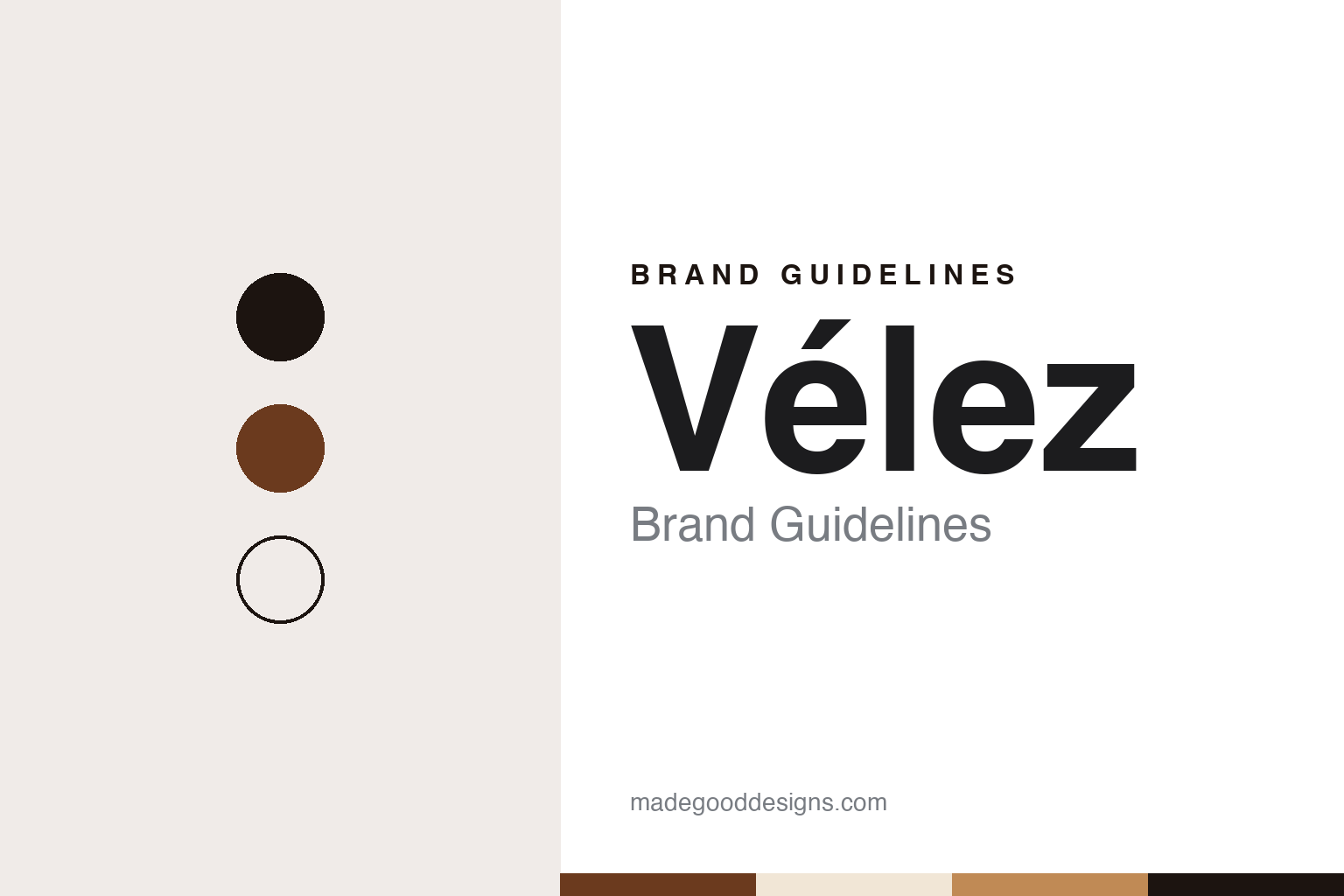
Vélez Brand Guidelines
Hand-cut belts in Medellín that grew into a leather house with its own tannery.
Aa
Two constants: a saddle-brown, tan and cream palette and a crafted serif register. Abstract homage — not a Vélez product or mark; no bag, logo or label is reproduced.
Cueros Vélez
Belts cut by hand in Medellín.
Vélez started with belts. Juan Raúl Vélez, at 22 and without having finished secondary school, made belts of webbing and cotton that he cut on his bed and fitted with buckles by hand, then sold in central Medellín, Portafolio reported in November 2019. Other materials followed, leather among them, and in 1986 he gave his goods a name: Vélez. The company is registered as Cueros Vélez S.A.S., Spanish Wikipedia says, and for years the press used that longer name; by 2019 Portafolio was writing simply “Vélez,” as the company’s website does today.
The early business was tiny. “Nobody knew us, we were a little company, we were only two people,” the founder told Portafolio in August 2011, recalling the first Colombia Leather Market fair in Bogotá in 1991, where the company showed a collection of bags and belts. That fair, he said, was its take-off: buyers began to order wholesale because the products were unlike what was then on the market. Spanish Wikipedia adds that a large clothing maker, Confecciones El Cid, became an early customer, ordering belts in batches of 300, then 500, then 1,500, and that loans, new staff and a first production plant followed.
The range grew out of the belts. Customers asked for things to match them, Spanish Wikipedia says, and the company added bags and shoes, with wallets cut from the leather left over from the bags; Portafolio lists bags, wallets and footwear as the next products. In 1994 Vélez began opening its own shops, because, the founder said in 2019, distributors were slow to pay and “did not display the product the way we wanted.”
Colour
A tannery, a plant and two second brands.
Vélez makes most of what it sells and has moved steadily up the supply chain. In July 2016 El Colombiano reported that 95 per cent of its production was made in Colombia, mainly at its complex in Medellín’s Guayabal industrial zone, with outside makers in Bogotá, Cali and Bucaramanga; its own plants for wallets, belts, footwear and bags then employed 2,500 of its 3,100 staff. That year it opened its own tannery in Amagá, Antioquia, Spanish Wikipedia says, after the closure of many Colombian tanneries made quality hides hard to find. In 2019 the founder described the business to Portafolio as “completely vertical,” with the tannery in Amagá and the leather-processing plant in Medellín, and said the company was exporting leather to Italy and Australia.
The group added lower-priced names around 2015. Tannino uses 20 to 30 per cent less leather than Vélez products and Nappa uses synthetic materials, the founder told Portafolio in 2019; the two together then had about 70 shops, mostly in mid-sized cities and towns, while 200 of the roughly 270 Colombian shops carried the Vélez name. By 2011 the company was already selling clothing, including leather jackets, T-shirts and socks, alongside its leather goods, Portafolio reported.
The shop counts have shifted over time. Portafolio reported 150 shops in six countries in August 2011 and 330 in seven in November 2019: Colombia, Peru, Panama, Guatemala, El Salvador, Costa Rica and Mexico. In September 2026 the paper put the network at 237 points of sale in Colombia and 43 elsewhere in Latin America, in Chile, Peru, Panama, Guatemala, El Salvador, Costa Rica and Venezuela.
The shops themselves have changed shape. In 2019 the founder told Portafolio that the company had remodelled about 20 stores that year into a new, larger and more welcoming format with a refreshed image; he named footwear, bags and belts, for both women and men, as its biggest sellers, and put the workforce at 4,000 direct employees across artisans, shops and offices.
Typography
Shop fronts, campaigns and founders.
Colombia’s clothing, bag, leather and underwear brands are mostly home-grown companies, and several still carry the name of the person who started them. Some began as very small workshops: Vélez with belts cut by hand in Medellín in the 1980s, and Totto in a Bogotá leather factory taken over in 1987, according to Portafolio. Both grew into chains with shops across Latin America.
Much of their identity is built in the shop. Store fronts, windows and tags carry the brand as much as any advertisement does: when Totto redrew its logo in 2021, Forbes Colombia reported, the new look went to its stores, signs, shop windows and product tags. Larger-format stores and remodelled shop interiors appear in the companies’ own accounts of how they present themselves, alongside the names of their collections and of the designers, artists and athletes they work with.
Campaigns often draw on Colombian references. Totto has dressed the national Olympic delegation since 2004, Portafolio reported, and Vélez built a 2026 collection with J Balvin around the Antioquian muleteer, the arriero. Regional crafts, rural dress and the national colours recur in the way these brands show themselves at home and abroad, and the companies say so in their own campaign material.
Ownership is usually easy to trace. Several of the groups in this guide are founder-led or family-owned, and their corporate pages set out who founded them, who runs them and which export markets they serve, commonly Central and South America first, then Spain or the United States. This guide keeps to what those pages and dated press reports show, describes family-owned groups plainly, and marks the companies’ own claims as theirs.
Aa
A crafted serif for a leather house. (Specimen set in Fraunces, a serif STAND-IN; NOT the Vélez logo.)
Vélez
Arriero codes, leather and craft.
Vélez presents itself through craft. Its website describes products “made by hand, one by one,” and its company pages speak of a workshop and a way of working leather from start to finish; those are the company’s own words. The clearest recent statement of that look came in September 2026, when Portafolio reported that Vélez and the Colombian singer J Balvin were presenting the fourth chapter of their creative alliance, “Artisan Gang in The City,” in a temporary shop in New York’s SoHo during New York Fashion Week.
The collection took the Antioquian arriero, the muleteer, and his journey from the mountains to the city as its reference, the paper reported. Leather was combined with natural fibres, crochet, cross-stitch, embroidery and layered textiles, and motifs such as the poncho, the carriel, equestrian boots, the Sacred Heart and the orchid were reworked. J Balvin took part in the concept and look of the capsules, in a collaboration that began in Medellín, the article said, and it described the United States as a new market for the company. Juan Raúl Vélez was still the company’s founder and president in November 2019, Portafolio reported.
For a design guide, Vélez shows how a leather-goods brand can draw its visual language from regional craft and rural dress rather than from a logo alone. Compare Totto, the Bogotá backpack maker that began in a leather workshop, and Mario Hernández, another Colombian leather-goods name. For this guide we use a saddle brown, a tan, a cream and a near-black espresso with a serif, an unofficial interpretation; no product or logo is reproduced.
Explore & save
Keep Vélez’s identity on hand — save it to a board in the Made Good inspiration library.
Vélez identity set
Pin the Vélez saddle-brown, tan and cream palette and the crafted serif register to your own board.
Source & notes
Frequently Asked Questions
What font can I use to match the Vélez look?
This guide describes Vélez’s type as “A crafted serif for a leather house”. Its type specimen is set in Fraunces from Google Fonts as a stand-in; Fraunces is not Vélez’s own lettering.
What colours are in the Vélez palette?
This guide’s Vélez palette is Saddle brown #6B3A1E, Espresso #1C1410, Tan #C08A55, Cream hide #F1E6D6 and Paper #FAF6F0. The tones are the guide’s own unofficial interpretation, not official Vélez hex codes.
When was Vélez founded?
Vélez was founded in 1986, in Medellín, Colombia. Vélez is known for Belts, bags, shoes, leather goods.
Who founded Vélez?
Vélez was founded by Juan Raúl Vélez in 1986. Vélez is known for Belts, bags, shoes, leather goods.