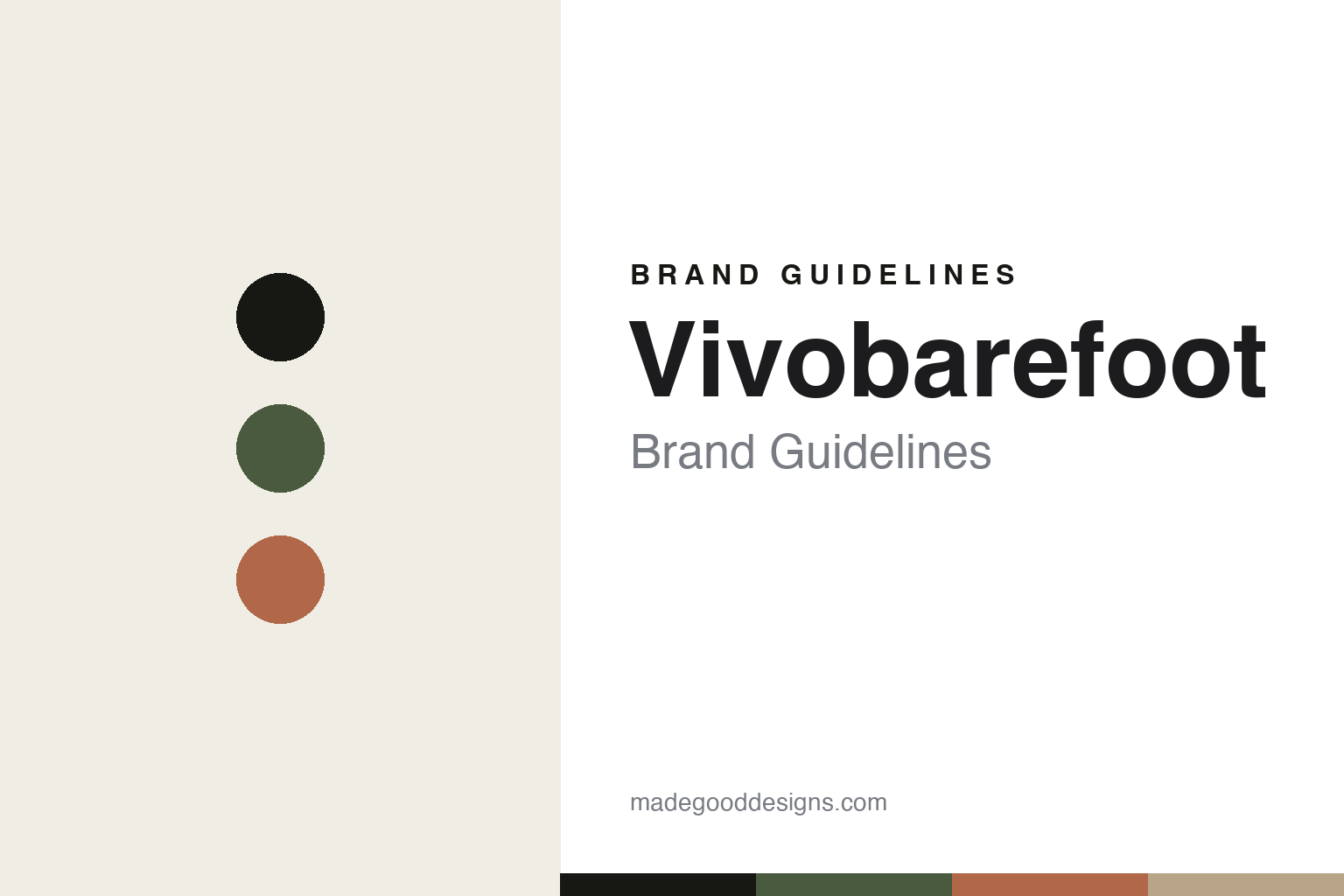
Vivobarefoot Brand Guidelines
Let feet think.
Aa
Two constants: a moss-and-terracotta palette and a humanist sans register. Abstract homage — not the Vivobarefoot footwear.
Let feet think
Vivobarefoot built a brand on the thinnest possible sole.
Vivobarefoot is a lesson in a philosophy as identity. Relaunched as Vivobarefoot in 2012 (with origins around 2003) by cousins Galahad Clark (CEO) and Asher Clark (design), descendants of the Clark shoemaking family, it is a London-based, founder-led brand — and a certified B Corp.
Its identity is the barefoot philosophy: an ultra-thin, flexible, puncture-resistant sole (its “Pro5” layer is around 0.8mm), a zero-drop profile, and a wide, foot-shaped toe box that lets the toes splay — “let your feet do the thinking.” The founder’s shorthand is “wide, thin, flexible, zero-drop, sustainable.” The models are named for terrain and function — Primus (active), Tracker (leather hiking boot), Magna (rugged hiking), Geo (everyday) — with newer circular ventures like ReVivo and VivoBiome.
(Honest notes: the Clark bloodline is heritage only — the Clarks company is unrelated to Vivobarefoot. It’s founder-led but strategically backed (Sofina, Innovate UK), so not wholly independent. The 2012 relaunch sits on ~2003 origins, and the regenerative and sustainability lines are the brand’s own claims. There’s no official brand hex, so these tones are an unofficial interpretation.)
Colour
Vivobarefoot lives in a moss-and-terracotta palette. Click a swatch to copy the hex.
Vivobarefoot’s identity is natural, minimal and grounded — an ink, a moss, a terracotta, a sand, and a chalk. The palette pairs a natural moss with an earthy terracotta — the register of a barefoot, back-to-nature shoe. It signals the ground and the body rather than fashion. The honest caveat: with no published brand hex, these tones are an original, unofficial interpretation, not first-party values.
The lesson is a natural moss with an earthy terracotta signals barefoot naturalism. Vivobarefoot’s world is a thin sole on the ground. For designers, it is a reminder that an earthy, minimal palette reads as natural and honest — right for a barefoot brand. The takeaways: source the palette from nature (moss, earth); keep it minimal; let the philosophy lead (thin, wide, zero-drop); and treat any single hex as unofficial.
Typography
The register is a humanist sans — natural, calm, minimal.
Vivobarefoot’s identity carries a natural, calm, minimal spirit — a barefoot philosophy and a thin sole. A humanist sans captures the mood: it is warm and unfussy, the register of a natural product. Set in a moss-and-terracotta palette, the humanist sans feels natural and calm — exactly the personality Vivobarefoot carries. It is minimal rather than loud, mirroring a stripped-back shoe. (Vivobarefoot’s real footwear is work we describe but do not reproduce, and the exact typeface is not ours to use.) Because it is not ours to use, the honest description is “a humanist sans spirit,” shown here in a stand-in. The type behaves like the brand: natural, calm and minimal.
Aa
A humanist sans spirit — natural and calm. (Specimen set in Epilogue, a humanist sans STAND-IN; NOT the Vivobarefoot footwear.)
A philosophy as identity
Vivobarefoot stands for letting the foot be a foot.
Vivobarefoot is a lesson in making a philosophy the identity. A moss-and-terracotta palette, a humanist sans and a barefoot sole make a belief the whole brand — natural, minimal, grounded. The philosophy is the differentiator. The differentiator is a barefoot, foot-shaped identity.
For designers and brand-builders, Vivobarefoot offers a clear takeaway: build the brand on a belief, then engineer it. The lessons: commit to the philosophy (wide, thin, flexible, zero-drop); engineer the proof (the Pro5 sole); name from terrain (Primus, Tracker, Magna); and keep the claims honest. It is also a reminder to stay accurate: the Clarks company is unrelated, it’s backed by outside investors, and the palette here is an unofficial interpretation. Vivobarefoot made a philosophy the brand — proof that a belief can be the difference.
Explore & save
Keep Vivobarefoot’s identity on hand — save it to a board in the Made Good inspiration library.
Vivobarefoot identity set
Pin the moss-and-terracotta palette and the humanist-sans register to your own board.