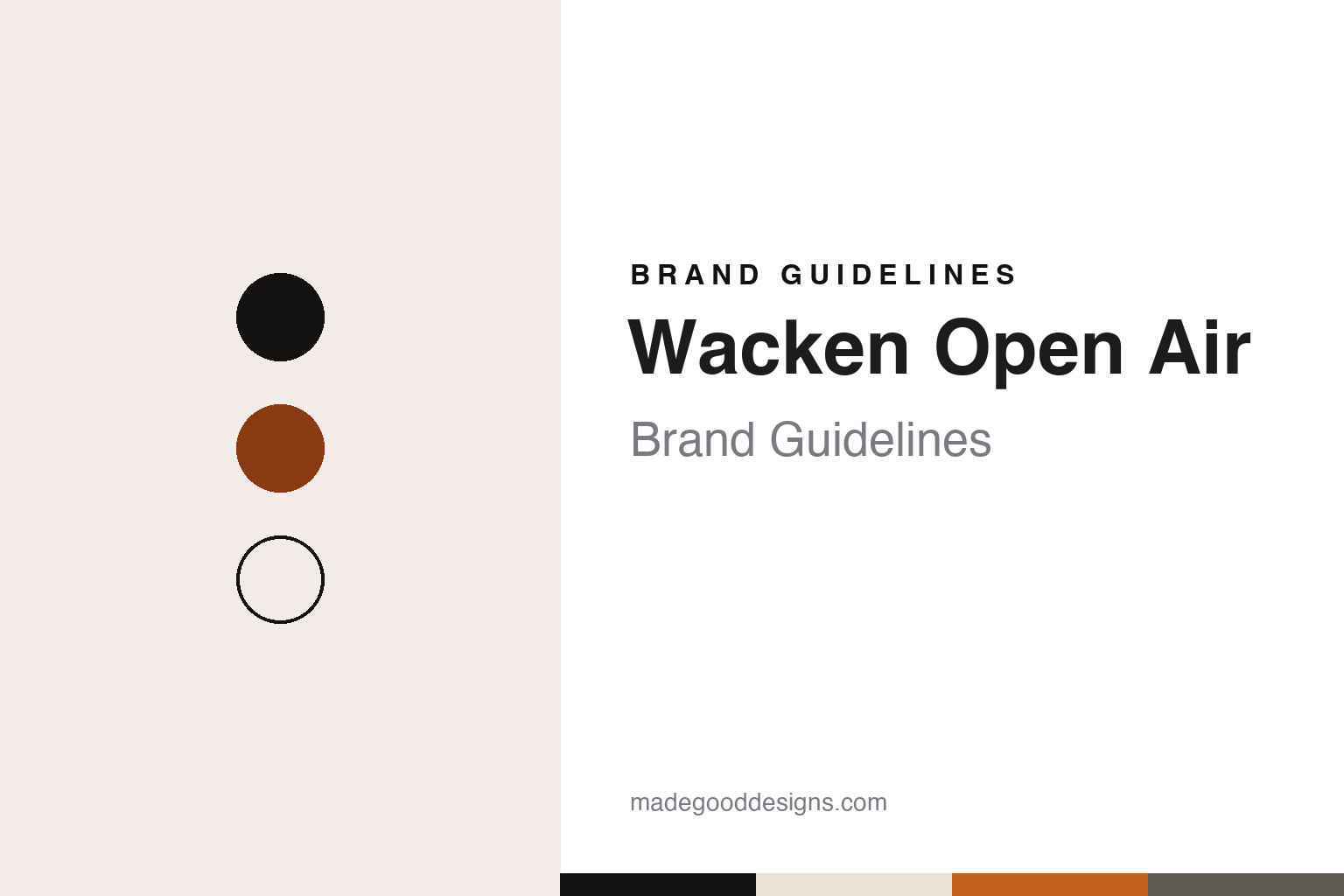
Wacken Open Air Brand Guidelines
The W:O:A skull from a sand pit in Schleswig-Holstein.
Aa
Two constants: a black, bone and ember palette and a condensed sans register. Abstract homage — not a Wacken Open Air asset; no logo, skull emblem or poster is reproduced.
A sand pit near Wacken
Two friends, a lorry and a beer tent.
The Wacken Open Air, written W:O:A on its own material, was first held on 24 and 25 August 1990 in a sand pit near Wacken, a village in the Steinburg district of Schleswig-Holstein, close to the Kiel Canal in northern Germany. NDR, the regional public broadcaster, says the idea came from two friends from the village, Thomas Jensen and Holger Hübner, who built a stage from a lorry and a beer tent with the help of friends and family. About 800 people came to hear six local bands; Jensen played bass in one of them.
German Wikipedia, citing a 2012 history of the festival by Andreas Schöwe, says the organisers set up a company named after the district for that first edition, “Stone Castle,” a direct translation of Steinburg; NDR spells it “Stoned Castle Rock Promotion.” The company has traded since 1999 as ICS, short for International Concert Service, and moved its seat from Dörpstedt to Wacken in 2014, German Wikipedia says. The second edition, in 1991, drew 1,300 visitors, according to NDR.
The festival grew in steps. In 1992 the organisers booked the British band Saxon; NDR counts 3,500 fans and 20 bands on two stages that year, while German Wikipedia gives 2,500 paying guests and says the campsite moved onto a neighbouring farmer’s meadows. A third stage, the W.E.T. Stage, short for “Wacken Evolution Tent” and meant for newcomers, followed in 1997, German Wikipedia says, and that year attendance passed 10,000 for the first time, by the organiser’s count as reported by NDR. NDR puts the 1998 edition at about 20,000, and the attendance table in German Wikipedia gives 25,000 visitors for 2000 and 82,500 for 2010.
Through the 2000s the site and the programme widened. German Wikipedia records a “Metal Train” special service from Zürich to the village since 2002, a programme running from Thursday to Saturday with the Thursday billed as the “Night to Remember,” and a Medieval Stage for medieval-rock and folk-metal bands from 2009. In 2007 the Thursday also carried a “Hellfest Stage,” it says.
Colour
From Stone Castle to Superstruct.
Ownership changed in 2019. On 19 August 2019 Music Week reported that the festival group Superstruct Entertainment had entered a partnership and investment agreement with ICS, describing Hübner and Jensen as the company’s founders and co-chief executives, who would remain responsible for day-to-day management. The same report listed other ICS events: the Hamburg Metal Dayz, the Wacken Winter Nights and the Werner Race, which combines motorsport and live music.
NDR reported on 12 October 2026 that the founders had sold further shares in ICS and now held about five percent each, down from about 15.5 percent each; Superstruct, through its German holding company, held close to 90 percent. NDR named the investment firm KKR as Superstruct’s majority owner. The festival itself is organised by an ICS subsidiary, WOA Festival GmbH, whose management includes the two founders and a third managing director, NDR said.
The festival is held on the first weekend of August, German Wikipedia says. NDR describes a site that has grown from the sand pit to about 360 hectares, with around 85,000 visitors a year; German Wikipedia gives 85,000 paying visitors for 2024. The 2020 and 2021 editions did not take place; in 2020 the organisers streamed concerts online free of charge instead, NDR reported, and the festival returned in 2022 with around 83,000 visitors and about 200 concerts, according to NDR.
The organisers have added smaller events around the main festival. German Wikipedia says the Wacken Winter Nights, a three-day folk and medieval open-air festival in the village, were first held in February 2017 with more than 3,500 visitors, most of them camping on site.
Village life is part of the way the event presents itself. NDR notes that the music corps of Wacken’s volunteer fire brigade, the Wacken Firefighters, appears at the festival every year, and the festival’s own website calls the site the “Holy Ground.” Each ticket sold on the website covers four days with camping included.
Typography
How festivals present themselves.
Music festivals in continental Europe usually take their names from a place or a coined word. Some carry the name of a village, a town, a racetrack or a stretch of seafront; others borrow the name of a youth club or invent a short word of their own, often in the local language. Rock Werchter is named after the Flemish village where it began in 1975; Pukkelpop kept the name of the Leopoldsburg youth house, De Pukkel, where its organisers met. Long names are soon cut down to initials on posters, wristbands and websites — TW for the old Torhout-Werchter, PKP with the year for Pukkelpop.
Behind the names stand different kinds of organiser. Some festivals were started by youth movements or non-profit associations and are still run by their founders; others are produced by promoters and festival companies, a number of which sit inside larger international live-entertainment groups. Municipalities appear in their institutional role, as landowners, planners or partners for transport. The organiser is rarely the face of the festival; its name sits in the small print.
The setting is part of the identity. A typical festival fills a festival park, a meadow, a racetrack, an airfield, a seafront or a farm for one long weekend, with several stages — often a large open-air main stage beside covered halls or tents — and campsites around the grounds. When a festival changes site, the new place name tends to join the dates in the line that sits beside the festival name.
Each year brings a new line-up poster, with headliners in large type above rows of smaller names, and an edition key visual that changes from year to year. Around these, a steady wordmark, the place and the dates hold the identity together, and some festival names have carried a title sponsor’s name for part of their history. This guide looks at how each festival handles that balance, using only what dated sources and the festivals’ own pages show.
Aa
A condensed sans for a set of initials with colons. (Specimen set in Oswald, a condensed sans STAND-IN; NOT the Wacken Open Air logo.)
W:O:A
A skull, a cow pasture and three initials.
The festival’s emblem is a horned skull. German Wikipedia, citing a 2019 video interview with the founders by the regional newspaper group shz, says the skull logo was drawn in 1990 from a basic form the two founders had already set out, and that the cow’s skull refers to the cow pasture the festival is held on and to its founders as “lads from the village.” The same article describes a burning version of the skull as the festival’s landmark on the site.
The initials, separated by colons, run alongside the full name across the festival’s website, which also carries a festival radio, a news page called The Bullhead and a loyalty programme called The Core. The village name does the rest of the work: NDR’s history of the event describes how the name of a small community in Schleswig-Holstein became bound up with heavy metal.
For a design guide, Wacken Open Air shows how a village name, a short set of initials and one animal emblem can carry a festival from a sand pit with six bands to an internationally owned events business. Compare Hellfest, whose name was given to a Wacken stage in 2007, and Rock am Ring, another German festival in this series. For this guide we use black, bone white and an ember orange with a condensed sans, an unofficial interpretation; no product or logo is reproduced.
Explore & save
Keep Wacken Open Air’s identity on hand — save it to a board in the Made Good inspiration library.
Wacken Open Air identity set
Pin the Wacken Open Air black, bone and ember palette and the condensed sans register to your own board.
Source & notes
Frequently Asked Questions
What font can I use to match the Wacken Open Air look?
This guide describes Wacken Open Air’s type as “A condensed sans for a set of initials with colons”. Its type specimen is set in Oswald from Google Fonts as a stand-in; Oswald is not Wacken Open Air’s own lettering.
What colours are in the Wacken Open Air palette?
This guide’s Wacken Open Air palette is Field black #141210, Ember #C2611F, Rust #8A3A12, Bone #E9E3D6 and Ash grey #5E5A54. The tones are the guide’s own unofficial interpretation, not official Wacken Open Air hex codes.
Who founded Wacken Open Air?
Wacken Open Air was founded by Thomas Jensen and Holger Hübner.