MEGACON Orlando Brand Guidelines
The Orlando comic show that grew into a four-day fan convention.
Aa
Two constants: a violet, electric teal and lilac white palette and a heavy condensed sans register. Abstract homage — not a MEGACON Orlando asset; no logo, badge or key visual is reproduced.
From Mega-Show to MegaCon
A comic organiser, a hotel show and the Orlando Expo Center.
MEGACON Orlando grew out of a Florida comic show of the early 1990s. English Wikipedia says the organiser James Breitbeil started a show called Mega-Show in December 1993 at a hotel on International Drive in Orlando, a smaller event held a few times a year, and that the larger MegaCon, short for Mega Convention, followed in 1995 at the Orlando Expo Center. A Tampa Mega-Show ran alongside it.
Newspaper coverage from the 1990s shows the organiser at work. The Tampa Bay Times of 31 May 1996 previewed the Tampa Mega-Show, a twice-yearly comic book, trading card and toy show, with Breitbeil named as its organiser. The Deseret News of 23 April 1999 described MegaCon as a three-day comic book and science fiction convention at the Orlando Expo Centre that month, explaining the name as comics shorthand for a mega-convention. It pictured fans arriving to buy and sell comic books, meet the artists and writers of their favourite titles and buy collectible artwork. The paper named Breitbeil as organiser and as publisher of Frank Frazetta Fantasy Illustrated, reported that the show had widened to take in science fiction, fantasy game tournaments and animation exhibits, and quoted his figure of 14,000 visitors over the three days that year.
The same year the show changed owner. English Wikipedia says the Tampa-based comic publisher CrossGen acquired the convention in 1999 and ended the smaller Mega-Shows; Breitbeil moved to a marketing and distribution role at CrossGen, and Beth Widera was brought in to run MegaCon, a role Wikipedia dates from 2000. During those years, it adds, the show gave prominent space to CrossGen’s own titles.
The venue changed early in that period. English Wikipedia says the Orange County Convention Center, which had hosted the show once in 1997, has been its home since 2001.
Colour
Beth Widera, 2003, and FAN EXPO HQ, 2015.
Widera bought the show herself in 2003. ICv2 reported on 18 November 2003 that CrossGen had sold MegaCon, “the annual Orlando convention devoted to comics, anime, gaming, science fiction, and media,” to Widera, who had run it for the previous four years. The sale, the trade site said, was part of a restructuring in which CrossGen was leaving businesses outside its core. English Wikipedia adds that 2003 brought after-hours entertainment to the convention, which spread to venues outside the convention centre from 2006.
The next sale came in 2015. On 7 April 2015 Informa announced that MegaCon Orlando had joined its FAN EXPO HQ portfolio, which the company described as an operating division of Informa Exhibitions. The release named Brian Powers as president of FAN EXPO HQ, said that Widera’s management team would continue to lead the show, and listed the group’s other events at the time, from FAN EXPO CANADA and FAN EXPO VANCOUVER to Dallas Comic Con.
ICv2, reporting the deal on 8 April 2015 and citing the Orlando Sentinel, placed it in a run of acquisitions of regional conventions by exhibition companies that year, after ReedPop’s purchase of Emerald City Comic Con in Seattle. It noted that Informa already owned the Toronto-based Fan Expo, acquired in 2013. English Wikipedia says that, unlike other conventions in the group, the show kept its MegaCon name, and that it is run from Fan Expo’s Toronto base with a regional office in Sarasota.
Change under the new owner came in days and sites. English Wikipedia says MegaCon was extended to four days in 2016, and that a separate MegaCon Tampa Bay edition was held from 2016 until 2018.
Typography
How comic, anime and pop-culture conventions present themselves.
Comic, anime and pop-culture conventions usually take their names from a city, a region or a coined word, joined to “comic con,” “expo” or “fest.” Most are soon shortened to initials or a nickname, and several now publish rules on how their own names should be written: New York Comic Con and Emerald City Comic Con both tell partners to spell the name out on first mention, to use the initials after that, and to keep “Comic” and “Con” as two separate words.
The organisers behind them vary. Some shows are run by events and exhibitions groups that also stage trade fairs; others by companies founded around a single show, by non-profit associations or by volunteer committees. Several conventions that began as one person’s local event have later been bought by larger groups and kept running under their original names, often with the founding team still involved.
The format is broadly shared. A typical convention fills a convention centre or exhibition hall over a long weekend, with an exhibit floor of publishers, studios and retailers, an artist alley of tables for illustrators and comic creators, panels and screenings on several stages, autograph and photo areas for invited guests, and cosplay, from informal costumes in the aisles to staged contests. Some add a trade or professional day before the public opens, or separate areas for families and for games.
The visual identity is usually split in two. A steady wordmark or logo, often with set versions for light and dark backgrounds and a single-colour form, stays the same from year to year, while each edition gets its own key visual, badge design, merchandise and sometimes a theme. This guide describes those identities as the shows and dated sources describe them; the colours and typefaces shown here are our own interpretation.
Aa
A heavy condensed sans for a name set in capitals. (Specimen set in Anton, a sans STAND-IN; NOT the MEGACON Orlando logo.)
MEGACON Orlando
Four days on International Drive, Thursday to Sunday.
The convention runs for four days, Thursday to Sunday, and English Wikipedia says it often falls in spring. Orlando Weekly reported in January 2026 that the 2026 edition would run from 19 to 22 March at the Orange County Convention Center. FOX 35 Orlando, previewing it on 18 March 2026, described celebrity appearances, panels, cosplay, gaming rooms and photo opportunities, with programming for comic, science fiction, film, television, gaming and anime fans and a show floor of vendors selling comic books and memorabilia. GeekDad, reviewing the edition in April 2026, described panels, a vendor floor, an Artist Alley and areas set aside for single fandoms, laid out across the convention centre’s East/West concourse.
The show’s footprint inside the building has grown. English Wikipedia says the exhibit hall took up the whole North/South Concourse in 2025 and moved into most of the West building in 2026.
Its look has been revised more than once. English Wikipedia says that in 2002 the logo was redrawn with rounded rectangular letters and a capital G set at lowercase height, and that in 2020 and 2021 the show’s website was redesigned with a new logo whose lettering forms an arch, part of a wider rebranding across Fan Expo. The name has changed in form too: newspapers of the 1990s and ICv2 wrote MegaCon, while the event’s website now writes MEGACON Orlando, in capitals with the city in title case, and in 2026 carries the footer of Informa Connect, which it describes as a trading division of Informa PLC.
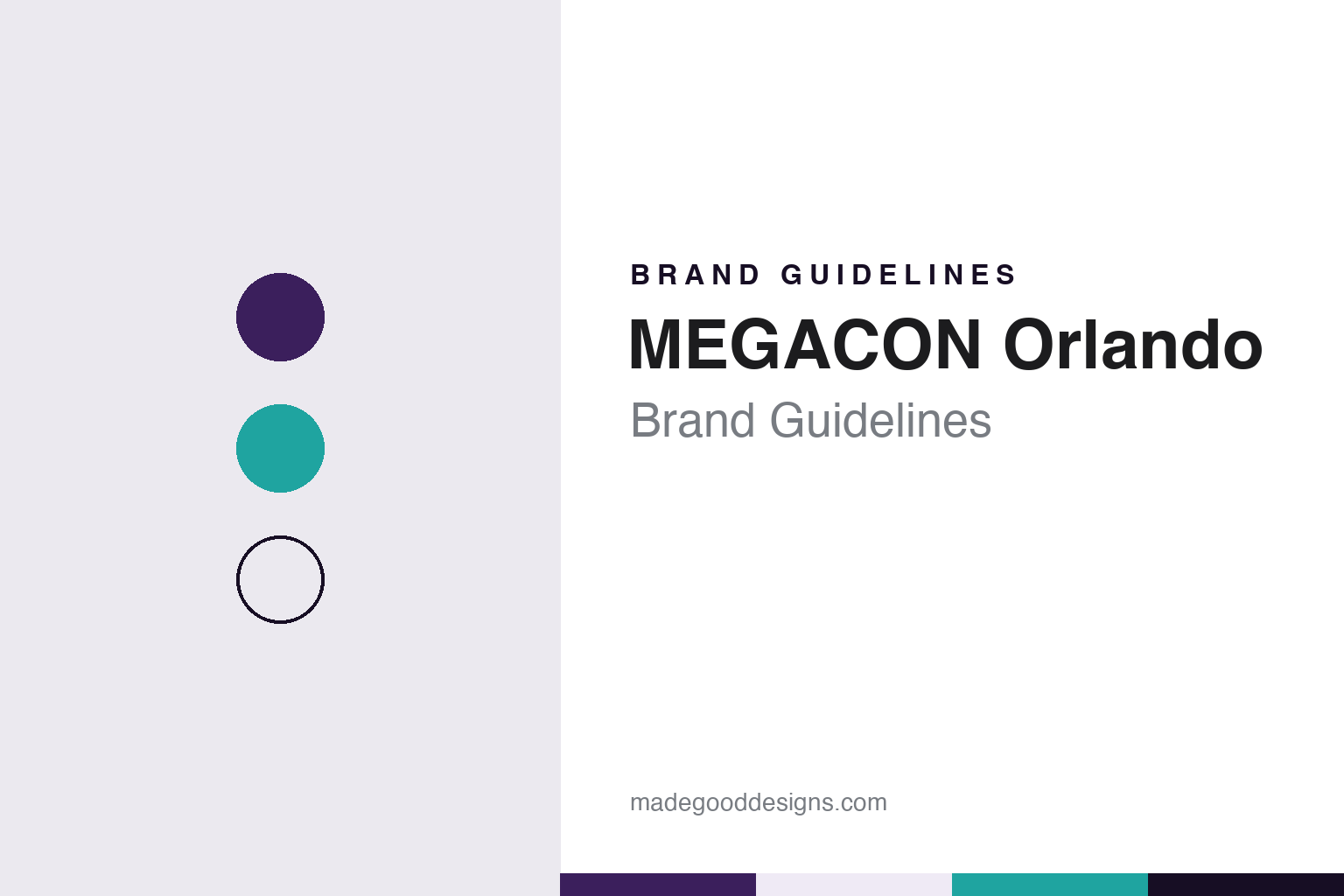
For a design guide, MEGACON Orlando shows a name that survived three owners by keeping its coined word and adding its city. Compare FAN EXPO Canada, the Toronto show at the head of the same group, and Emerald City Comic Con, sold to ReedPop in the same year. For this guide we use a deep violet, an electric teal and a lilac white with a heavy condensed sans, an unofficial interpretation; no product or logo is reproduced.
Explore & save
Keep MEGACON Orlando’s identity on hand — save it to a board in the Made Good inspiration library.
MEGACON Orlando identity set
Pin the MEGACON Orlando violet, electric teal and lilac white palette and the heavy condensed sans register to your own board.
Source & notes
Frequently Asked Questions
What font can I use to match the MEGACON Orlando look?
This guide describes MEGACON Orlando’s type as “A heavy condensed sans for a name set in capitals”. Its type specimen is set in Anton from Google Fonts as a stand-in; Anton is not MEGACON Orlando’s own lettering.
What colours are in the MEGACON Orlando palette?
This guide’s MEGACON Orlando palette is Deep violet #3B1F5C, Night #170E24, Electric teal #1FA4A0, Lilac white #EFEAF5 and Paper #FAF8FC. The tones are the guide’s own unofficial interpretation, not official MEGACON Orlando hex codes.
When was MEGACON Orlando founded?
MEGACON Orlando was founded in 1995 (Mega-Show from 1993), in Orlando, Florida, USA.