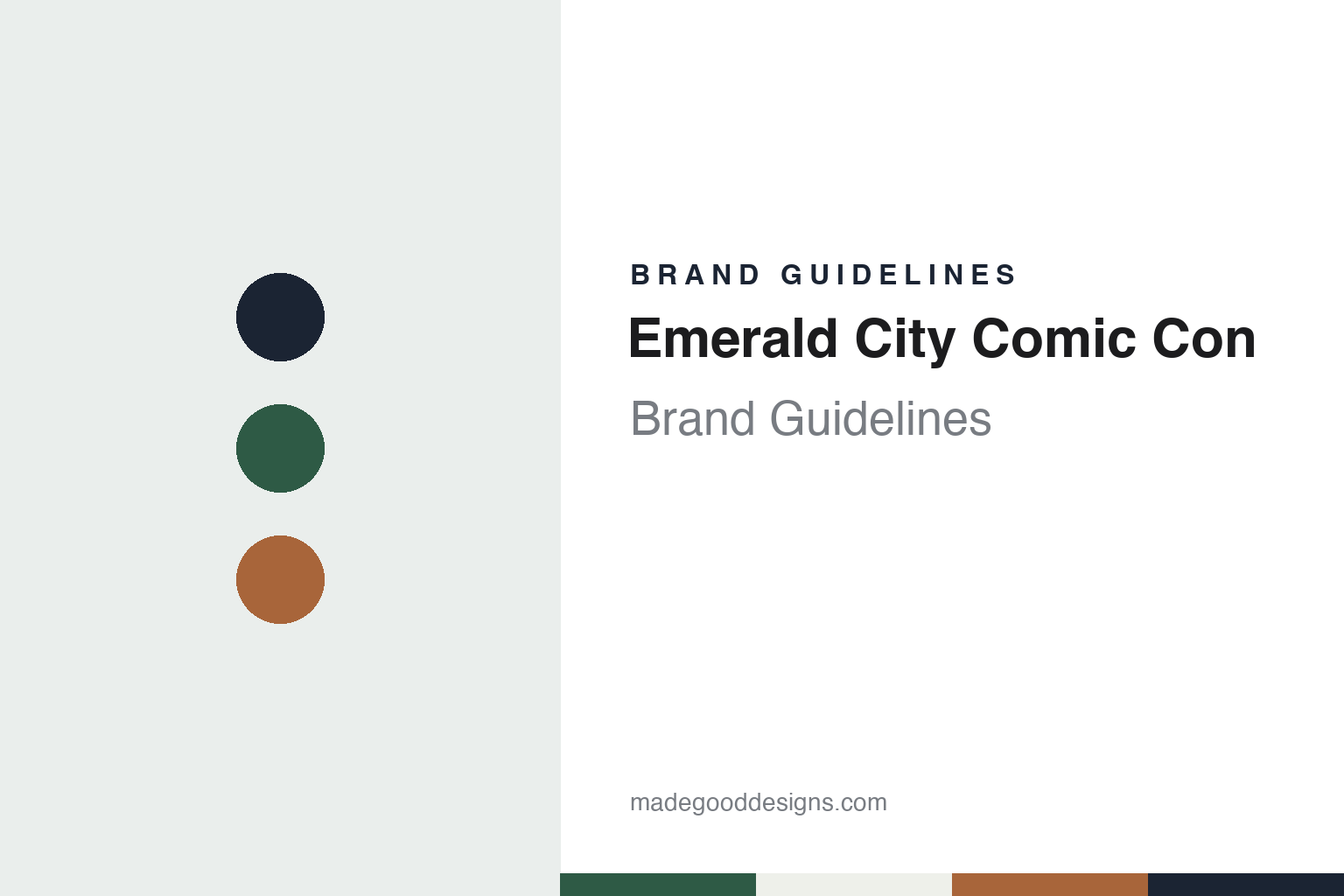
Emerald City Comic Con Brand Guidelines
A one-day stadium show that grew into a downtown weekend.
Aa
Two constants: a spruce, rain slate and cedar palette and a Condensed grotesque register. Abstract homage — not an Emerald City Comic Con asset or mark; no logo, circle device, badge or wordmark is reproduced.
A one-day show at the stadium
A comics retailer from Mukilteo and a plaza at Qwest Field, 2003.
Emerald City Comic Con began in 2003 as a one-day comics show at Qwest Field, the Seattle stadium. Its founder was Jim Demonakos, a comics retailer from Mukilteo, north of Seattle. In an interview with The Herald of Everett, published on 29 March 2007, Demonakos said the first event had taken place on a single day in the stadium’s smaller West Field Plaza, that about 3,000 people attended, and that it soon became clear later shows would need a larger hall and a second day. He told the paper that, having been involved in comics for as long as he could remember and having travelled to many other shows, he believed Seattle could support a major comic-book show.
By 2007 the event had moved into the Qwest Field Event Center, and The Herald described that spring’s show as the fifth annual Emerald City ComiCon, held over a weekend. The paper listed what it offered: a costume contest open to anyone who made their own costume, activities for children, caricature artists drawing young visitors as superheroes, photo opportunities with film guests, and a panel of comic-book creators answering questions from fans, who could also bring books from their collections for evaluation.
English Wikipedia records the next steps. In 2008 the show moved downtown to the Washington State Convention Center, now called the Seattle Convention Center; it grew to three days in 2011 and, according to the same article, used the whole convention centre for the first time in 2013. It has kept a late-winter or early-spring place in the calendar: the 2026 edition ran from 5 to 8 March at the Seattle Convention Center.
Colour
A 2015 sale to ReedPop.
The show changed hands at the start of 2015. GeekWire reported on 13 January 2015 that Emerald City Comicon, as it was then written, had been acquired by ReedPop, the group that also produced New York Comic Con and C2E2. The announcement, the publication said, called the deal a “classic superhero team-up,” and said the Seattle event would still be produced by the same team, with additional help from ReedPop, while the Emerald City staff would also work on ReedPop’s other events. No price was published.
GeekWire quoted Demonakos, then the convention director and also the founder of a chain of comic shops, from an interview with the site ComicsAlliance. He said the team had a certain feel to Emerald City that was hard to put into words, and that everyone working on the show would keep doing so while also starting work on C2E2 and the New York show. The same interview also included Lance Fensterman, then a vice-president of ReedPop. GeekWire gave the founding year as 2003 and said the next edition would run from 27 to 29 March 2015 at the Washington State Convention Center, after the show had passed 75,000 attendees the previous spring.
Today the show sits inside a larger events business. Its website footer reads “Built by ReedPop” and carries an RX copyright; ReedPop describes itself as a group within RX, and lists Emerald City Comic Con among its events with C2E2, PAX and MCM Comic Con.
The programme follows the familiar convention pattern, with a Seattle twist in its names. The website lists celebrity and comic guests, panels, autographs and photo sessions, an Artist Alley, an exhibitor floor, Cosplay Central, a Family HQ, a gaming zone, a writers’ area and a space called The Tavern. It describes guests from film, television, games, books and comics coming to downtown Seattle for panels, autographs and photo sessions.
Typography
How comic, anime and pop-culture conventions present themselves.
Comic, anime and pop-culture conventions usually take their names from a city, a region or a coined word, joined to “comic con,” “expo” or “fest.” Most are soon shortened to initials or a nickname, and several now publish rules on how their own names should be written: New York Comic Con and Emerald City Comic Con both tell partners to spell the name out on first mention, to use the initials after that, and to keep “Comic” and “Con” as two separate words.
The organisers behind them vary. Some shows are run by events and exhibitions groups that also stage trade fairs; others by companies founded around a single show, by non-profit associations or by volunteer committees. Several conventions that began as one person’s local event have later been bought by larger groups and kept running under their original names, often with the founding team still involved.
The format is broadly shared. A typical convention fills a convention centre or exhibition hall over a long weekend, with an exhibit floor of publishers, studios and retailers, an artist alley of tables for illustrators and comic creators, panels and screenings on several stages, autograph and photo areas for invited guests, and cosplay, from informal costumes in the aisles to staged contests. Some add a trade or professional day before the public opens, or separate areas for families and for games.
The visual identity is usually split in two. A steady wordmark or logo, often with set versions for light and dark backgrounds and a single-colour form, stays the same from year to year, while each edition gets its own key visual, badge design, merchandise and sometimes a theme. This guide describes those identities as the shows and dated sources describe them; the colours and typefaces shown here are our own interpretation.
Aa
A condensed grotesque — after the narrow capitals of convention signs and lanyards. (Specimen set in Barlow Condensed, a sans STAND-IN; NOT the Emerald City Comic Con logo or any ECCC lettering.)
Emerald City Comic Con
A circle, a horizontal lock-up and a space between two words.
Emerald City Comic Con publishes its own logo and brand guidelines for partners and exhibitors. The page on its website offers two main logo versions, the ECCC Circle and the ECCC Horizontal, each in colour, black and white and one-colour black or white, as well as a version with the show dates and a separate ECCC Exclusives logo. The exclusives mark may be used only on items that are exclusive to the show and sold on site, not online or in stores before the event, and any use of the main logo has to be approved by the show’s marketing team first.
The guidelines describe a palette of four main colours, named simply as a green, a blue, a dark blue and a dark green, with a coral as a secondary colour. In single-colour use, the logo appears only in black, white or what the show calls ECCC green, with black as the default on light backgrounds and white on dark ones, and with clear space around it. The page rules out altering, redrawing, outlining or cropping the logo, adding glows, drop shadows, gradients, textures or images, and rotating, tilting or setting it vertically.
The name has its own rule. The guidelines say the event should be written as Emerald City Comic Con on first mention and abbreviated to ECCC after that, that there is always a space between “Comic” and “Con,” and that any other spelling or abbreviation is incorrect. The earlier spellings are on record: The Herald wrote Emerald City ComiCon in 2007, and GeekWire wrote Emerald City Comicon in 2015.
For a design guide, Emerald City Comic Con shows how a convention that began as a one-day local show can write down its logo, colours and spelling as rules once it becomes part of a larger events group. Compare New York Comic Con and C2E2, the two ReedPop shows named alongside it in 2015. For this guide we use a spruce green, a rain-slate blue and a cedar brown with a condensed sans, an unofficial interpretation; no product or logo is reproduced.
Explore & save
Keep Emerald City Comic Con’s identity on hand — save it to a board in the Made Good inspiration library.
Emerald City Comic Con identity set
Pin the Emerald City Comic Con spruce, slate and cedar palette and the Condensed grotesque register to your own board.
Source & notes
Frequently Asked Questions
What font can I use to match the Emerald City Comic Con look?
This guide describes Emerald City Comic Con’s type as “A condensed grotesque — after the narrow capitals of convention signs and lanyards”. Its type specimen is set in Barlow Condensed from Google Fonts as a stand-in; Barlow Condensed is not Emerald City Comic Con’s own lettering.
What colours are in the Emerald City Comic Con palette?
This guide’s Emerald City Comic Con palette is Spruce #2E5A45, Rain slate #1B2433, Cedar #A8653A, Sound mist #DCE3DF and Paper #F6F7F3. The tones are the guide’s own unofficial interpretation, not official Emerald City Comic Con hex codes.
Who founded Emerald City Comic Con?
Emerald City Comic Con was founded by Jim Demonakos, comics retailer.