WonderCon Brand Guidelines
A coined word that moved from the Bay to Anaheim.
Aa
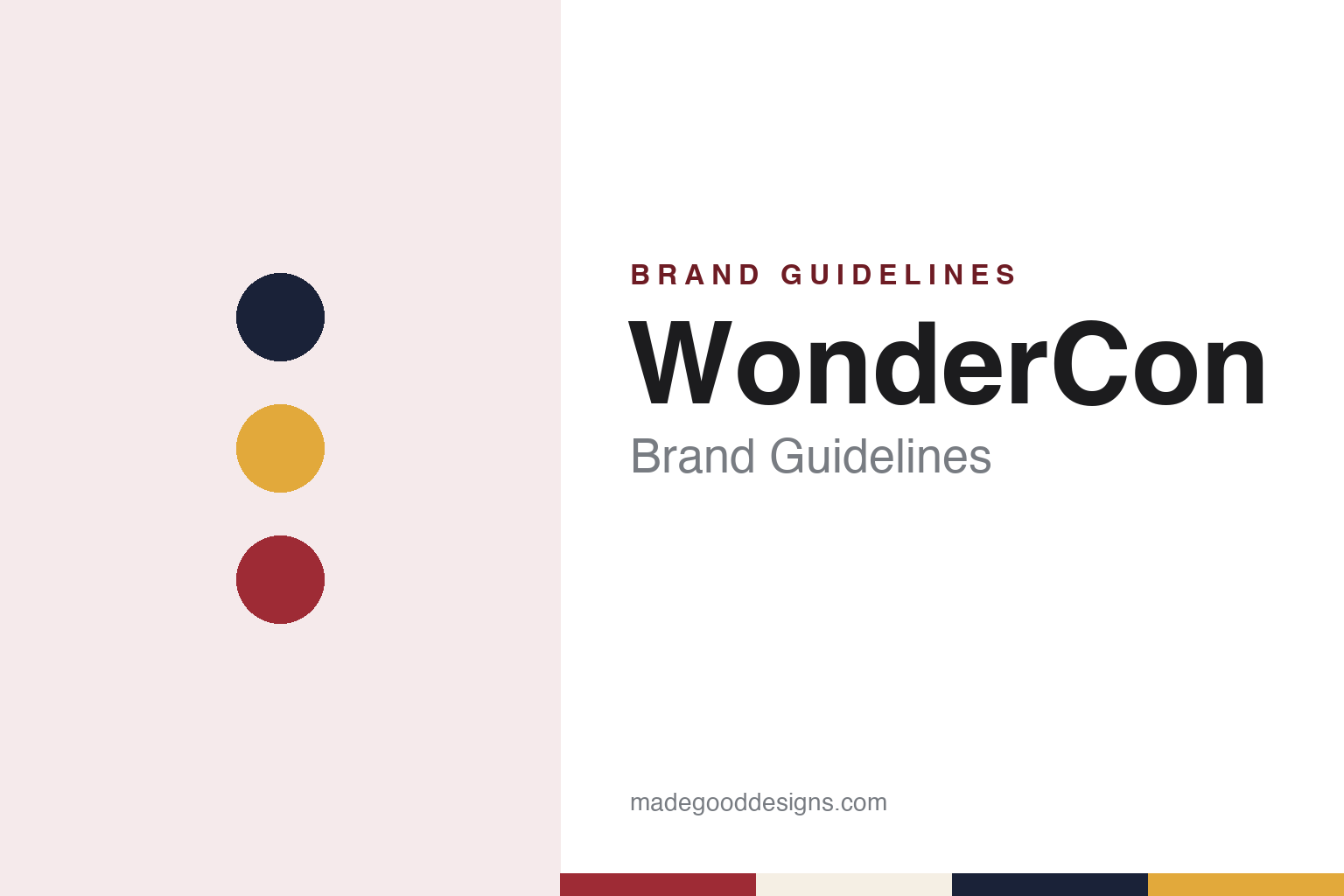
Two constants: a deep crimson, ink navy and warm gold palette and a Bold narrow sans register. Abstract homage — not a WonderCon asset or mark; no logo, key visual or wordmark is reproduced.
The Wonderful World of Comics in Oakland
A Bay Area retailer’s show from 1987.
WonderCon is a comics, science-fiction and film convention held each spring in Southern California, but it began in the San Francisco Bay Area. ABC7 Los Angeles reported on 6 April 2015 that WonderCon started in Oakland in 1987 as “the Wonderful World of Comics Convention,” and that by its third year WonderCon had become the official name. English Wikipedia says the show was conceived by the retailer John Barrett, a founder of the Comics and Comix shop chain, and held at the Oakland Convention Center.
For its first years the convention was a retailers’ show. Wikipedia says the comic-shop owners who operated it for about fifteen years arranged in 2001 for it to join the family of shows run by the team behind the San Diego Comic-Con; Comic-Con International’s own history page dates the takeover to 2002. The show passed to the San Diego Comic Convention, the California non-profit corporation behind Comic-Con International, which today describes WonderCon as Comic-Con’s sister show, covering comics, film, television, animation and more.
The new owners moved the show across the bay. Comic-Con International says it took WonderCon from Oakland to downtown San Francisco in 2003, and Wikipedia names the venue as the Moscone Center. The San Francisco years tied WonderCon to film: Wikipedia says the show became a venue for previews and early screenings of comic-based films, with cast members taking questions from the audience, and gives attendance of 34,000 in 2009, 39,000 in 2010 and 49,500 in 2011. The core of the floor, it says, has always been retailers selling back issues of comic books and action figures, later joined by sellers of specialty DVDs and by film and television actors signing photographs.
Colour
From San Francisco to Anaheim, by way of Los Angeles.
The move south came from a building project. ICv2 reported on 1 September 2011 that because the Moscone Center was being renovated, WonderCon would leave the Bay Area and hold its 2012 edition on 16–18 March at the Anaheim Convention Center. A Comic-Con International spokesman told the magazine that, faced with cancelling the show for a year or moving it, the organisers had chosen to keep it on the 2012 calendar at a venue that could take it. The change rippled through the calendar: ReedPop moved C2E2 in Chicago from that March weekend to April. Comic-Con International’s history page says the event became Comic-Con International Presents WonderCon Anaheim. When the move was announced, Wikipedia notes, Comic-Con International said the show would return to San Francisco once the renovation was finished; in the event it stayed in Southern California.
Anaheim then had building work of its own. ABC7 reported in April 2015 that WonderCon would spend 2016 at the Los Angeles Convention Center, after four years in Anaheim; Wikipedia gives the dates as 25–27 March 2016 and the name as WonderCon Los Angeles. Comic-Con International says the Los Angeles year covered the period when the Anaheim Convention Center was adding a new building, and that the show returned to Anaheim in 2017; Wikipedia dates that return edition to 31 March–2 April 2017. The 2016 move had been announced by the Los Angeles Convention Center itself, ABC7 reported, with Comic-Con International named as the presenter. The organiser gives attendance of 66,000 for 2018 in the expanded centre. The 2020 and 2021 editions did not take place.
WonderCon 2026 ran from 27 to 29 March at the Anaheim Convention Center, according to the organiser’s website, which describes more than 900 exhibitors in a 412,000-square-foot Exhibit Hall of comics, original art, toys and merchandise, with film and television programming, comics panels, autographs, games and portfolio reviews. Wikipedia adds an Artists Alley where comic artists sell artwork, sign books and draw sketches, a “Trailer Park” of film trailers and, since 2007, the Comics Arts Conference, a meeting of academics and comics professionals held alongside the show.
Typography
Conventions as a category.
Comic, anime and pop-culture conventions usually take their names from a city, a region or a coined word, joined to “comic con,” “expo” or “fest.” Most are soon shortened to initials or a nickname, and several now publish rules on how their own names should be written: New York Comic Con and Emerald City Comic Con both tell partners to spell the name out on first mention, to use the initials after that, and to keep “Comic” and “Con” as two separate words.
The organisers behind them vary. Some shows are run by events and exhibitions groups that also stage trade fairs; others by companies founded around a single show, by non-profit associations or by volunteer committees. Several conventions that began as one person’s local event have later been bought by larger groups and kept running under their original names, often with the founding team still involved.
The format is broadly shared. A typical convention fills a convention centre or exhibition hall over a long weekend, with an exhibit floor of publishers, studios and retailers, an artist alley of tables for illustrators and comic creators, panels and screenings on several stages, autograph and photo areas for invited guests, and cosplay, from informal costumes in the aisles to staged contests. Some add a trade or professional day before the public opens, or separate areas for families and for games.
The visual identity is usually split in two. A steady wordmark or logo, often with set versions for light and dark backgrounds and a single-colour form, stays the same from year to year, while each edition gets its own key visual, badge design, merchandise and sometimes a theme. This guide describes those identities as the shows and dated sources describe them; the colours and typefaces shown here are our own interpretation.
Aa
A bold narrow sans for a single coined word. (Specimen set in Oswald, a sans STAND-IN; NOT the WonderCon logo.)
WonderCon
A logo by Bruning and Zach.
The identity is shared with the San Diego organisation. English Wikipedia says the WonderCon logo was designed by Richard Bruning and Tim Zach, and Comic-Con International lists WonderCon and the WonderCon logo among the registered trademarks of San Diego Comic Convention, alongside its own Comic-Con marks. The organiser’s website presents the show under the WonderCon name with the year and the venue, as in “WonderCon 2026” at the Anaheim Convention Center.
The name itself carries the history. The Wonderful World of Comics Convention was shortened to a single coined word by the third show, ABC7 reported, and place-names have been added to it as the venue changed: WonderCon Anaheim from 2012, WonderCon Los Angeles in 2016 and Anaheim again from 2017, with “Comic-Con International Presents” set in front in the organiser’s own history. Through those moves the core word stayed the same, and ABC7 in 2015 introduced the show simply as “the sister show to Comic-Con,” the description the organiser itself uses. Comic-Con International’s history page lists what the two share: comics, films, television, animation and the Masquerade.
For a design guide, WonderCon shows how a coined word can travel between cities while a place-name around it changes. Compare Comic-Con International, the organisation behind its sister show in San Diego, and C2E2, the Chicago expo whose dates moved with it in 2012. For this guide we use a deep crimson, an ink navy and a warm gold with a narrow sans, an unofficial interpretation; no product or logo is reproduced.
Explore & save
Keep WonderCon’s identity on hand — save it to a board in the Made Good inspiration library.
WonderCon identity set
Pin the WonderCon deep crimson, ink navy and warm gold palette and the Bold narrow sans register to your own board.
Source & notes
Frequently Asked Questions
What font can I use to match the WonderCon look?
This guide describes WonderCon’s type as “A bold narrow sans for a single coined word”. Its type specimen is set in Oswald from Google Fonts as a stand-in; Oswald is not WonderCon’s own lettering.
What colours are in the WonderCon palette?
This guide’s WonderCon palette is Deep Crimson #9E2B35, Ink Navy #1A2238, Warm Gold #E2A93B, Bay Fog #E4E1DA and Paper #FAFAF8. The tones are the guide’s own unofficial interpretation, not official WonderCon hex codes.
When was WonderCon founded?
WonderCon was founded in 1987 (Wonderful World of Comics Convention, Oakland).