Wang Mian painted one subject so often that it became his signature: the flowering plum, which blossoms at the end of winter, often in snow. His scrolls use nothing but black ink on silk or paper, yet they read as full of light, because the blossoms are left pale and the branches are drawn in dark, fast strokes. For anyone who designs in a limited palette, from logo marks to two-colour print, Wang Mian shows how far contrast, rhythm and a strong diagonal can carry an image.
Both images in this guide are public domain, from the Cleveland Museum of Art and The Met. For more works to study and download, browse the MGD museum inspiration collection and the Chinese art theme.
Who was Wang Mian?
The Cleveland Museum of Art, The Met and the National Palace Museum in Taipei all give his dates as 1287–1359. The National Palace Museum’s catalogue record says he came from Zhuji in Zhejiang province, used the courtesy name Yuanzhang and the sobriquet Zhushi Shannong, and was born into a poor family. Both that record and a 2019 article by Fu Yu for the People’s Political Consultative Conference Network tell the same story of his youth: sent out to herd animals, he studied on the side and was taken on as a pupil by the scholar Han Xing.
His official career never happened. The Cleveland Museum of Art writes that he failed the civil and military service examinations, later rejected appointments under the Mongol government, and returned home to make a living by selling plum paintings. The National Palace Museum record also notes that he failed the examinations and then travelled widely. Fu Yu adds that he was skilled in poetry, calligraphy, painting and seal carving, and that the painter and calligrapher Zhao Mengfu painted orchids for him in 1304; both of those details come from that single article.
The Cleveland Museum of Art also notes that few of his works have survived.
Key works by Wang Mian
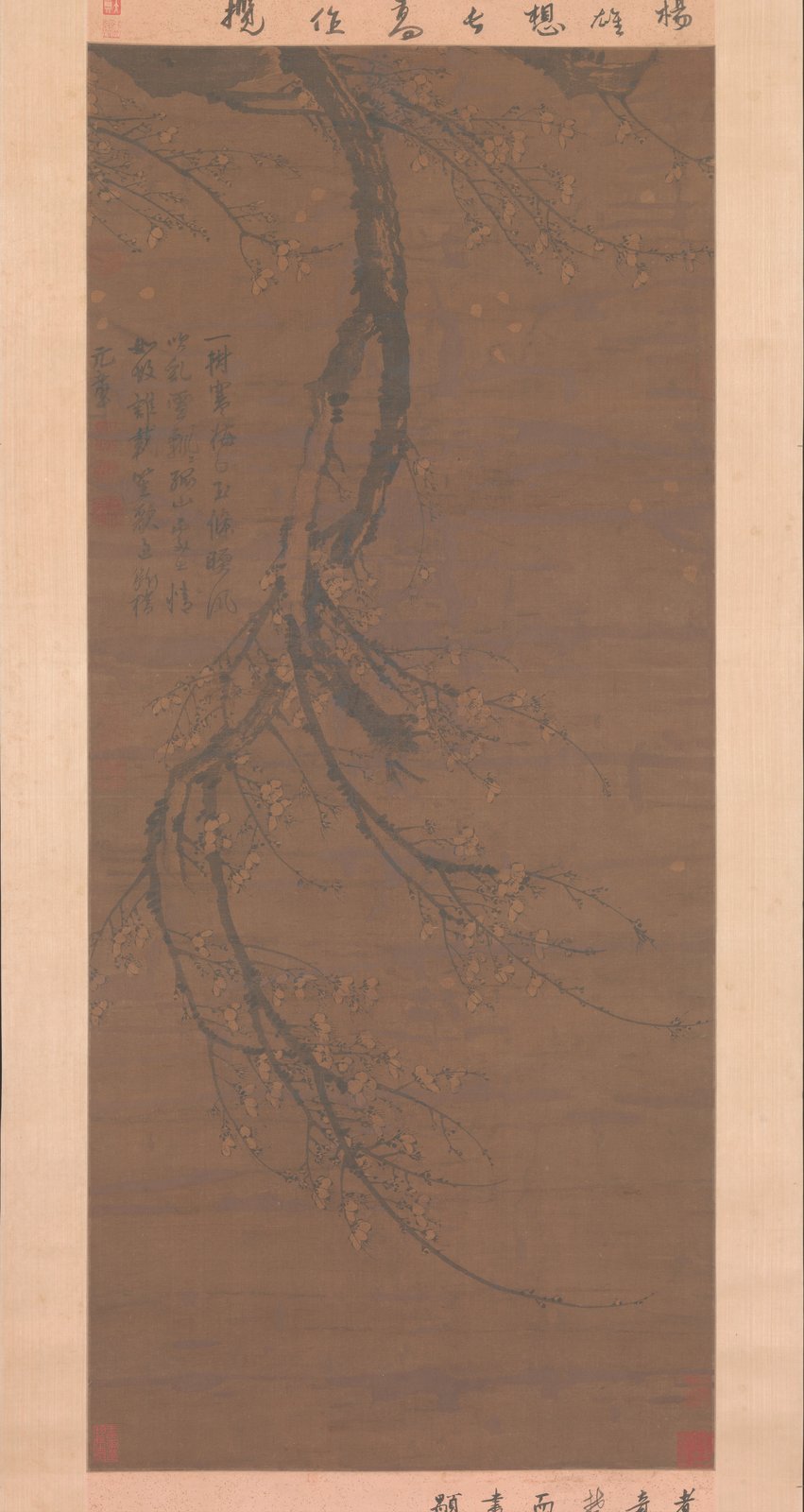
A Prunus in the Moonlight, 1300s (Cleveland Museum of Art). A large hanging scroll in ink on silk, with a painted area of 164.6 by 94.6 cm, according to the museum. An old trunk rises from the lower right in a broad S-shape, branches spray upward into the top third, and a pale moon floats at upper left. The artist’s poem, signature and two seals sit in a narrow column on the left edge. Cleveland’s record lists eight more seals, six of them belonging to the Qianlong emperor, and its translation of the poem opens: “A break in the sea of clouds unveils the circle of moon.”
Fragrant Snow at Broken Bridge, 14th century (The Met). Another hanging scroll in ink on silk, with an image area of 113 by 50.2 cm, according to The Met’s collection record. Here the composition is inverted: a branch enters from the top edge and hangs down almost the full height of the silk, with a block of handwritten text tucked into the empty space at left.
Ink Plum, about the 1350s (Yale University Art Gallery). Yale catalogues this hanging scroll as ink on paper and records an inscription by “Wang Yuanzhang of Kuaiji.” Its label describes his branches in “cascading S-curves” paired with poems.
Early Spring in a Secluded Valley (National Palace Museum, Taipei). A small album leaf, 27.7 by 22.7 cm, undated in the museum’s record. The record describes an old trunk drawn in “flying white” strokes, where the dry brush lets the silk show through, and light ink washes around the blossoms.
Ink Plum (Shanghai Museum). Fu Yu describes this hanging scroll as a late work with hanging branches, crowded blossoms and poems filling its lower half. Published dates for it vary, so it is listed here without one.
Technique: ink plum in Wang Mian’s hands
Ink plum, or momei, was an established genre before him. Yale’s label says ink paintings of plum became associated with scholar-painters in the late Northern Song period, around the turn of the 12th century, and that the subject’s literary and pictorial meanings deepened after the Mongol conquest. The National Palace Museum record and Fu Yu both name the Song painter Yang Wujiu (also written Yang Buzhi) as his model, and Fu Yu says he developed that tradition into his own style. The Cleveland Museum of Art adds that his surviving works show the genre fully developed by his time.
Fu Yu describes the method in three parts: ink only, with no colour; strong, sinuous branches; and petals drawn as outlines with the stamens added as dots. The two scrolls above show the same approach. Look closely at the blossoms and each is a tiny ring of thin lines left open, so the silk shows through as the petal colour. The branches, by contrast, are laid down in broad, dark strokes, sometimes dry enough to break up.
The poem is part of the picture. Yale stresses that he paired images with his own poems, and both embedded scrolls carry a column of writing placed in an empty area of silk. In the Cleveland scroll the text balances the trunk on the opposite side; in The Met’s scroll it fills a gap between hanging branches.
What to look at: composition, line and colour
One dominant curve. Each composition is built on a single long branch or trunk. In Cleveland’s scroll it is an S that runs from bottom right to top centre; in The Met’s it is a near-vertical drop.
Mass against lace. The heavy trunk is surrounded by thin twigs and hundreds of small, open blossoms. That contrast in weight makes the image read from a distance.
Density as texture. Fu Yu describes his blossoms as crowded rather than sparse. Small units repeated at slightly different sizes and angles create a field of texture rather than a scatter of isolated motifs.
Negative space with a job. Large areas of bare silk are not empty: one holds the moon, another holds the poem, another lets a branch breathe.
Colour from the support. Measured from the museum’s scan of this impression, Cleveland’s A Prunus in the Moonlight gives a darkest ink tone of about #4E4639, a silk ground around #9A7952 and highlights near #A8865C. Measured the same way from The Met’s scan of Fragrant Snow at Broken Bridge, the ink sits around #675A50 and the silk ground around #876956. These are the colours of aged silk and ink in modern photographs, not the original materials. Try them in the image colour picker with your own scans.
How designers can borrow from Wang Mian
- Build on one gesture. Before adding detail, find the single curve your layout hangs on, then let smaller elements follow it, as the blossoms follow the branch.
- Design in one ink. A one-colour mark or two-colour print can still have depth if you separate heavy strokes from hairlines and let the paper supply the light tone.
- Use open shapes for light. Wang Mian’s outlined petals show how an unfilled shape reads brighter than a filled one. The same idea works in line icons and engraved-style illustration.
- Treat text as a compositional weight. Place a block of copy where it balances the main image, not where it is left over. His columns of poetry are a good model for captions and pull quotes beside photography.
- Repeat a small motif densely. Packaging and pattern work can borrow his crowded blossoms: one simple unit, rotated and scaled slightly, repeated until it becomes texture.
For the brush traditions behind his inscriptions, see our guide to Chinese calligraphy. For two Yuan painters connected with his world, see Zhao Mengfu and Wang Meng.
Why the plum mattered
Yale’s label explains that the plum flowers alone at the end of winter, often surrounded by snow, and so came to stand for renewal and endurance through hardship. The Cleveland Museum of Art places Wang Mian’s choice in the context of his refusal of office under the Mongol government. Used consistently, one simple motif became a personal emblem.
Where to see his work
Works catalogued under his name are held by the Cleveland Museum of Art (A Prunus in the Moonlight), The Metropolitan Museum of Art (Fragrant Snow at Broken Bridge), Yale University Art Gallery (Ink Plum), the National Palace Museum in Taipei (an album leaf) and the Shanghai Museum. Check each museum’s online collection for display status before visiting.
Frequently asked questions
What is Wang Mian known for?
Ink paintings of flowering plum, usually on hanging scrolls, with branches drawn in dark strokes, small outlined blossoms and his own poems written on the painting.
When did Wang Mian live?
The Cleveland Museum of Art, The Met and the National Palace Museum in Taipei give his dates as 1287–1359, during the Yuan dynasty.
What materials did Wang Mian use?
Ink alone, on silk or paper. The Cleveland and Met scrolls are ink on silk; Yale’s Ink Plum is ink on paper.
Are Wang Mian’s paintings in the public domain?
The Cleveland Museum of Art marks A Prunus in the Moonlight as CC0, and The Met marks Fragrant Snow at Broken Bridge as public domain, so their open-access scans can be reused. Check each museum’s record for other works.