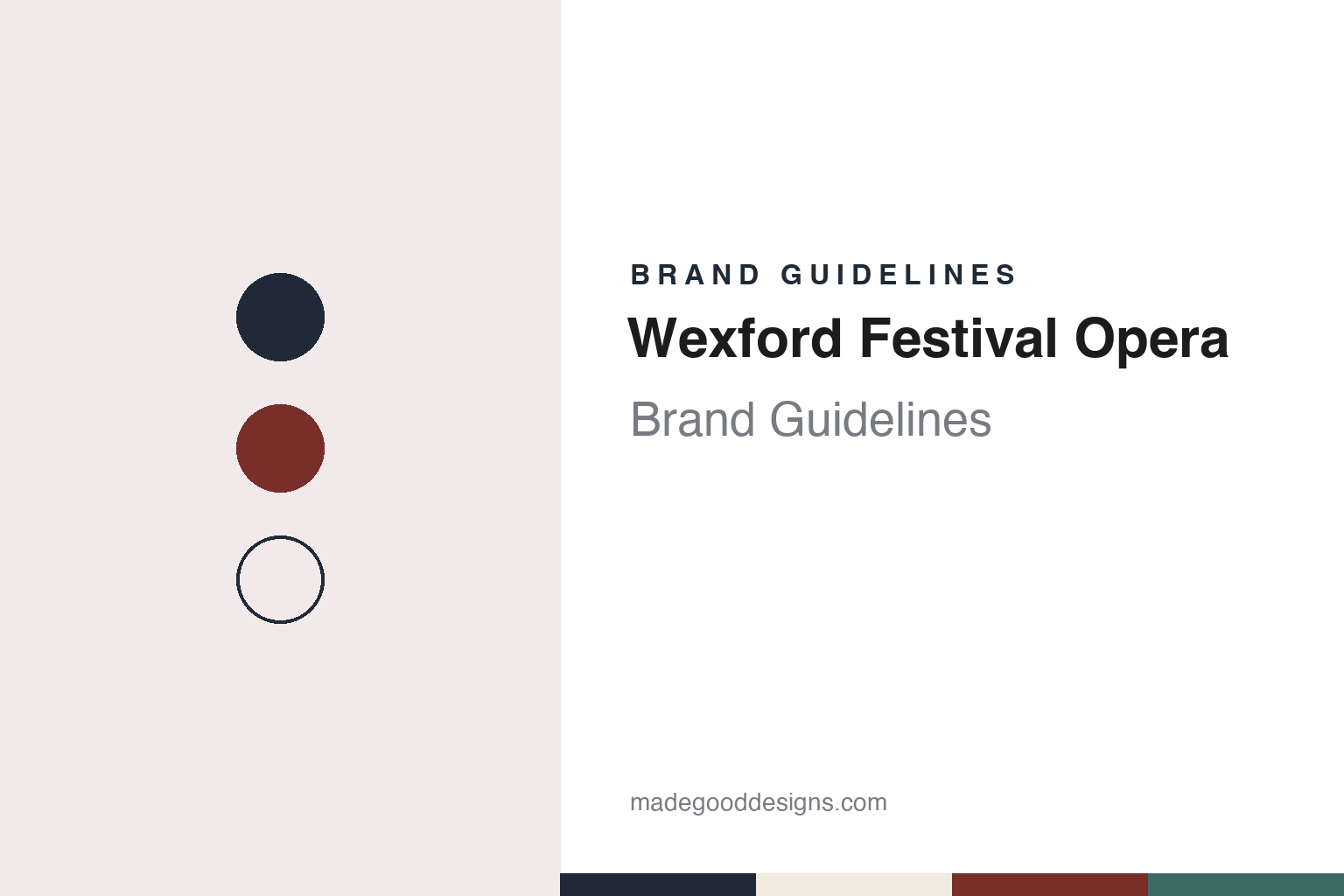
Wexford Festival Opera Brand Guidelines
Rarely heard operas, every autumn, in a harbour town.
Aa
Two constants: a harbour navy, autumn red and cream palette and a theatre serif register. Abstract homage — not a Wexford Festival Opera poster or mark; no logo, programme or photograph is reproduced.
Tom Walsh’s festival
A study circle, a novelist’s suggestion and a little-known opera.
Wexford Festival Opera began with a local opera society. English Wikipedia says Tom Walsh, a Wexford opera lover, started the Wexford Opera Study Circle in 1950 and invited the novelist Sir Compton Mackenzie, founder of the magazine The Gramophone, to give its first lecture. The festival’s own history says it was Mackenzie who suggested that Walsh stage an opera in Wexford, and English Wikipedia records that Mackenzie became the first president of the new festival.
The first edition, called the Festival of Music and the Arts, ran from 21 October to 4 November 1951, according to English Wikipedia. Its centrepiece was The Rose of Castille by Michael William Balfe, an Irish composer of the 19th century who had lived in Wexford. Walsh served as the festival’s first artistic director, and from its first decade the festival built its programmes around operas that were seldom staged elsewhere, among them Lortzing’s Der Wildschütz and Bellini’s La sonnambula.
For more than half a century the festival’s home was Wexford’s Theatre Royal. The 1960 season did not take place while the theatre was renovated, and the festival returned with Verdi’s Ernani in September 1961, English Wikipedia says. From 1962 to 2005 the Radio Éireann Symphony Orchestra, now the RTÉ National Symphony Orchestra, played in the pit.
Artistic direction passed through a series of directors over the following decades; English Wikipedia records that the director appointed in 1995 came from the Rossini Opera Festival at Pesaro, and that a new director programmed the seasons from 2005. In 1982 the festival introduced “Operatic Scenes,” staged excerpts from operas, later followed by condensed “mini opera” versions of more familiar works. A four-year series of commercial recordings from the festival began in 1994, and the fiftieth festival, in 2001, introduced surtitles.
Colour
From the Theatre Royal to the National Opera House.
The Theatre Royal was demolished in early 2006 to make way for a new theatre on the same site, English Wikipedia says. While it was built, the festival moved twice: in 2006 a reduced festival of two operas took place in the Dún Mhuire Hall on South Main Street, and in 2007 the festival was held in the summer in a temporary theatre in the grounds of Johnstown Castle, a country house about five kilometres from the town centre.
The new building, first called Wexford Opera House, was officially opened on 5 September 2008, and the first opera in it opened on 16 October 2008. It holds two auditoriums: the O’Reilly Theatre, with 771 seats, and the smaller Jerome Hynes Theatre, seating up to 176. English Wikipedia credits the design to an architecture practice working with the Office of Public Works, with acoustics and structure by Arup. At the opening of the 2014 festival the building was officially renamed the National Opera House.
The festival now runs for about two weeks in late October, with main-stage operas in the opera house and smaller events in venues around the town. The 2026 festival, its 75th anniversary, ran from 15 to 31 October. OperaWire reported in October 2025 that the anniversary programme paired three main-stage operas, Mascagni’s Iris, Rossini’s L’equivoco stravagante and Prokofiev’s The Gambler, with shorter “pocket operas” including a return of Balfe’s The Rose of Castille, the work that opened the first festival, and a new opera, The First Festival, commissioned for the young singers of the Wexford Factory. The same report listed a community opera, pop-up performances in cafés, hotels and shops, and lunchtime recitals in St Iberius Church.
Training is built into the festival. The Wexford Factory, the festival says, is a two-year programme for young singers, pianists and stage managers, with an academy each September and performances at the festival, run with partners including the academy of the Rossini Opera Festival in Pesaro, TU Dublin and the Royal Irish Academy of Music.
Typography
How opera festivals present themselves.
Opera festivals usually present themselves through a place or a person. Many take the name of their town with the word “festival” or “opera” attached, as Aix-en-Provence does; others carry the name of a composer, as the Rossini Opera Festival in Pesaro does, or the name of a house or estate. The name, the town and the stage often become the identity before any logo does.
Most run for a few weeks in summer. The Festival d’Aix-en-Provence takes place principally in July and the Rossini Opera Festival in August, each over a few weeks. Behind them stand non-profit bodies of different kinds: charities, associations and foundations, often with a city council or regional authority among their founders or members. The festival in Pesaro, for example, was set up by its city council in 1980 and became a foundation in 1994.
The settings vary as much as the names. Some festivals perform in castle or palace courtyards under the open sky, as Aix has done in the courtyard of its former archbishop’s palace since 1948; others use country-house theatres, historic Italian-style opera houses, purpose-built modern theatres or converted halls. Many festivals use more than one stage, and the list of venues is often part of how a festival describes itself.
Programmes commonly mix new productions with revivals, concerts and training. Academies and young-artist schemes, such as the Académie in Aix and the Accademia Rossiniana in Pesaro, put early-career singers, directors and musicians on the festival’s own stages. A poster, programme cover or season image is usually made anew for each edition, and Aix, for one, has worked with the same graphic designer since 2019. This guide describes those identities plainly, using our own unofficial colours and type.
Aa
A bookish serif, set as our own reading of a festival of rediscovered scores. (Specimen set in Libre Baskerville, a serif STAND-IN; NOT the Wexford Festival Opera logo.)
Wexford Festival Opera
A festival defined by what it chooses to revive.
Since 2020 the festival’s artistic director has been Rosetta Cucchi, a pianist and stage director. The festival says she had worked at Wexford for more than 25 years as assistant to the artistic director before her appointment. Writing for RTÉ in April 2026, as booking opened for the 75th festival, she described the festival’s founders as believing that audiences would take to rare works brought back to the stage, and named the town’s volunteers as part of how the festival runs each autumn.
That idea of rediscovery is the festival’s clearest identity. Its own history describes the work as seeking out operas that slipped out of the repertoire and presenting them to new audiences, and each season is announced around its main-stage titles, three in 2026 according to OperaWire. The festival is also tied closely to its town: its pages describe performances spread through Wexford, and the RTÉ piece describes posters filling shop windows and music in rehearsal rooms as the festival begins.
For a design guide, that points to a palette of place and season rather than of stage glamour: the dark blue of a harbour at dusk, a deep red for autumn and for the theatre, a muted estuary green, a stone grey and a warm cream that reads like an old printed programme. A bookish serif with clear italics suits the festival’s habit of naming unfamiliar titles and composers, while a plain sans handles dates, times and venues.
For a design guide, Wexford Festival Opera shows how a festival can build its identity on a repertoire choice rather than on a building or a star. Compare the Rossini Opera Festival, whose academy is a partner of the Wexford Factory, and the Festival della Valle d’Itria, another festival of rarely performed operas. For this guide we use harbour navy, autumn red, estuary green and programme cream with a serif, an unofficial interpretation; no product or logo is reproduced.
Explore & save
Keep Wexford Festival Opera’s identity on hand — save it to a board in the Made Good inspiration library.
Wexford Festival Opera identity set
Pin the harbour navy, autumn red and cream palette and the theatre serif register to your own board.
Source & notes
Frequently Asked Questions
What font can I use to match the Wexford Festival Opera look?
This guide describes Wexford Festival Opera’s type as “A bookish serif, set as our own reading of a festival of rediscovered scores”. Its type specimen is set in Libre Baskerville from Google Fonts as a stand-in; Libre Baskerville is not Wexford Festival Opera’s own lettering.
What colours are in the Wexford Festival Opera palette?
This guide’s Wexford Festival Opera palette is Harbour navy #1F2A36, Autumn red #7A2E2A, Estuary green #3F6B66, Quay stone #8C8478 and Programme cream #F1EBE0. The tones are the guide’s own unofficial interpretation, not official Wexford Festival Opera hex codes.
When was Wexford Festival Opera founded?
Wexford Festival Opera was founded in 1951, in Wexford, Ireland.
Who founded Wexford Festival Opera?
Wexford Festival Opera was founded by Tom Walsh in 1951.