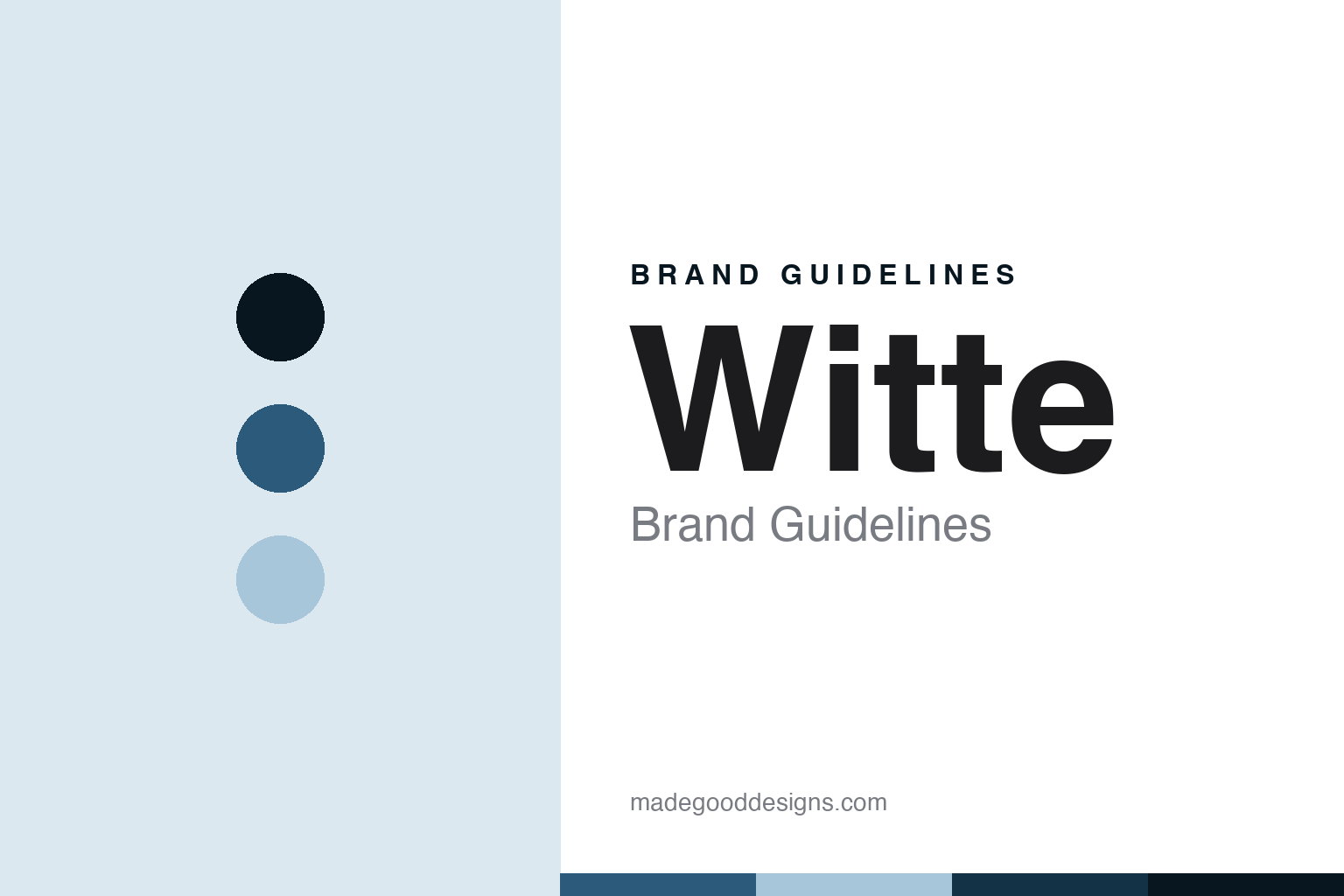
Witte Brand Guidelines
The needle factory that became a screwdriver house.
Aa
Two constants: a Witte-steel-blue palette and a late-arrival-sans register. Abstract homage — not a Witte product or mark; no screwdriver, blade or handle is reproduced.
The needle factory that became a screwdriver house
Witte dates to 1785 and an Iserlohn needle-and-pin factory — but it has only been a hand-tool maker since the middle of the twentieth century.
Witte is the round’s second absorbed node, and its best warning about reading a founding date too quickly. An eighteenth-century date on a tool brand invites the assumption of an eighteenth-century tool tradition. Witte’s is not that. Its answer to a round about who owns and where-makes the driver is a very old company that came to this product very late: the needle factory that became a screwdriver house.
Its identity is the needle factory that became a screwdriver house. The 1785 founding, the mid-century turn to hand tools and the Hagen plant are the story here. The screwdriver. The needle factory that became a screwdriver house.
(Honest notes, so the founding, the ownership and the making are framed accurately — and so the gaps are left visible rather than filled in. On founding: the house dates itself to 1785 at Iserlohn, in the Sauerland, and it began as a maker of needles and pins, not tools. The turn to hand tools came much later, in the middle of the twentieth century; sources place it either in the late 1940s or in 1954, and we report the range rather than pick one. That gap of roughly a century and a half is the most interesting fact about the brand, and the one a heritage line on a packet would quietly elide. We do not make claims about the founder’s identity or about when the founding family left the business, because the sources we could check do not establish either to a standard worth printing. On ownership: Witte is reported to sit within the Kirchhoff group, a German family-owned industrial group better known for automotive metal-forming — so, like Felo before it, this is a heritage tool name held inside a larger family-owned German industrial house rather than an independent firm. We attribute that rather than assert it. On the making: production is at Hagen in North Rhine-Westphalia, which is a genuine and specific German manufacturing answer. On the name, a caution that matters for search as much as for accuracy: Witte is not Wiha and not Wera — three separate German firms — and Witte Tools is a different company again from Witte Automotive of Velbert. Its marks are IP we describe but do not reproduce; there is no official brand hex.)
Colour
Witte lives in a Witte steel blue. Click a swatch to copy the hex.
Witte’s identity is German, absorbed and late-arriving — a Witte steel blue, an ink, a pale blue, a deep slate, and a paper. The palette leans Witte steel blue and deep slate: a cool, plain register that stands in for a working screwdriver house rather than a loud logo colour. It signals the needle factory that became a screwdriver house — German, absorbed and late-arriving. The honest caveat: with no official brand hex, these values are an unofficial interpretation, not first-party colours, and we assert no handle-colour convention for the brand because we could not verify one.
The lesson is a founding date is not a product history. Witte’s world is the blade shaft and the moulded grip. For designers and brand-builders, the useful move here is negative rather than positive: when a brand carries a date as old as 1785, the honest question is what it was doing then, and whether that has anything to do with what it sells now. In Witte’s case the answer is needles and pins, which is a real heritage but not a tool heritage. A brand that leads with the number and stays quiet about the century and a half in between is borrowing credibility it has not quite earned. Because a strong hue can fail as small text, keep type dark and let the colour live in the accents, palette and band. The takeaways: date the founding to 1785 but say what it founded; place the turn to hand tools in the mid-twentieth century and report the range; attribute the Kirchhoff ownership; and keep Hagen as the specific making.
Typography
The register is a late-arrival sans — German, absorbed, plain.
Witte’s identity carries a German, workmanlike spirit — an old name doing a modern job. A late-arrival sans captures the mood: plain, current and unromantic, the register of a firm whose real product history starts after the Second World War rather than in the eighteenth century. Set in a Witte-steel-blue palette, the late-arrival sans feels practical rather than antique — exactly the personality the facts support. It behaves like a ground, moulded thing rather than a loud logo, mirroring a blade shaft and a grip ring. (Witte’s real products and the name itself are things we describe but do not reproduce, and the exact typeface is not ours to use.) Because it is not ours to use, the honest description is “a late-arrival-sans brand,” shown here in a stand-in. The type behaves like the brand: German, absorbed and plain.
Aa
A late-arrival-sans brand — plain and current. (Specimen set in Manrope, a late-arrival-sans STAND-IN; NOT the Witte logo or products.)
The late-arrival node
Witte stands for the needle factory that became a screwdriver house.
Witte holds the round’s late-arrival node. A Witte-steel-blue palette, a late-arrival sans and a 1785 founding make one thing — the needle factory that became a screwdriver house — the whole identity: German, absorbed and plain. The 1785 founding is the frame, the mid-century turn to hand tools is the substance, and the Kirchhoff ownership is the signature. The point is a genuinely old German company whose tool history is much younger than its date implies, sitting beside Felo as the round’s second name held inside a larger group.
Put to work, the identity is the date explained rather than displayed. A brand in this spirit would date the founding to 1785 and immediately say what was founded — a needle and pin factory at Iserlohn — place the turn to hand tools in the mid-twentieth century while reporting that sources differ between the late 1940s and 1954, attribute the Kirchhoff ownership rather than assert it, keep Hagen as the specific place of manufacture, and leave the founder and the family exit unstated while they remain unverified. A reader in this spirit would keep the facts right: Witte makes screwdrivers; it dates to 1785 as a needle maker; it is reported to sit inside the Kirchhoff group; and it produces at Hagen. Witte follows Felo, before Hazet. The honest editorial moves are to date the founding, to explain what it founded, to attribute the ownership, and to decline the claims that cannot yet be checked.
For designers and brand-builders, Witte holds the late-arrival node: heritage is a claim about continuity, not just about age. The lessons: a category can include a house that arrived late, here Witte; a founding is dated to 1785 and described honestly, a needle-and-pin factory at Iserlohn rather than a tool works; a product history is placed where it actually begins, in the middle of the twentieth century, with the range between the late 1940s and 1954 reported rather than resolved; an ownership is attributed, reportedly within the Kirchhoff group, a family-owned German industrial house, which makes Witte the second heritage tool name in this round to be held inside a larger family group rather than independently; and a making is placed specifically, at Hagen in North Rhine-Westphalia. It is also a reminder that a brand round has to police its own name confusions: Wiha, Wera and Witte are three unrelated German firms founded in different centuries by different families, and Witte Tools is not Witte Automotive of Velbert — a distinction that matters to anyone searching. And it is a reminder about restraint: several of the most quotable things said about this company could not be verified to a standard worth printing, so they are absent here rather than hedged into the copy. The hook is that gap: Witte is the needle factory that became a screwdriver house, the 1785 Iserlohn maker that came to hand tools a century and a half later. Read that way, Witte is less a single screwdriver than the needle factory that became a screwdriver house: German, absorbed, plain. The lesson for a brand is that an old date is only worth printing next to what it actually founded. Witte made the-needle-factory-that-became-a-screwdriver-house the identity — proof that an honest gap is better than a borrowed continuity.
Explore & save
Keep Witte’s identity on hand — save it to a board in the Made Good inspiration library.
Witte identity set
Pin the Witte-steel-blue palette and the late-arrival-sans register to your own board.