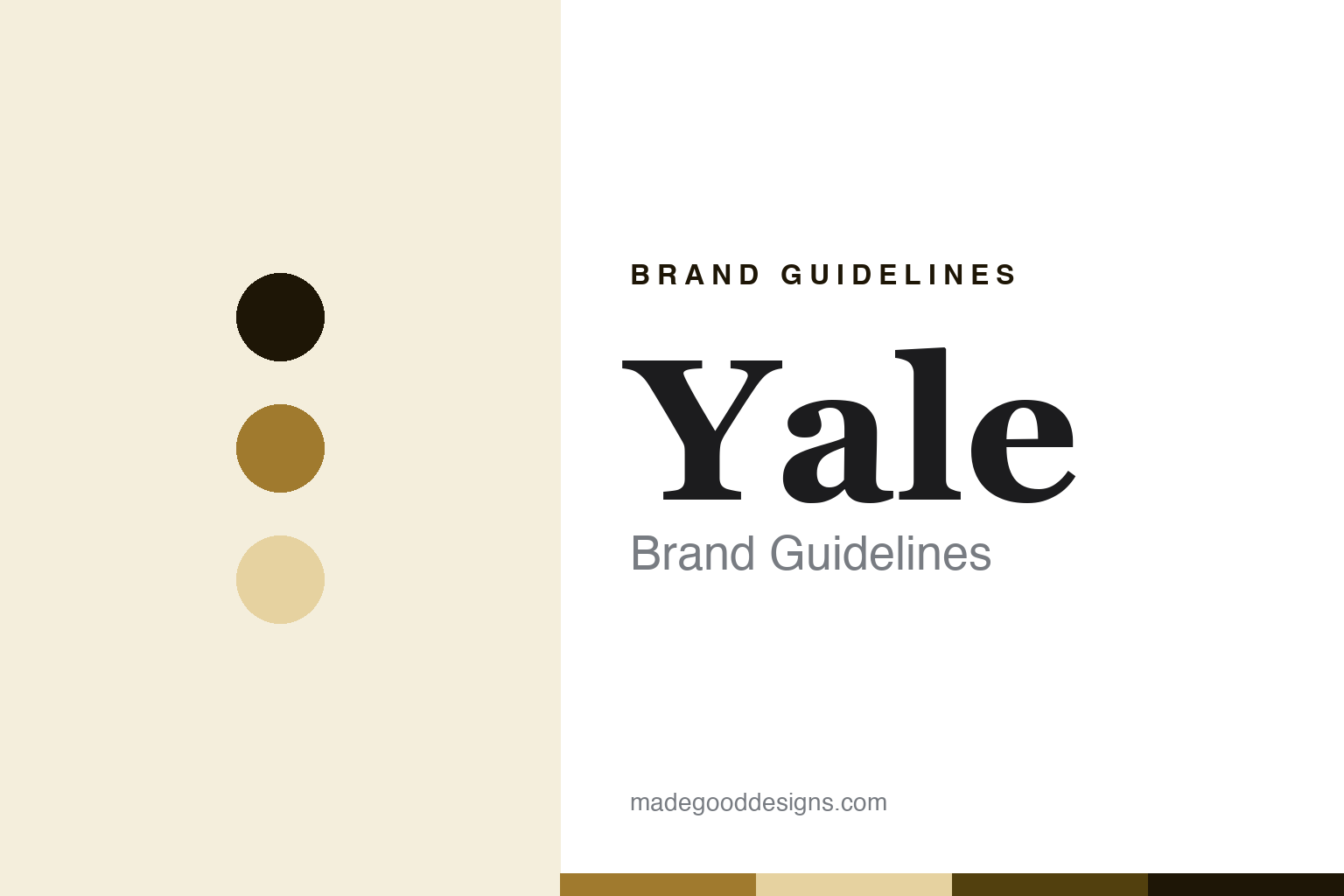
Yale Brand Guidelines
The 1868 lock name in the smart-lock reshuffle.
Aa
Two constants: a heritage-brass palette and a heritage-serif register. Abstract homage — not a Yale product or mark; no lock, keypad or logo is reproduced, and this is unrelated to the same-named university.
The 1868 lock name in the smart-lock reshuffle
Yale is the 150-year-old pin-tumbler lock name whose smart locks are ASSA ABLOY’s abroad but Fortune Brands’ in North America.
Yale opens the smart-lock round as its heritage node — the oldest name here, and the clearest example of how tangled the ownership of this aisle has become. It traces to Linus Yale Jr. and the pin-tumbler cylinder lock, and the Yale Lock Manufacturing Company was founded in 1868. Yale makes and sells smart locks today, and its answer to a round about who owns these devices is the most complicated in the round: one brand, two owners, split by a border.
Its identity is the 1868 lock name in the smart-lock reshuffle. The deep pin-tumbler heritage, the split ownership and the modern smart locks are the story here. A brand, reshuffled. The 1868 lock name in the smart-lock reshuffle.
(Honest notes, so the heritage, the ownership and the name are all framed accurately, because the ownership especially is easy to get wrong. Yale sells smart locks as its heroes — the Assure Lock 2, with swappable connectivity modules and an optional fingerprint reader, and the 2024 Yale Approach, its first retrofit deadbolt — and we report its language as the brand’s own. On heritage: it descends from Linus Yale Jr., who developed the modern pin-tumbler lock, and the company was founded in 1868 in Stamford, Connecticut, with Henry Towne, though Yale Jr. died within months of its founding. On ownership, the correction that matters most: ASSA ABLOY, the Swedish giant, acquired Yale in 2000 and still owns it across most of the world, but in 2023 it was forced by a competition remedy to sell the US and Canadian Yale and August residential smart-lock businesses to Fortune Brands Innovations, so in North America Yale smart locks are Fortune Brands products, while elsewhere they remain ASSA ABLOY’s — we state both. On where it is made: reported to be Asia, mainly China with some Korea, which we hedge since Yale does not prominently disclose it. On a name trap: this Yale is unrelated to Yale University. Its designs, the Yale name and its livery are IP we describe but do not reproduce; there is no official brand hex; these tones are an unofficial interpretation.)
Colour
Yale lives in a heritage brass. Click a swatch to copy the hex.
Yale’s identity is heritage, established and connected — a heritage brass, an ink, a pale wheat, a deep bronze, and a paper. The palette leans heritage brass and pale wheat: a warm, metallic register that nods to old lock brass and long history rather than a loud logo colour, and deliberately not to a Yale blue, which would collide with the university’s. It signals the 1868 lock name — heritage, trusted and now smart. The honest caveat: with no published brand hex, these values are an original, unofficial interpretation, not first-party colours.
The lesson is a heritage brass signals an established, trusted identity. Yale’s world is a lock name people have trusted for over a century, now on a phone. For designers, it is a reminder that a warm heritage brass and a soft pale wheat can carry a maker brand — a metallic tone held as colour, not a product shot. Because these tones can fail as small text, keep type dark and let the colour live in the accents, palette and band. The takeaways: date it to 1868; tell the ASSA-ABLOY-abroad, Fortune-Brands-in-North-America split; hedge the manufacturing; keep it separate from the university; and avoid asserting a blue hex.
Typography
The register is a heritage serif — established, trusted, connected.
Yale’s identity carries an established, trusted, connected spirit — a heritage lock name, not a startup. A heritage serif captures the mood: warm, refined and confident, the register of a name that has meant “lock” for generations. Set in a heritage-brass palette, the heritage serif feels established and trusted — exactly the personality Yale carries. It behaves like an established name rather than a loud logo, mirroring a deadbolt-cylinder ring and a keypad-dot grid. (Yale’s real locks and the name are things we describe but do not reproduce, and the exact typeface is not ours to use.) Because it is not ours to use, the honest description is “a heritage-serif brand,” shown here in a stand-in. The type behaves like the brand: established, trusted and connected.
Aa
A heritage-serif brand — established and trusted. (Specimen set in Cormorant Garamond, a heritage-serif STAND-IN; NOT the Yale logo, and unrelated to the same-named university.)
The smart lock
Yale stands for the 1868 lock name in the smart-lock reshuffle.
Yale opens the smart-lock round as its heritage node. A heritage-brass palette, a heritage serif and an 1868 founding make one thing — the 1868 lock name in the smart-lock reshuffle — the whole identity: heritage, established and connected. The pin-tumbler heritage is the pitch, and the split ownership is the twist. The point is the oldest name here, caught in the reshuffling of the smart-lock aisle, in a round about who owns these devices.
Put to work, the identity is the brand told straight, the ownership split told honestly. A maker in this spirit would date it to 1868, tell the ASSA-ABLOY-abroad, Fortune-Brands-in-North-America split, and keep it separate from the university. A reader in this spirit would keep the facts right: Yale sells the Assure Lock 2 and Yale Approach as its heroes; it descends from Linus Yale Jr. and was founded in 1868; ASSA ABLOY owns Yale globally but sold the US and Canadian residential smart-lock business to Fortune Brands in 2023; and its manufacturing is reported as Asian. Yale opens the round, before August. The honest editorial moves are to date it to 1868, to tell the ownership split, to hedge the manufacturing, to separate it from the university, and to avoid a blue hex.
For designers and brand-builders, Yale opens the smart lock: carry a heritage name into a new category — and tell a split ownership honestly. The lessons: build on a genuinely old name; explain when a brand has different owners in different regions; hedge a manufacturing location a company will not confirm; clear a famous name collision; and never reproduce a logo or assert a contested colour. It is also a reminder to stay precise: Yale is the 150-year-old pin-tumbler lock name whose smart locks are ASSA ABLOY’s abroad but Fortune Brands’ in North America — with the palette here an unofficial interpretation. The hook is that reshuffle: the same Yale name that has meant “lock” since 1868 is now owned by the Swedish giant ASSA ABLOY in most of the world and by America’s Fortune Brands in the US and Canada — the heritage brand split down the middle by an antitrust remedy, its smart locks answering to different parents depending on where you buy them. Read that way, Yale is less a single company than a heritage name in play: established, trusted, connected. The lesson for a brand is that heritage and honest ownership reinforce each other, and telling the split straight keeps the story earned. Yale made the-1868-lock-name-in-the-smart-lock-reshuffle the identity — proof that heritage can open a round.
Explore & save
Keep Yale’s identity on hand — save it to a board in the Made Good inspiration library.
Yale identity set
Pin the heritage-brass palette and the heritage-serif register to your own board.


