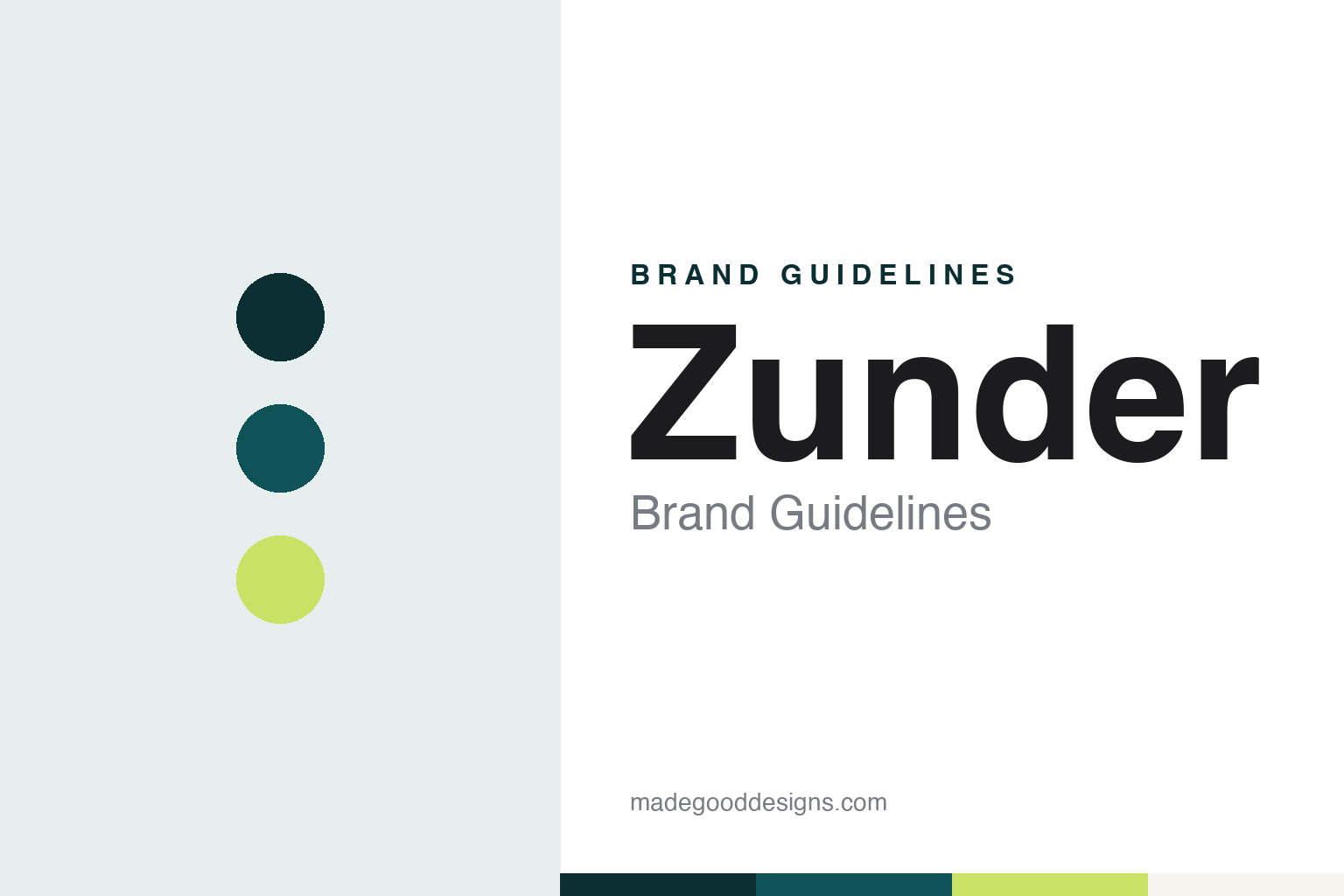
Zunder Brand Guidelines
A software start-up from Palencia that became an ultra-fast charging network.
Aa
Two constants: a deep teal, night and lime palette and a geometric sans register. Abstract homage — not a Zunder product or mark; no charger, logo or app screen is reproduced.
EasyCharger
Two electric-car drivers and a piece of software.
Zunder began in Palencia, in Castilla y León, in 2017, under the name EasyCharger. English Wikipedia and the company’s own timeline name its founders as Daniel Pérez and Lorenzo Antolín, and the company describes them as electric-car drivers who first wrote software to manage charging points. In a long feature published in June 2023, El Español reported that Pérez had started out making YouTube videos about electric cars and charging, which took him across thousands of kilometres of Spanish roads and showed him how hard charging was for drivers at the time.
According to the same report, the two partners set up EasyCharger with early investors and an agreement with Nissan, and began building their own stations. The idea, Pérez told the paper, was to put several chargers at each site and run them on software written by the same team that built the stations. The company’s timeline says its first station opened at the Tudanca service area, and that the founders then decided to build a network of their own rather than only manage other people’s chargers.
Outside money arrived in stages. The timeline places the entry of the investment firm White Summit Capital in 2021, the year it says the network opened its first ultra-fast station. In 2022 the company opened an office in Madrid, launched a new app and changed its name and image from EasyCharger to Zunder; it gives its size that year as 25 stations and 50 employees. El Español linked the change of name to a capital increase led by the French investor Mirova in the same year.
Palencia has stayed the base. The European Investment Bank, announcing a loan to the company in February 2023, described Zunder as an independent operator of ultra-fast charging infrastructure in Spain, based in Palencia, and noted that much of its planned network would sit in EU cohesion regions such as Castilla y León.
Colour
Hubs on the motorway, a card and an app.
Zunder’s product is the charging hub rather than the single post. When El Español drove from Madrid to Palencia in 2023, its reporter stopped at the Tudanca area in Fuentespina, near Burgos, and found 12 charging points rated at 200, 50, 43 and 22 kW. At the company’s headquarters, Pérez told the paper the network then had about 60 stations and some 240 charging points in operation, with about 20 more stations built and waiting to be connected.
The network grew quickly from there. The Spanish trade site Conecta reported in January 2026 that Zunder had ended 2025 with 209 stations in Spain, France and Portugal and more than 1,300 charging points, covering more than 84 per cent of Spain’s main dual carriageways with a station roughly every 200 km, and with sites rated at up to 480 kW. In France it counted 17 stations and 235 ultra-fast points. By September 2026, Forococheselectricos reported, the company had passed 1,500 operational points in Spain and France and more than 220 high-power stations.
Much of the brand lives in how drivers pay and plan. Conecta lists three ways in: the Zunder app, the eZCard charging card and direct payment by bank card at the terminal, all on the same price scheme, and says the company runs its own software for monitoring, operations and support. The company’s timeline adds an Apple CarPlay integration in 2022 and an Apple Watch app in 2023. Its network sits inside other apps too: Conecta reports integration into Waylet and an agreement with Telpark in 2025, and, acting as an e-mobility service provider, access to around 850,000 charging points in Europe through one app or card.
Partnerships carry the name further. In April 2026 laSexta reported an agreement with Club Tesla España, the owners’ club, giving its members charging advantages and letting the Zunder app send station locations to a Tesla’s navigation system. Conecta also mentions agreements in 2025 with Uber and Grupo AURO aimed at ride-hailing drivers, and a growing focus on fleets and electric trucks.
The company says it received an operator award from AUVE, the Spanish electric-vehicle users’ association, in 2024. Its own campaign line is #ChargingYourFreedom.
Typography
How charging networks present themselves.
EV charging networks sell something drivers cannot see: electricity delivered in a car park or at a service area. Their identities therefore lean on what can be pictured — the charger units, the buildings and shelters around them, the app and the network map — and on the names they give to different kinds of site. Gridserve, for example, sorts its network into Electric Forecourts®, Electric Super Hubs on motorways and Electric Retail Hubs, while Osprey defines a hub as a site with six or more ultra-rapid bays.
Hardware is often shown by name. Networks publish the makers of their chargers and the power ratings they quote for them: Osprey lists units from Circontrol, Wallbox, Tritium and Kempower on its chargers page, and Gridserve has installed ABB units capable of 400kW at its newer sites, according to Transport + Energy. Speeds in this guide are given only as each network or a dated report states them.
The app and the map carry much of the brand. Network maps use colour as a key — Osprey’s marks its fastest sites with orange pins — and apps handle payment, receipts and membership schemes; in 2026 Osprey added a feature that starts a charge as soon as a car is plugged in. Photographs of hubs and forecourts illustrate the networks’ news pages and the partner announcements carried by the trade press.
The other audience is the landlord. Gridserve and Osprey both keep pages for landowners and partners, because their sites are hosted by supermarkets, retail parks, pubs, councils and motorway service areas. This guide sets out what can be checked about each network — who founded it, who owns or funds it, and how it names and presents its sites — and marks clearly what rests on a company’s own word.
Aa
A geometric sans for a network built around software. (Specimen set in Sora, a sans STAND-IN; NOT the Zunder logo.)
Zunder
Funds, a bank loan and software for other operators.
Zunder is backed by investment funds. When Mirova, a subsidiary of Natixis Investment Managers, invested through its Mirova Energy Transition Fund 5 in October 2022, El Periódico de la Energía reported, citing a Zunder statement, that the deal gave Mirova a minority position while White Summit Capital and other co-investors stayed the majority shareholders. Debt finance followed: the European Investment Bank signed a loan in February 2023 for fast and ultra-fast charging along the trans-European transport network in Spain, and in July 2024 the company closed a green loan with Banco Santander, tied to a plan for more than 3,000 charging points in Spain, France, Portugal and Italy, according to Forococheselectricos.
Expansion abroad has followed Spain’s borders. The company dates its first stations in France and Portugal to 2023, and says it opened six ultra-fast stations in France with Vinci and Atlandes in 2024. In Portugal it first worked as an electricity retailer for electric mobility in 2023, Forococheselectricos reported in September 2026, before opening a station at Marinhas in July 2026 and another at Caldas da Rainha, beside the A8 motorway between Lisbon and Porto, with 12 points of up to 400 kW, bays designed for heavy vehicles and a large solar canopy.
The software that runs the network has become a product of its own. In May 2026 Zunder launched KAWAT, a platform that offers companies, public bodies and other operators the tools it uses on its own chargers, combining a charge-point management system with services for drivers. SomosEléctricos, reporting the launch, cited the company’s press release as saying KAWAT already managed more than 4,000 third-party charging points for more than 250 clients in six countries. The company has since taken KAWAT to Portugal as well.
For a design guide, Zunder shows how a charging network can grow out of software: the hub, the card, the terminal and the app are designed to work as one system. Compare Powerdot, another Iberian charging network, and IONITY, a motorway network built by carmakers. For this guide we use a deep teal, a night tone and a lime with a sans, an unofficial interpretation; no product or logo is reproduced.
Explore & save
Keep Zunder’s identity on hand — save it to a board in the Made Good inspiration library.
Zunder identity set
Keep the Zunder deep teal, night and lime palette and the geometric sans register on your own board.


