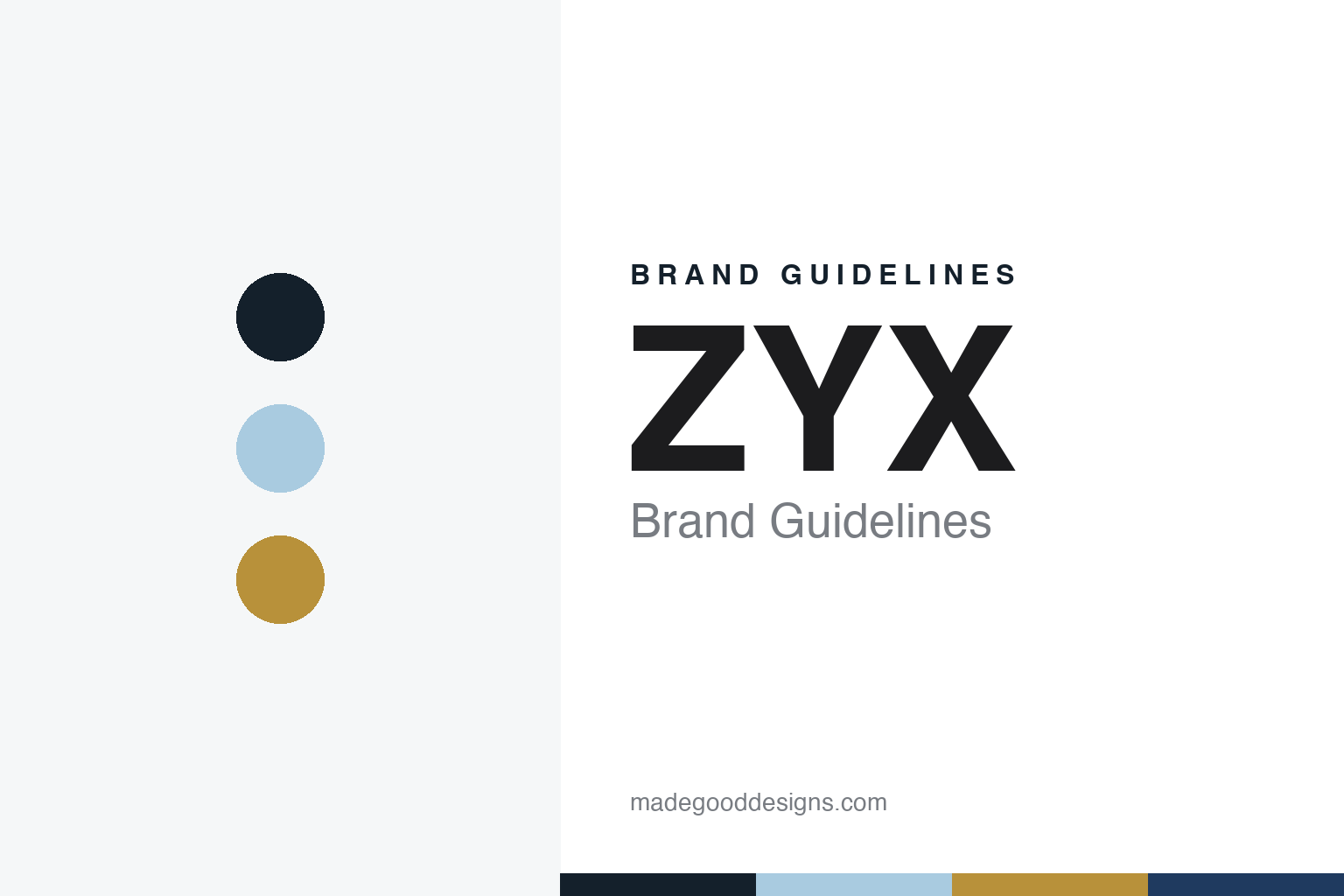
ZYX Brand Guidelines
The Chiba moving-coil maker named for time, amplitude and frequency.
Aa
Two constants: a ZYX ink, acrylic blue and gold palette and a technical sans register. Abstract homage — not a ZYX product or mark; no cartridge, logo or nameplate is reproduced.
Z, Y and X
An engineer’s company in rural Chiba.
ZYX is a small Japanese maker of moving-coil phono cartridges. Its website gives the company as ZYX Co., Ltd., established in December 1986, with Hisayoshi Nakatsuka as president and an office at Funaki, in the town of Nagara in Chiba Prefecture, east of Tokyo. Archived copies of the site from 2013, 2015 and 2018 give the same date and address. Japanese Wikipedia agrees on both and gives the Japanese reading of the name as “Jikkusu,” but its article has no footnotes and has been flagged since 2022 as needing sources, so we treat it only as support. One review differs: TNT-Audio wrote in 2017 that Nakatsuka founded the company in 1989. We follow the company’s own date.
The name is meant to be read as three axes. The company says Z stands for time, Y for amplitude and X for frequency, and that “ZYX insists on the consistency” of the three. Its homepage argues that analogue playback is the only medium with a continuous time axis, while digital systems, however fast their sampling, produce “a continuous series of disconnected synthetic sounds.” That is the company’s view, not a finding.
Most of what is known about Nakatsuka’s career comes from the company’s own background page. It says he was born in Nagano Prefecture and, after university, worked in development at Trio, the company later known as Kenwood; the English page adds that he developed “the world’s first optical cartridge” there, a claim the Japanese page does not make. The company says he then went to Ortofon in Denmark and developed the MC20; we found no independent confirmation of that in the sources we checked. In 1976, it says, he joined Namiki Precision Jewel, which the Japanese page calls a major maker of phono-cartridge parts, and managed OEM cartridges for several manufacturers there, before setting up ZYX in 1986 with Namiki’s backing. The company credits him with 15 patents.
One part of that story has an independent echo. Reviewing a ZYX cartridge in 2004, Stereophile wrote that Nakatsuka had specialised in damper materials “since the mid-1980s, when he developed the Alpha Genesis series of cartridges for Monster Cable.” The magazine did not say who manufactured them.
Colour
Clear bodies and balanced channels.
ZYX’s technical case is about balance between the two channels. On its website the company argues that in most cartridges the right channel sounds brighter and the left heavier, “just like a 10-year younger singer on the right and 10-year older on the left,” even when measurements match. It says it improved more than 15 items in the generator to give the two channels equal sound, calls the result its “real stereo” generator, and says it puts “only about 10% importance on data.” These are the company’s claims rather than measured results.
The best-documented early ZYX cartridge is the R-1000 Airy S, reviewed by Art Dudley in Stereophile in May 2004. He described a clear acrylic body, chosen “to prevent eddy currents,” coils of silver wire, cryogenically treated parts from the terminal pins to the armature, a 3-by-6-micron Micro-Ridge stylus and a weight of 5 grams. After six months with it he called the Airy S “the most tonally neutral moving-coil cartridge I’ve ever heard.” Its American importer at the time was Bertrand Audio Imports of Nashua, New Hampshire.
Later reviews show the range growing upward. TNT-Audio reviewed the Bloom 3 in October 2017 at $1,100, describing a “pale translucid blue plastic” body that shows the parts inside, shared with the Ultimate 100 and Ultimate Airy; it said the North American line then ran up to the UNIverse Premium at $15,000, and that the distributor SORAsound had sold ZYX since 2003. In August 2018 Part-Time Audiophile reviewed the UNIverse Optimum at $16,995.
The company’s current range, listed on its website, centres on the Ultimate VX series — Astro Diamond, Astro, Diamond, Omega, 4D, Airy and 100 — with the R50 Bloom VX and a group of mono cartridges. Its news page dates the VX series to August 2025 and an accessory, the VX Sheet, to December 2025. The company also says ZYX has won several “cartridge of the year” awards, holds a Class A rating from Stereophile, and that its R-100T was the recommended cartridge for the Teragaki player; we have not checked those claims one by one.
Typography
A small world of specialists.
These seven makers belong to a small trade. A phono cartridge is a few grams of magnet, coil and diamond, largely assembled by hand, yet only a few of these brands say who does the work.
Goldring, which traces its roots to Berlin in 1906, belongs to Armour Home Electronics of Bishop’s Stortford, a subsidiary of Q Acoustics Limited, Companies House records show. It says its cartridges are “designed and handmade in the UK,” though its own history says it outsourced much component manufacturing in the 1990s. Soundsmith says every product is “hand-crafted” at its factory in Peekskill, New York.
Sumiko, the cartridge brand of a Berkeley, California, distributor bought by Fine Sounds of Milan in 2011, Stereophile reported, says all its cartridges are hand-built by Excel Sound in Yokohama.
Three are Japanese. Nagaoka, a family stylus maker based in Higashine, Yamagata, makes an MP-700 that is “still completely built by hand in Japan,” Hi-Fi News reported in 2025. ZYX works from Nagara in Chiba; its founder says he managed OEM cartridges for several makers at Namiki Precision Jewel before 1986. My Sonic Lab gives a Tokyo address; its US distributor, quoted by Stereophile in 2018, said founder Yoshio Matsudaira had earlier made cartridges for Air Tight.
Benz Micro, the Swiss name, is hardest to place: its website is a holding page, and the Swiss business-name index lists a Benz-Micro AG as deleted in 1997.
This guide sets out what can be checked about each brand — who founded it, who owns it, and what it says about where its products are made — and marks clearly what rests only on the company’s own word.
Aa
A technical sans for a three-letter name. (Specimen set in Space Grotesk, a sans STAND-IN; NOT the ZYX logo.)
ZYX
Three letters, three axes.
Nothing in the sources we checked suggests that ZYX has changed hands: they record no sale or change of ownership, and the company’s website still names Hisayoshi Nakatsuka as president, a role it describes as “chief engineer and the President.” The address has not changed across the archived versions of the site we checked, from 2013 to today.
The company does not publish much about production. It says all its cartridges are produced with its own generator system, and its only address is the Chiba office; it does not say how many people build the cartridges or where its parts come from, so we do not guess. What it does publish is a long list of distributors: it says it exports to more than 40 countries, names an exporter, MuSon Project, and lists distributors including SORAsound in the United States, GT Audio in Britain and Audio Plan in Germany. It warns that cartridges bought outside that network get no aftercare, such as stylus replacement.
The name is a trap for searchers. ZYX Music is an unrelated German record label, founded in 1971, and Wikipedia lists other unrelated uses, including a Japanese video-game company; the cartridge maker’s site is zyx-audio.com.
As a brand, ZYX works with very little: three letters in reverse alphabetical order, a meaning the company explains in physics terms, and bodies that are often clear or translucent so the generator can be seen. No logo typeface or colour is documented.
For a design guide, ZYX shows how a one-engineer company can build a brand around an idea — that time, amplitude and frequency should be kept in step — and around letting the buyer see inside the product. Compare Lyra, another Japanese moving-coil specialist, and Dynavector. For this guide we use a dark ink, an acrylic blue and a pin gold with a sans, an unofficial interpretation; no product or logo is reproduced.
Explore & save
Keep ZYX’s identity on hand — save it to a board in the Made Good inspiration library.
ZYX identity set
Pin the ZYX ink, acrylic blue and gold palette and the technical sans register to your own board.