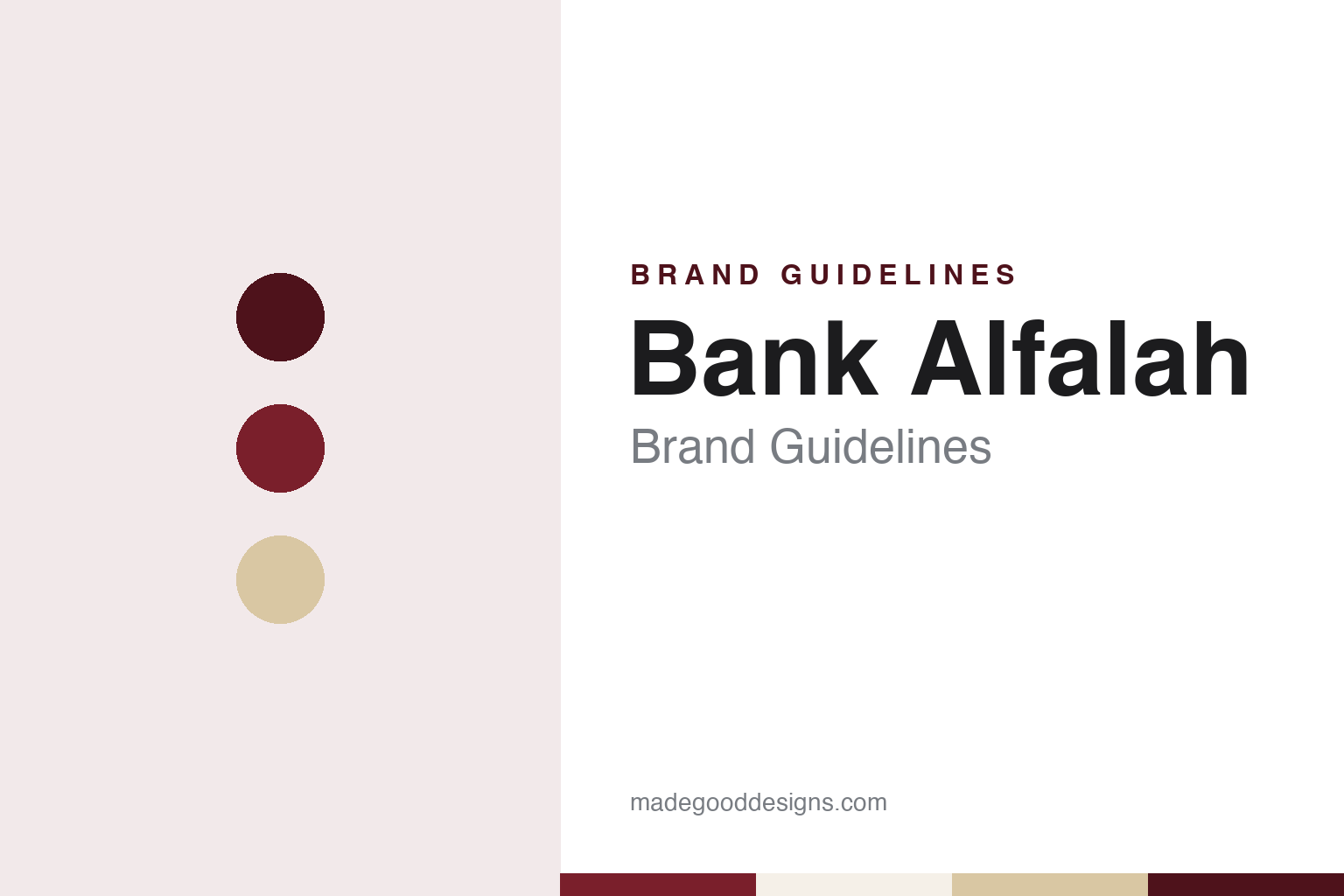
Bank Alfalah Brand Guidelines
A Karachi bank built from three branches and a new name in 1998.
Aa
Two constants: a maroon, sandstone and linen palette and a warm serif register. Abstract homage — not a Bank Alfalah product or mark; no logo, card or signage is reproduced.
Habib Credit and Exchange Bank
Three branches and a rescue.
Bank Alfalah did not start as a new bank. Its roots are in the Bank of Credit and Commerce International, or BCCI, which had three branches in Pakistan, in Karachi, Lahore and Rawalpindi. BCCI was closed down internationally in 1991, and in 1992 the State Bank of Pakistan took over the three Pakistani branches to look after their depositors, English Wikipedia says.
The State Bank reorganised those branches as Habib Credit and Exchange Bank Limited, run as a subsidiary of HBL, then still owned by the state. For five years the small bank traded under that name, with the same three branches it had inherited, while its owner, HBL, remained in state hands.
Its present ownership dates from July 1997, when the Abu Dhabi Group, an Emirati business group, bought a 70 percent stake. Banking under the new owners began on 1 November 1997, and on 25 February 1998 the bank was formally renamed Bank Alfalah Limited. In 2002 the Abu Dhabi Group bought the remaining 30 percent from the Government of Pakistan at an open auction, and the bank has been a subsidiary of the group since, according to English Wikipedia.
Colour
From 3 branches to more than 1,100.
Growth came quickly once the new name was in place. English Wikipedia says the bank went from three branches in 1997 to 45 branches in 21 cities by the end of 2002 and to more than 215 by 2007. It listed its shares on the Karachi Stock Exchange in 2004, after an initial public offering, and is now listed on the Pakistan Stock Exchange. The same source describes it as one of the largest private banks in Pakistan, with more than 1,100 branches in over 200 cities.
The bank also looked abroad. In 2005 it bought the Bangladesh operations of Shamil Bank of Bahrain and opened its first branch in Kabul, later adding one in Herat. In 2007 it set up a wholesale banking unit at the Bahrain Financial Harbour in Manama, and it went on to open branches in the United Arab Emirates and a representative office in Abu Dhabi. In 2014 the International Finance Corporation, the World Bank Group’s private-sector arm, took a 15 percent stake.
More recently the bank has used small stakes to reach into financial technology: a stake in the Pakistani buy-now-pay-later platform QistBazaar in May 2023 and a 9.9 percent stake in the Dubai payments company Jingle Pay in January 2025, English Wikipedia says.
Some of the overseas network has now been sold. On 4 December 2025 the bank’s board accepted a non-binding offer from Ghazanfar Bank, a Kabul lender, for its Afghanistan business, Profit reported in November 2026. The State Bank of Pakistan and Da Afghanistan Bank allowed due diligence in January 2026, and the sale closed on 5 November 2026: the Kabul and Herat branches, with their assets and liabilities, passed to Ghazanfar Bank, and Bank Alfalah stopped banking in Afghanistan, Mettis Global reported on 6 November 2026. Profit noted that the sale ended 21 years in the country and that the price was not disclosed. Profit described it as the second foreign business the bank had agreed to sell in 2026; the other is its Bangladesh operation, which Bank Asia agreed to buy in March 2026. That sale had not been completed at the time of writing.
Typography
How South Asian banks present themselves.
Banks in Pakistan, Bangladesh and Sri Lanka present themselves to customers who may read in more than one script. A bank’s name can appear in English on one line and in Urdu, Bengali or Sinhala on another, on branch signs, cards, forms and apps. Short initials such as HBL or MCB travel well across those scripts, and several of the banks in this group have turned long founding names into letters that work on a cash machine, a cricket broadcast or a phone screen.
Colour does a lot of the work. Green, red and blue wordmarks are common across the region’s banking signage, and each colour has to hold up in strong sunlight on a shopfront, at small sizes in a mobile app and in print on a passbook or statement. The palettes in these guides are our own interpretations, chosen to show how a dark accent and a pale ground can carry a name in all of those places.
The product range shapes the website as much as the logo does. Islamic-banking and conventional ranges often sit side by side: MCB Bank, for example, runs its Islamic business through a separate subsidiary, MCB Islamic Bank, with its own product names and its own app. Pages on savings accounts, remittances from workers abroad, mobile wallets and lending to small and medium-sized businesses appear next to branch-locator maps and photographs of branch interiors and staff.
Formal documents complete the picture. Listed banks publish annual reports, and some also issue sustainability reports, with the same typefaces, colours and photography carried into long financial tables. For a designer, the useful lesson from this category is consistency across scripts, channels and formats, from a stadium board to a page of notes to the accounts.
Aa
A warm, bookish serif for a bank with an Arabic-derived name. (Specimen set in Fraunces, a serif STAND-IN; NOT the Bank Alfalah logo.)
Bank Alfalah
A name chosen in 1998.
The name is the clearest part of the identity. The bank dropped the Habib Credit and Exchange Bank name within months of the change of ownership and has kept Bank Alfalah for almost three decades; English Wikipedia gives its Urdu pronunciation as bank-al-fuh-LAH. The change marked a clean break from both of its earlier names, BCCI and Habib Credit and Exchange, and from its time as a subsidiary of another bank. The Abu Dhabi Group’s ties showed elsewhere in Pakistan too: English Wikipedia says the bank funded the Pakistani operations of Warid Telecom after that company received a mobile licence in the 2000s.
The story the bank can tell is one of expansion from Karachi, first across Pakistan’s cities and then into the Gulf, Bangladesh and Afghanistan, followed in 2026 by a narrowing of that foreign footprint. Its ownership has stayed simple: an Emirati parent since 1997, with a public listing in Pakistan since 2004 and, from 2014, the International Finance Corporation as a minority shareholder. That steady ownership sits behind a sequence of quite different public moments, from the rescue of three branches in 1992, through the renaming of 1998, to the Afghanistan exit of November 2026.
For a design guide, Bank Alfalah shows how a new owner can turn an inherited, rescued business into a national brand with one decisive renaming. Compare HBL, whose subsidiary it was in the 1990s, and Allied Bank, another Pakistani bank shaped by changes of owner. For this guide we use maroon, sandstone and linen with a serif, an unofficial interpretation; no product or logo is reproduced.
Explore & save
Keep Bank Alfalah’s identity on hand — save it to a board in the Made Good inspiration library.
Bank Alfalah identity set
Pin the Bank Alfalah maroon, sandstone and linen palette and the warm serif register to your own board.