Co-op Bank Brand Guidelines
The Kenyan bank owned by the co-operative movement since 1968.
Aa
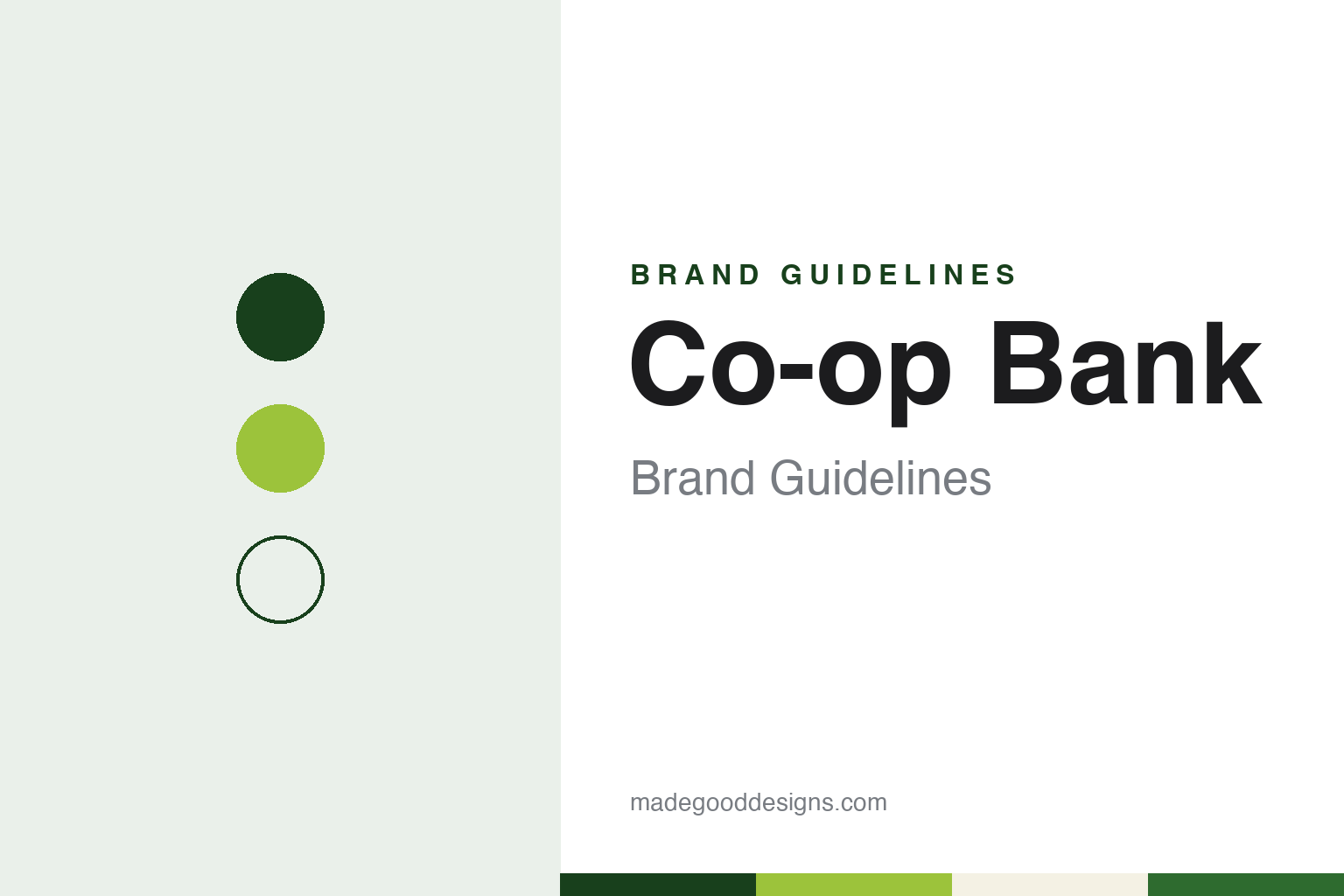
Two constants: a leaf green, lime and cream palette and a friendly rounded sans register. Abstract homage — not a Co-op Bank product or mark; no logo, card or branch sign is reproduced.
A bank for the movement
Farmers’ societies, a new law and a study visit.
The Co-operative Bank of Kenya was created to serve the country’s co-operative societies. The bank says it was first registered under the Co-operative Societies Act when it was founded in 1965 and began operations in 1968; English Wikipedia gives 1966 as the year it was established as a co-operative society, with its banking licence following in 1968. The bank’s history page places its roots in a 1931 ordinance under which Kenya Co-operative Creameries became the first registered co-operative, followed by farmers’ and planters’ unions in the 1930s and 1950s.
The company’s account of the founding years is detailed. It says that in 1966 a new Co-operative Societies Act replaced the colonial-era ordinance, the Kenya National Federation of Co-operatives was formed as an apex body, and officials from the Department of Co-operative Development visited Israel to study how to set up a viable co-operative bank. A joint paper from two ministries then recommended the bank’s establishment.
The Co-operative Bank opened for business on 10 January 1968, the bank says, with a small capital base topped up by an interest-free government loan and a grace period to meet the Banking Act’s minimum capital. Wikipedia adds that the government directed co-operative societies to move their deposits to the new bank and to buy its shares — the origin of the ownership structure that still defines it.
Colour
From a captive bank to a listed lender.
For its first decades the bank served mainly the co-operative sector. It registered a finance company, Co-operative Finance Limited, in December 1977, according to its history page. It then became a full commercial bank open to personal, corporate and institutional customers — in 1994, the bank says, while English Wikipedia gives 1989. In October 1998 it became an agent for MoneyGram’s international money transfers, and in 2003, the bank says, it moved back into Co-operative Bank House in central Nairobi after renovations that followed damage in the 1998 bombing in the city.
The legal form changed in 2008. A special general meeting on 27 June 2008 resolved to incorporate the bank under the Companies Act so that it could list, and its shares began trading on the Nairobi Securities Exchange on 22 December 2008 under the symbol COOP, the bank says. The shares held by 3,805 co-operative societies and unions were ring-fenced in CoopHoldings Co-operative Society Limited, which the bank describes as its strategic investor with a majority stake; the remainder trades on the exchange.
The group has grown through subsidiaries. The bank lists a Co-operative Bank of South Sudan, owned jointly with the Government of South Sudan; a bancassurance broker; the fund manager Co-optrust; the stockbroker Kingdom Securities; and Kingdom Bank, an MSME lender that was formerly Jamii Bora Bank and was acquired in 2020–21. It also holds a stake in CIC Insurance Group. In July 2026 The Standard reported that the bank was restructuring into a non-operating holding company, Co-op Bank Group Plc, with a new subsidiary, Co-op Bank Kenya Ltd, taking over domestic banking; that change needed shareholder and regulatory approval and had not been completed at the time of that report.
Typography
Banks of East and West Africa.
Banks in East and West Africa tend to present themselves through short, bold names. Many trade under abbreviations or compact wordmarks, often set in strong single colours such as orange, green, red or blue, and the same mark has to work on a branch fascia, a cash machine, a mobile banking app and a sponsored event banner. Some groups operate in many countries at once, so one identity has to read clearly in English, in French and in local languages.
Language is part of the voice. Many bank websites in the region are written mainly in English, with French in francophone markets, while taglines, product names and campaign lines can borrow from Swahili, Yoruba, Hausa, Amharic or other local languages; Guaranty Trust, for example, named its online entertainment channel NdaniTV after the Swahili word for “inside,” the company says. Photography on bank websites usually leans on branches, city skylines and customers at work rather than abstract imagery.
Bank websites in the region tend to follow a common structure. Pages on current and savings accounts sit beside pages on loans for small and medium-sized businesses, mobile money, short USSD codes for banking from a basic phone, and agent banking through shops and kiosks. Investor sections carry annual reports and sustainability reports, often designed with as much care as the consumer pages.
Sponsorship and community programmes carry much of the brand work. Banks fund fashion and food festivals, arts programmes, school essay competitions, sports tournaments and foundations, and announce them through the national press. For a designer, the useful lesson is how a short name, one strong colour and a consistent tone hold together across branches, apps, reports and events in many markets.
Aa
A friendly rounded sans for a hyphenated short name. (Specimen set in Figtree, a sans STAND-IN; NOT the Co-op Bank logo.)
Co-op Bank
A financial institution “predominantly owned by the Kenyan Co-operative movement.”
The short name does much of the work. The bank’s legal name is the Co-operative Bank of Kenya, but its website, app and press coverage use Co-op Bank, and its agency network carries the Swahili name Co-op Kwa Jirani, which The Standard described in July 2026 as a network of agency outlets alongside the bank’s branches in Kenya and South Sudan. The same report called the bank the financial arm of Kenya’s co-operative movement.
Ownership is written into the brand statement. The bank’s purpose, as its website puts it, is to be “a financial institution predominantly owned by the Kenyan Co-operative movement, Transforming lives,” and its stated values include being “Bold and Courageous” and having a “Passion for Excellence.” Its stated vision is to be the dominant bank in Kenya and the region “riding on the unique Co-operative Model.” The history page names the “Soaring Eagle” transformation programme of 2014–15 as a turning point.
Recognition is reported in the trade press. At the Euromoney Awards for Excellence 2026, presented in London on 16 July, the bank was named Kenya’s top retail bank and top digital bank, The Standard reported, and it was named SME Bank of the Year in Africa at the 2026 African Banker Awards. The paper said the digital award reflected work on digital onboarding, payments and credit, open-banking links and the Co-op Bank App, together with an e-credit platform that lends to small businesses. In October 2026 the same paper reported industry data from June 2026 showing Co-op Bank as the most-followed Kenyan bank on several social platforms, including TikTok, as banks court younger customers on their phones.
For a design guide, Co-op Bank shows how an ownership model can become the identity, with a short hyphenated name and a local-language agent brand. Compare KCB, the Nairobi group that began as an 1896 branch in Mombasa, and Equity Bank. For this guide we use a leaf green, a lime and a warm cream with a sans, an unofficial interpretation; no product or logo is reproduced.
Explore & save
Keep Co-op Bank’s identity on hand — save it to a board in the Made Good inspiration library.
Co-op Bank identity set
Pin the Co-op Bank leaf green, lime and cream palette and the friendly rounded sans register to your own board.