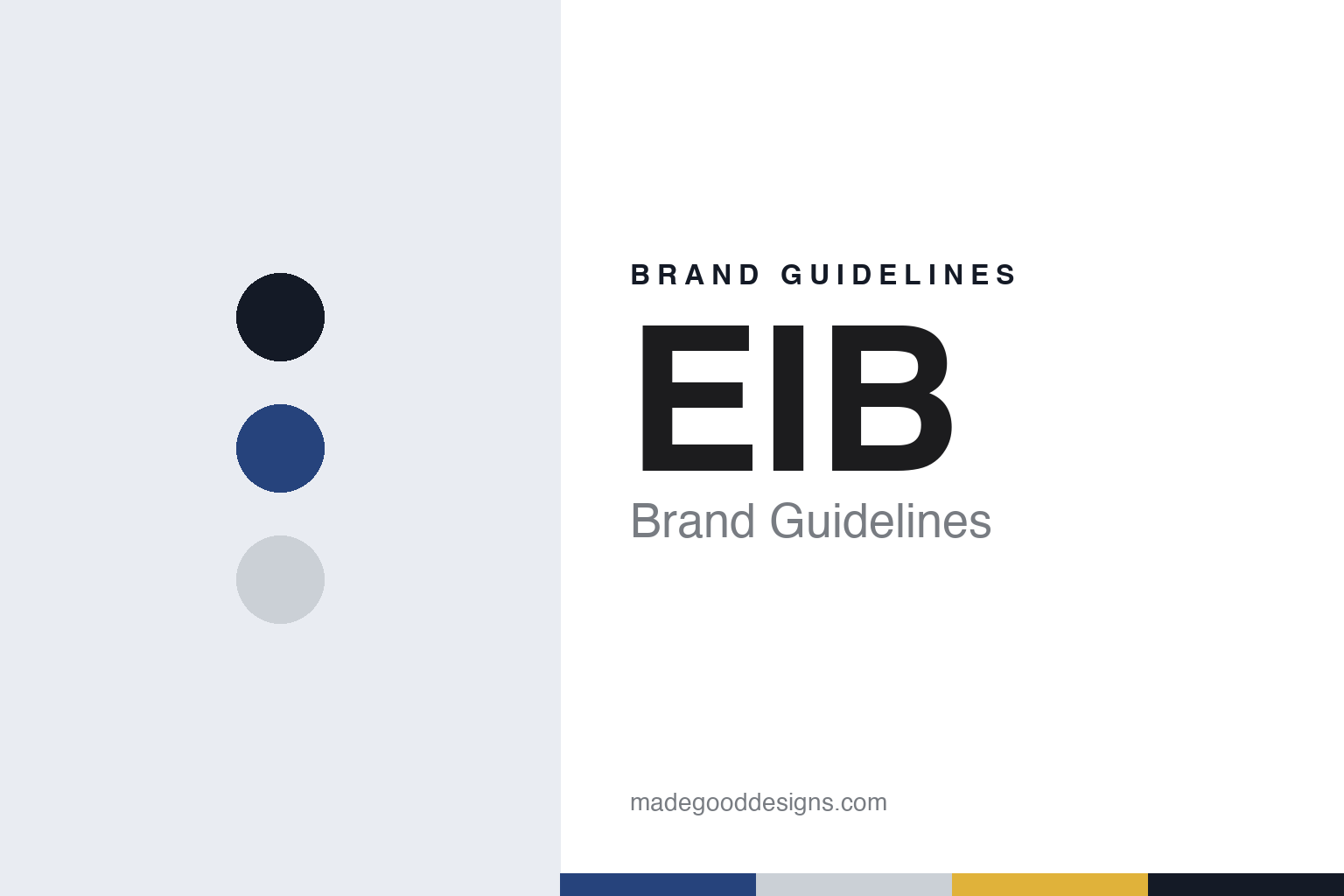
EIB Brand Guidelines
The Treaty of Rome’s 1958 bank, with a logo drawn from its Luxembourg headquarters.
Aa
Two constants: an EIB blue, grey and yellow palette and a Civic serif register. Abstract homage — not an EIB asset or mark; no logo, flag or building drawing is reproduced.
The Treaty of Rome’s bank
Brussels in 1958, Luxembourg from 1968.
The European Investment Bank was created by the Treaty of Rome, the treaty that set up the European Economic Community and came into force on 1 January 1958, English Wikipedia says. The bank’s own timeline dates its establishment to January 1958, when it was first located in Brussels; the members of its first management committee were appointed in February 1958, when Pietro Campilli began his term as president. English Wikipedia describes it as the first of the regional development banks.
Its first loan followed in April 1959, according to the timeline: a transaction carried out jointly with the International Bank for Reconstruction and Development, for three Italian companies — Sincat and Celene, to build a petrochemical complex in Sicily, and Mercure, to work a lignite seam in Lucania for electricity. Its first borrowing operation came in March 1961, and in January 1962 it was authorised to finance projects outside the European Community.
In January 1968 the bank moved to Luxembourg, first to the Place de Metz, and that November it opened an office in Rome. Its owners are the member states of the European Union. Each state’s share in the capital is based on its economic weight in the Union when it joined, the bank says, and it raises its money by issuing bonds on the capital markets rather than from the EU budget, English Wikipedia adds. Membership has followed the Union’s growth, from the six founding states to Greece in 1981, Spain and Portugal in 1986 and ten new members in 2004; the United Kingdom’s membership ended with its departure from the EU in January 2020, the bank’s timeline records.
Colour
A group with three parts.
The bank calls itself the “lending arm of the European Union” and “one of the biggest multilateral financial institutions in the world.” Its offer, as it lists it, is loans, guarantees, equity investments and advisory services, to the public and private sectors; smaller companies are reached through local banks. It names eight core strategic priorities, among them climate action and environmental sustainability, digitalisation and technological innovation, security and defence, and a modern cohesion policy.
The EIB Group was created in June 2000, when the bank became the majority shareholder of the European Investment Fund, set up in June 1994 to provide risk capital; English Wikipedia gives the bank’s share as 62 per cent, with the European Commission holding 29 per cent. The EIF supports micro, small and medium-sized businesses through banks and funds, the bank says. In January 2022 the bank founded EIB Global, a branch for its work outside the EU. The EIB Institute, created in 2012 for social, cultural and academic initiatives, is part of the bank without a separate legal personality, English Wikipedia says. Today the bank says it has more than 4,000 staff and works in over 160 countries.
Some of its milestones concern the capital markets. Its timeline records its first borrowing in euros in February 1997, more than a year before the currency’s launch, and, in July 2007, its first Climate Awareness Bonds, which the bank describes as the first green bonds anywhere. In November 2019 the group adopted its Climate Bank Roadmap and revised its energy lending policy, a step the bank says made it the first international finance institution to end financing for fossil-fuel projects.
Its president since January 2024 has been Nadia Calviño. In September 2026 she told CBC News that the bank had not been very active in Canada until then, and that it was exploring a framework agreement that would let it invest in critical minerals there.
Typography
Design and documentation.
Development banks are owned by their member countries and economies rather than by private shareholders, and their websites put that ownership up front. The Asian Development Bank lists its 69 members with the year each one joined; the Asian Infrastructure Investment Bank publishes a register of regional, non-regional and prospective members with their subscriptions and voting power. For these institutions the shareholder list is part of the brand, set out as openly as a logo.
Names travel in several languages. ADB’s website runs in English, Japanese and Chinese, with some country pages in other languages, and most of these lenders are known by short sets of initials that have to read the same on a loan document in one country and a project sign in another. The palettes in this group of guides lean on deep blues, greens and teals, chosen here as our own unofficial interpretations rather than official colours.
Their websites are organised around what they finance and where. ADB’s menus divide its work by region and subregional programme and separate public- from private-sector financing, which can take the form of loans, guarantees or equity; the AIIB sorts its project list by status, from proposed to approved, on hold or cancelled, and by sovereign-backed and nonsovereign-backed financing. These project databases are where a reader can follow a single road, power line or water scheme from proposal onward.
Accountability is presented as part of the same identity. ADB lists an Accountability Mechanism and Independent Evaluation among its pages; the AIIB has its Project-affected People’s Mechanism, approved in 2018. Alongside annual reports and financial statements, these evaluation pages and complaint routes are where the banks set out, in their own words, how their projects are reviewed.
Aa
A civic serif — the bank of the EU family. (Specimen set in Source Serif 4, a serif STAND-IN; NOT the EIB logo.)
EIB
A building turned into a logo.
The EIB’s identity is tied to its buildings in Luxembourg. In August 1980 the bank moved to its Kirchberg headquarters, now called the West building, whose first phase was designed by the British architect Sir Denys Lasdun — one of his few works outside the UK, the bank says; English Wikipedia describes it as brutalist. In June 2008 it inaugurated the East building, a glass structure designed by Ingenhoven Overdiek Architekten, which the bank contrasts with the “low, cruciform” West building.
That second building is now the logo. The bank’s story on the change, published on 2 February 2023, says the new mark was designed by Sabine Tissot, head of the EIB’s graphic design team, who spent more than a year on dozens of proposals. It combines three elements, the bank says: a stylised drawing of the headquarters, the EU flag and the institution’s name. Its straight horizontal lines trace the wave-shaped East building and stand for the horizon and the land, “or stability, balance and trust,” while a rising grey line stands for progress. The design aligns the bank with EU institutions such as the European Commission, Council and Parliament, which also use logos drawn from their buildings together with the flag.
The earlier marks followed a different idea. Five logos used from 1963 to 1998 were similar, the bank says, inspired by the United Nations’ circular emblem with a map at the centre; the logo used from 1999 to January 2023, adopted in February 1999 according to its timeline, was abstract, based on a Chinese character meaning “river.” The bank now issues vertical and horizontal versions of its logo, and separate logos for the EIB Group, EIB Global, EIB Advisory and the EIB Institute; the EIF’s own logo, adopted in 1994, shows a bridge for the link between public and private finance.
For a design guide, the EIB shows how an institution can take its mark from its own architecture and from its place in a wider family of logos. Compare EBRD, which the EIB helped found in 1990, and World Bank, whose International Bank for Reconstruction and Development took part in the EIB’s first loan. For this guide we use a deep blue, a glass grey and a warm yellow with a serif, an unofficial interpretation; no product or logo is reproduced.
Explore & save
Keep EIB’s identity on hand — save it to a board in the Made Good inspiration library.
EIB identity set
Pin the EIB blue, grey and yellow palette and the Civic serif register to your own board.