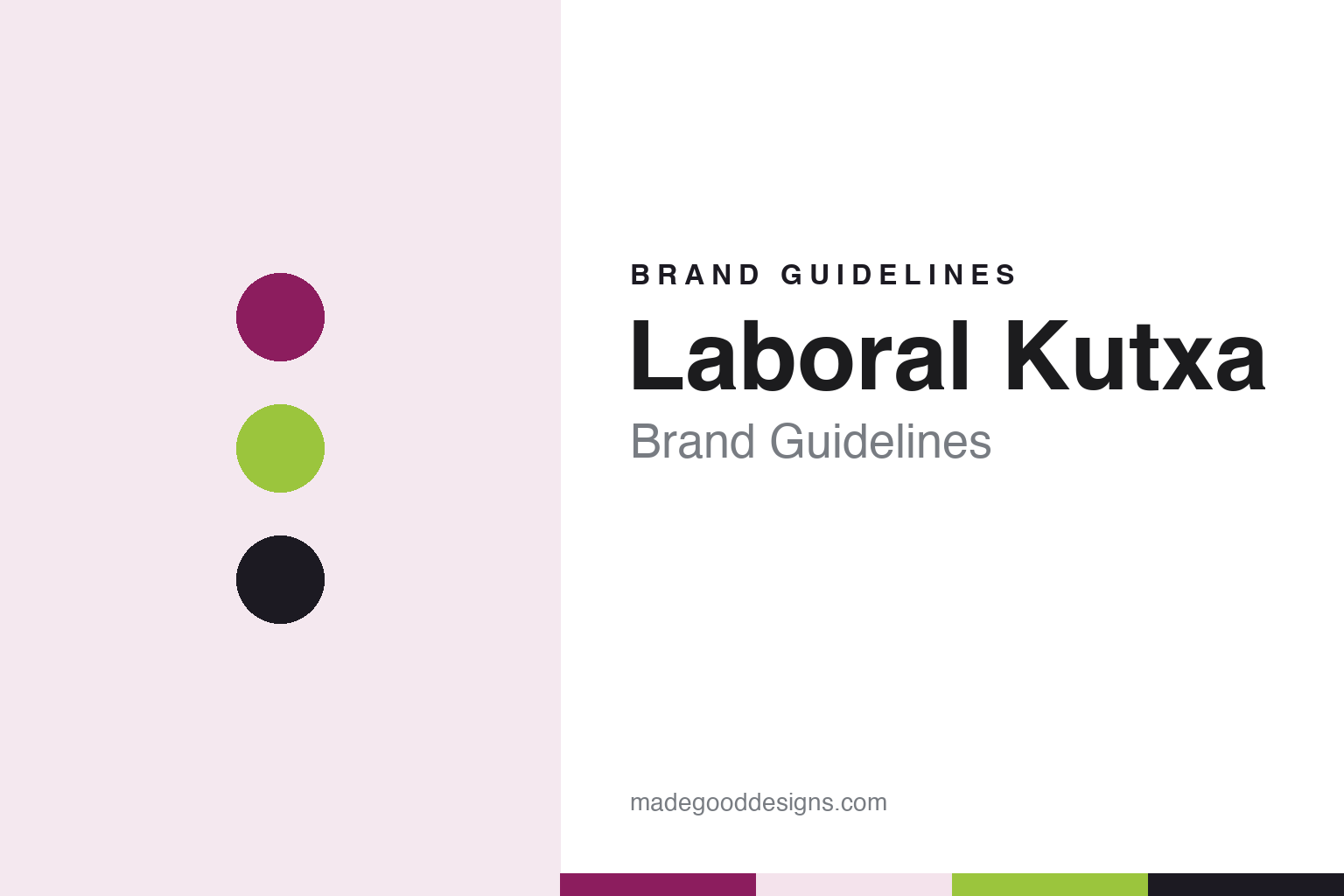
Laboral Kutxa Brand Guidelines
Mondragón’s 1959 credit cooperative, a key and two colours.
Aa
Two constants: a Laboral Kutxa magenta and lime palette and a Friendly sans register. Abstract homage — not a Laboral Kutxa product or mark; no logo, key symbol or card is reproduced.
Caja Laboral
A savings bank for Mondragón’s cooperatives.
Laboral Kutxa is a Basque credit cooperative with its home in Mondragón, called Arrasate in Basque, in the Gipuzkoa valley of the Deba. Its story begins with Caja Laboral Popular, founded in 1959 at the prompting of José María Arizmendiarrieta, a Catholic priest who had come to Mondragón in the early 1940s and set up a technical school for the young people of the district. Spanish Wikipedia says five former pupils of that school went on to found ULGOR, a stove maker that became Fagor Electrodomésticos and the first production unit of what is now the Mondragon Corporation.
Caja Laboral was meant to gather local savings and channel them into the new cooperatives. Its founding members, Spanish Wikipedia says, were Talleres Ulgor, Funcor (now part of Fagor Ederlan), Arrasate (now Fagor Arrasate) and the San José consumer cooperative, later part of Eroski, together with the bank’s own worker members. Its early slogan, “libreta o maleta” — the savings book or the suitcase — tied local saving to local jobs as the alternative to leaving the region in search of work.
For five decades its Companies Division acted as an incubator for new cooperatives, English and Spanish Wikipedia say. In the 1970s, during the restructuring of Basque industry and the energy crises of 1973 and 1979, it lent on favourable terms to cooperatives in difficulty, and in the same period it opened offices outside the Basque Country. In the 1990s reorganisation of the Mondragon group it was placed in the Financial group alongside Lagun Aro.
The structure was unusual for a bank. Caja Laboral was both a credit cooperative and a worker cooperative: its staff were members with a vote in the General Assembly, while the associated cooperatives held most of the capital and most seats on the governing council, Spanish Wikipedia explains. It also says Caja Laboral was the first financial institution in Spain to open its branches in the afternoon, and that in 2006 it signed the United Nations Global Compact.
Colour
Ipar Kutxa and the 2012 merger.
The second half of today’s bank comes from Biscay. In the autumn of 1965 two farm cooperatives — the dairy cooperative Beyena, in whose building the first office opened, and Uteco, a union of farm cooperatives — founded the Caja Rural Provincial de Vizcaya in Bilbao, Spanish Wikipedia says. In 1986, after a Bank of Spain intervention linked to financial problems at Beyena, it became Caja Rural Vasca and began to grow outside the province. It opened its first offices in Gipuzkoa in 2003 and took the trading name Ipar Kutxa, which English Wikipedia glosses as “union of the North,” while keeping “Rural” in its legal name.
In March 2012 Caja Laboral and Ipar Kutxa announced formal talks to merge. Their stated aim, quoted by Spanish Wikipedia, was to strengthen a social-economy financial institution built on a model different from the conversion of Spain’s savings banks into commercial banks. The process was gradual: between March and November the fees between the two were dropped, the IT teams were integrated and early retirement was offered to worker members. The combined entity began operating on 1 November 2012 under the Caja Laboral name, and the new brand, Laboral Kutxa, was presented in 2013. The legal name remains Caja Laboral Popular Sociedad Cooperativa de Crédito.
The cooperative model carried over. Worker members have a vote in the General Assembly, and in February 2013 the bank began inviting closely linked customers to join its capital as small cooperative members, Spanish Wikipedia says. As a Spanish credit cooperative it must give preference to the financial needs of its members, and its operations with third parties cannot reach half of its total resources.
Laboral Kutxa remains part of the Mondragon world. In February 2025 Europa Press, in a report carried by Bolsamania, said the bank had created the artificial-intelligence start-up Innkia in Arrasate with the technology centre Ikerlan, with the support of Mondragon and the Basque Government; Laboral Kutxa was to back the project financially and offer it use cases in its own processes. In April 2026 Diario Vasco reported from the cooperative’s annual General Assembly, held at the Kursaal in San Sebastián, that the Arrasate-based bank was working with Mondragon Unibertsitatea and Ikerlan on artificial intelligence and quantum computing, including a project at its insurer, Seguros Lagun Aro.
Typography
Cooperative and ethical banks.
Cooperative and ethical banks sit in a corner of finance where the ownership model is part of the message. A cooperative bank is owned by its members, who usually buy shares and vote at a general meeting; an ethical bank sets out which sectors it will and will not lend to. Many institutions do both, and their identities tend to say so plainly, with wordmarks in strong single colours — orange, green and red among them — and names that point to a place, a farming root or a founding idea.
Their websites follow a recognisable pattern. Beside pages on current accounts, savings, mortgages and business lending, they usually carry a section on membership: how to join, how many shares a member needs, and how voting works. GLS Bank in Bochum, for example, gives each member one vote at its annual general assembly regardless of how many shares they hold, according to German Wikipedia.
Imagery tends towards the local and the collective: branch fronts, regional offices, member meetings and the projects a bank has financed, from housing to renewable energy and schools. Statements of values and sustainability policies are given prominent space, and they are presented as the bank’s own commitments rather than as independent findings. GLS Bank goes further than most by publishing its business loans in its customer magazine, Der Bankspiegel, German Wikipedia says.
The paper trail matters as much as the logo. These banks publish annual reports, and many add impact or sustainability reports that set out where deposits went. This guide uses those documents, encyclopaedias and dated press reports to record when each bank was founded, how its local banks and central institutions merged, and how it describes its own structure, keeping the bank’s claims attributed to the bank.
Aa
A friendly, rounded sans for a bank that says “there is another way.” (Specimen set in Outfit, a sans STAND-IN; NOT the Laboral Kutxa logo.)
Laboral Kutxa
A key, a fuchsia and a lime green.
The identity is a merger of two. Caja Laboral had used different versions of a key as its logo for decades, while Ipar Kutxa relied on its initials or its full name, Spanish Wikipedia says. During the transition the joint mark Caja Laboral – Ipar Kutxa mixed the two banks’ corporate colours, which Spanish Wikipedia describes as fuchsia and lime green; the merged logo keeps both colours and Caja Laboral’s key. English Wikipedia calls the pair deep red and lime green, and says they run through the logo, the branches and the advertising.
On its own website the bank writes its name as LABORAL Kutxa, with the first word in capitals, and its line is “Hay otra forma” — “there is another way.” The site groups customers by stage of life: SUPER BAT for children under 16, GO! for young people aged 14 to 29 and SUPER LK for customers over 60, alongside insurance, mortgages, savings and investment, and online banking. Its corporate site says it belongs to the Global Alliance for Banking on Values and has signed the United Nations Principles for Responsible Banking, and that its headquarters buildings hold an ISO 14001 environmental management certificate issued by AENOR. The bank also owns the non-profit Gaztenpresa foundation, which says it has supported people starting businesses for 30 years.
The name has also been visible in sport: Laboral Kutxa was the main sponsor of the Vitoria basketball club Saski Baskonia for seven seasons, from 2009–10 to 2015–16, Spanish Wikipedia says.
For a design guide, Laboral Kutxa shows how a merger can keep one bank’s symbol and both banks’ colours. Compare Cajamar, another Spanish credit cooperative, and Desjardins, the Quebec cooperative group. For this guide we use a deep magenta, a lime green and ink with a sans, an unofficial interpretation; no product or logo is reproduced.
Explore & save
Keep Laboral Kutxa’s identity on hand — save it to a board in the Made Good inspiration library.
Laboral Kutxa identity set
Save the Laboral Kutxa magenta and lime palette and the Friendly sans register to your own board.