SEACOR Marine Brand Guidelines
Supply boats, fast crew boats and liftboats from a Houston fleet.
Aa
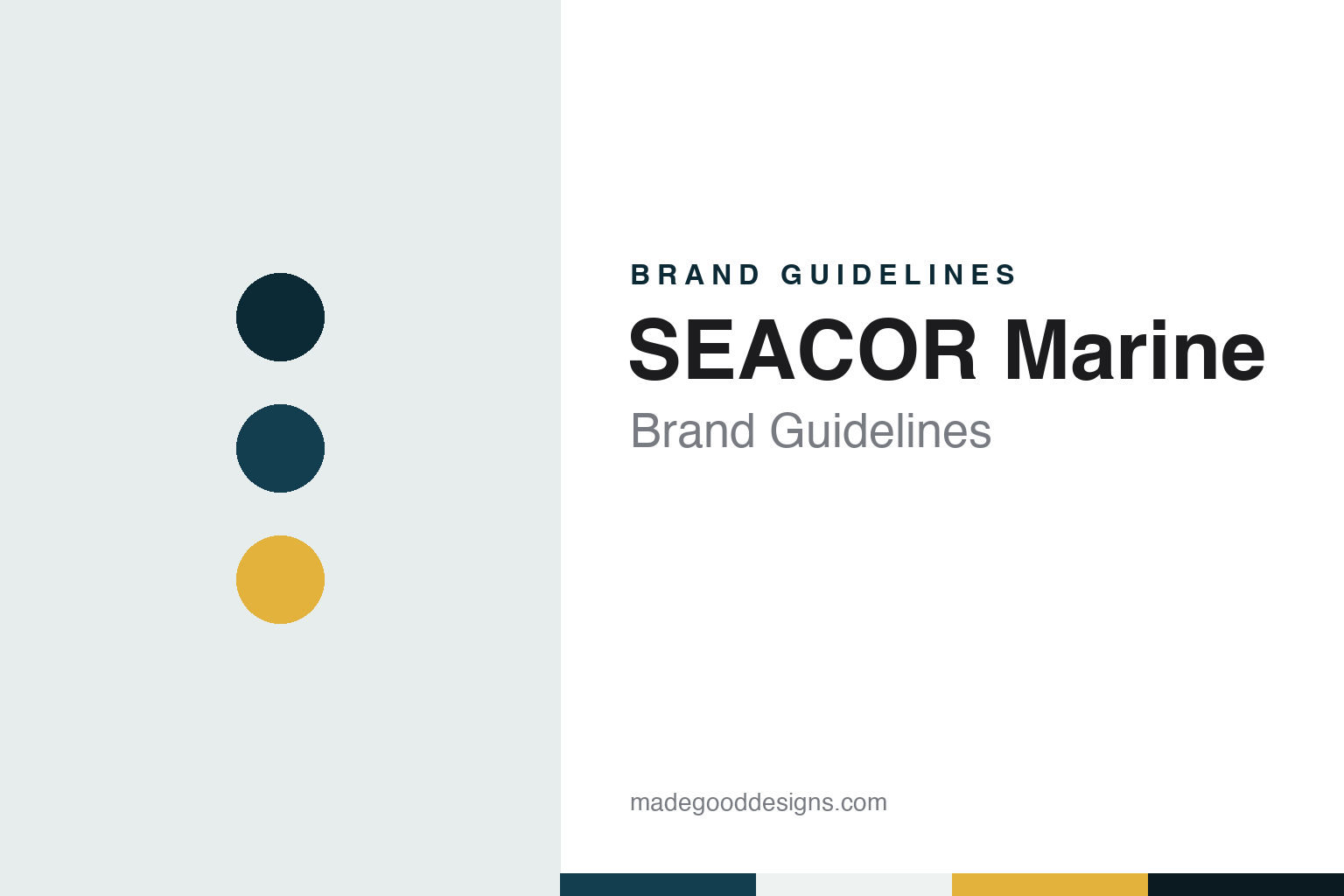
Two constants: a teal, white and yellow palette and a fleet sans register. Abstract homage — not a SEACOR Marine vessel, livery or mark; no logo or nameplate is reproduced.
From SEACOR
An offshore arm that became its own company.
SEACOR Marine’s roots lie in SEACOR Holdings, the American maritime group that English Wikipedia says was founded on 7 November 1989 by Charles Fabrikant. In December that year Fabrikant and a group of investors bought NICOR Marine, the marine unit of the gas utility Nicor, and renamed it SEACOR. The group listed on the New York Stock Exchange in 1992 and spread into helicopters, inland barges, ocean shipping and other lines over the following decades, with an Offshore Marine Services division supplying offshore support vessels, including anchor handling tugs, to the oil industry worldwide.
That offshore division is the business that now trades as SEACOR Marine. The company’s own management biographies say its president and chief executive, John Gellert, has led SEACOR Marine as president, chief executive and director since 1 June 2017, after running SEACOR Holdings’ Offshore Marine Services segment from July 2005; he joined SEACOR in 1992. Its finance chief, Jesús Llorca, became executive vice president of corporate development on the same date. English Wikipedia’s SEACOR Holdings article lists offshore support vessel operations among the sectors the parent has since left; the parent itself was acquired by the private equity firm American Industrial Partners in April 2021.
Today the company is SEACOR Marine Holdings Inc., listed on the New York Stock Exchange under the symbol SMHI, according to its press releases. Its website gives its corporate headquarters as Houston, Texas, and The Maritime Executive described it as “Houston-based” in June 2026. The company says its operations are concentrated in the United States Gulf, Africa and Europe, the Middle East and Asia, and Latin America, mainly Mexico and Guyana.
Colour
Supply vessels, fast crew boats and liftboats.
SEACOR Marine describes its work as carrying cargo and people to offshore installations, including offshore wind farms; supporting production and storage facilities; providing construction, well work-over, wind farm installation and decommissioning support; and carrying equipment used underwater on rigs and platforms. Its vessels also provide emergency response services and accommodation for technicians, the company says.
Its fleet pages divide that work into a handful of classes. Platform supply vessels run from 190 to more than 250 feet and carry material and equipment for deepwater drilling and production; some are hybrids with battery systems alongside diesel-electric propulsion, and the company says new integrated hybrid PSVs built to the OSV Chemical Code are scheduled for delivery in late 2026 and early 2027. Fast support vessels of 145 to 200 feet carry up to 150 passengers, with reclining seats and satellite television, and carry cargo of up to 425 long tons, the company says. Its CREWZER catamaran class, which the company says launched in 2007, is built for speeds of more than 40 knots.
The third class is the liftboat: a self-propelled vessel that lowers legs to the seabed and raises itself into a working platform. SEACOR Marine says its liftboats range from 235 to 300 feet in leg length and work in water depths of up to 230 feet, on tasks from wind farm installation and platform maintenance to well plug-and-abandonment and diving support. The fleet list also names crew transfer vessels, anchor handling towing supply vessels, emergency response and rescue vessels and specialty vessels.
The company presents itself as an early adopter. It says it pioneered the use of catamarans in the oilfield and was the first to use “ride control” technology on its crew boats, claims it makes on its own About page. Vessel names on its website follow clear families: fast support vessels named for members of the McCall family, such as Alya McCall and Molly R. McCall; a group named for big cats, from SEACOR Cheetah to SEACOR Puma; and liftboats such as Falcon Diamond, Falcon Pearl and SEACOR Hawk.
Typography
How offshore support vessel operators present themselves.
Offshore support vessel operators sell a service rather than a product, so their public face is the fleet itself. Their websites lead with photographs of platform supply vessels, anchor-handling tugs, fast crew boats and liftboats as the companies publish them, usually at sea or alongside a quay, with the working deck and the bridge in view.
Behind those photographs sits the fleet list. Operators sort their vessels by type, from supply vessels and anchor handlers to crew boats, liftboats and specialist ships, and give each class a short description, a named example and a length or deck size. Vessel names often run in families, such as a shared prefix, a family surname or a set of animal or place names, and those naming habits become part of how an operator is recognised in port and on charter lists.
Colour plays a similar role. Hull paint, superstructure colour and the mark on the funnel or the side of the bridge are what people see first from a distance, and many operators repeat the same few colours across a whole fleet. In this guide those colours are described in plain words rather than copied, and the palettes shown are our own interpretation.
The rest of an operator’s identity lives in plainer pages: contract and charter news, regional contact lists, sustainability reports and, for listed companies, investor pages with results and presentations. Ownership in the sector has changed often through mergers, restructurings and sales, so each guide sets out who owns the company today, what it says about its fleet, and which facts come from the company and which from independent reports.
Aa
A clean fleet sans for a listed vessel operator. (Specimen set in Barlow, a sans STAND-IN; NOT the SEACOR Marine logo.)
SEACOR Marine
A smaller fleet and a strategic review.
The fleet has shrunk as the company has sold vessels. The Maritime Executive reported in June 2026 that SEACOR Marine had a reported 44 vessels at the end of 2025, down from 54 in 2024 and 81 in 2021, and that it had also been reducing its onshore operations. The same report said two new platform supply vessels were due, one in the fourth quarter of 2026 and the other in the first quarter of 2027.
Shareholders then pressed for change. In June 2026 the company’s largest shareholder, holding more than seven percent of the stock, called on the board to start a strategic review that could lead to a sale of the company or its fleet, The Maritime Executive reported, and a second shareholder made a similar call days later. On 30 July 2026 the same publication reported that SEACOR Marine had retained advisers and launched a “strategic alternatives review,” with options ranging from a sale of vessels or other assets to a merger or a sale of the whole company. The company said there was no assurance that the review would lead to any transaction. That quarter it also completed the sale of five vessels and other equipment, the report said. The review was announced in July 2026, and no transaction from it had been completed at the time of writing; SEACOR Marine continues to trade as a listed company.
For a design guide, SEACOR Marine shows how a listed fleet operator speaks to two audiences at once: its website pairs vessel classes, lengths and passenger counts for charterers with investor pages, sustainability reports and regional contacts. Compare Tidewater, another listed offshore support vessel operator, and Edison Chouest, a family-held Louisiana fleet. For this guide we use an offshore teal, sea-spray white and a deck yellow with a sans, an unofficial interpretation; no product or logo is reproduced.
Explore & save
Keep SEACOR Marine’s identity on hand — save it to a board in the Made Good inspiration library.
SEACOR Marine identity set
Pin the SEACOR Marine teal, white and yellow palette and the fleet sans register to your own board.