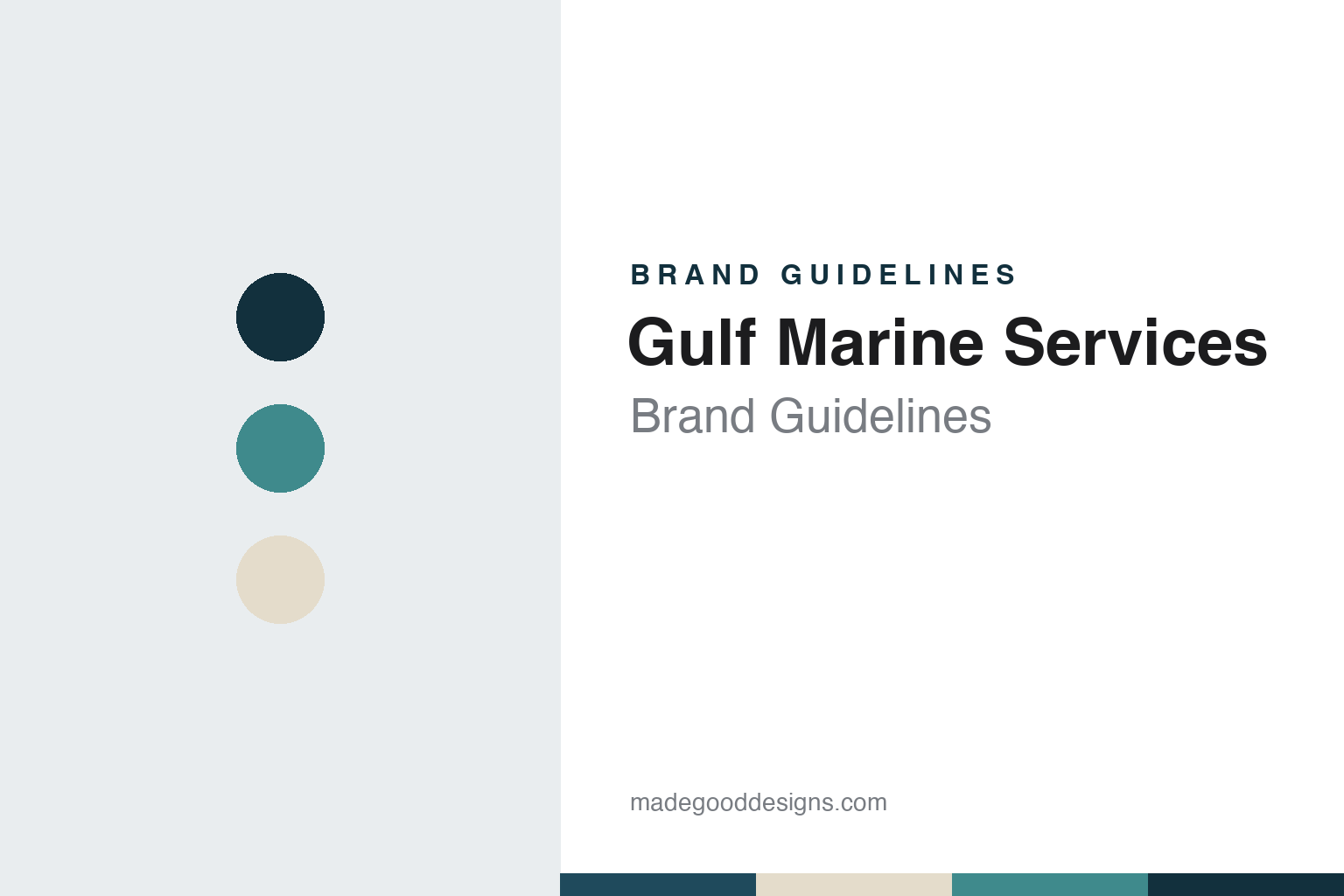
Gulf Marine Services Brand Guidelines
An Abu Dhabi fleet of vessels that stand on their own legs.
Aa
Two constants: a deep teal, sand and shallow-water palette and an industrial sans register. Abstract homage — not a Gulf Marine Services vessel or mark; no logo, livery or funnel mark is reproduced.
Abu Dhabi, 1977
A Gulf barge operator that became a London-listed company.
Gulf Marine Services, usually shortened to GMS, is an Abu Dhabi company that owns and runs self-propelled, self-elevating support vessels, the craft the industry also calls liftboats or jack-up barges. A Reuters report of May 2014, carried by gCaptain, says the business was set up in 1977 and served the oil, gas and renewable energy industries from offices in the United Arab Emirates, Saudi Arabia, Singapore and the United Kingdom.
The idea behind the vessels is simple to describe. Each one sails to an offshore platform or wind turbine under its own power, lowers its legs to the seabed and lifts its hull clear of the water, giving crews a stable deck, cranes and living quarters beside the structure they are working on. In 2017 MarineLink listed the jobs GMS vessels take on: platform refurbishment and maintenance, wind turbine maintenance, and platform installation and decommissioning.
By 2009 MarineLink was describing GMS as the Middle East region’s largest operator of elevating support vessels, and the company was building its own designs. In July 2009 it formed a joint venture with Saudi Arabia’s Shoaibi Group, named Gulf Maritime Services Saudi Arabia and based in Al Khobar, to offer barge charters for well work, lifting, construction and temporary offshore accommodation. In October 2009 MarineLink described the GMS Endurance, a four-legged vessel developed with the Dutch designer MSC Gusto and under construction in Abu Dhabi, with a sister, the GMS Endeavour, whose hull was being towed to the company’s yard at Mussafah. The report gave the Endurance an operating water depth of up to 65 metres, about 1,000 square metres of deck, a heavy-lift crane of up to 350 tonnes and accommodation for 150 people, with plans aimed at deeper water and at the renewables sector. At that time the company said it had five working jack-up barges.
The group’s parent today is Gulf Marine Services PLC, a company that the UK’s Companies House shows was incorporated in England and Wales on 24 January 2014, weeks before the flotation.
Colour
Liftboats for platforms and wind farms.
The flotation came in March 2014. gCaptain reported on 14 March that GMS had launched its initial public offering on the London Stock Exchange that morning, when it owned nine self-propelled elevating support vessels. Reuters added in May 2014 that the pre-listing shareholders Gulf Capital, Horizon Energy and Al Ain Capital had also sold shares in the offering, and that the company planned new vessels and work in south-east Asia and west Africa.
The fleet is sorted into size classes. In 2014 gCaptain described new Gusto-designed S-Class vessels with dynamic positioning, a main crane and accommodation for up to 300 people, smaller than the company’s E-Class, the class of the GMS Endurance. The S-Class was rated for water up to 55 metres deep, with about 800 square metres of deck, and was to be offered both for well services and for offshore wind farm maintenance. Later reports refer to large-class and mid-class vessels; by November 2017 MarineLink counted a fleet of fourteen.
Offshore wind brought GMS to Europe. The English Wikipedia article on the Sheringham Shoal wind farm, off the Norfolk coast, says turbine installation there was contracted to Gulf Marine Services in December 2010 and carried out by the jack-ups Sea Jack and GMS Endeavour. In December 2025 the company announced a contract covering two of its large-class vessels in Europe for a combined 1,624 days, MarineLink reported.
Reuters wrote in 2014 that the firm was among the main offshore service providers in the Middle East and North Africa, as well as in the southern North Sea, and that it saw strong demand for its vessels in brownfield oil and gas recovery, well services and maintenance.
Typography
Design and documentation.
Offshore support vessel operators sell a service rather than a product, so their public face is the fleet itself. Their websites lead with photographs of platform supply vessels, anchor-handling tugs, fast crew boats and liftboats as the companies publish them, usually at sea or alongside a quay, with the working deck and the bridge in view.
Behind those photographs sits the fleet list. Operators sort their vessels by type, from supply vessels and anchor handlers to crew boats, liftboats and specialist ships, and give each class a short description, a named example and a length or deck size. Vessel names often run in families, such as a shared prefix, a family surname or a set of animal or place names, and those naming habits become part of how an operator is recognised in port and on charter lists.
Colour plays a similar role. Hull paint, superstructure colour and the mark on the funnel or the side of the bridge are what people see first from a distance, and many operators repeat the same few colours across a whole fleet. In this guide those colours are described in plain words rather than copied, and the palettes shown are our own interpretation.
The rest of an operator’s identity lives in plainer pages: contract and charter news, regional contact lists, sustainability reports and, for listed companies, investor pages with results and presentations. Ownership in the sector has changed often through mergers, restructurings and sales, so each guide sets out who owns the company today, what it says about its fleet, and which facts come from the company and which from independent reports.
Aa
An industrial sans — sturdy letters for a fleet of working vessels. (Specimen set in Archivo, a sans STAND-IN; NOT the Gulf Marine Services logo.)
GMS
Restructured debt, then a first new vessel in a decade.
The years after the listing were harder. In March 2020 GMS said it had agreed terms with its syndicate of banks to restructure its debt and extend its loans, Reuters reported through MarineLink; the company also sought shareholder approval to raise new equity, after a long downturn in the oil services market. Its results for 2019 were delayed at the request of the UK’s Financial Conduct Authority while that process was completed, the same report said.
By the mid-2020s the company was winning work again. In January 2026 it agreed to acquire a new mid-class self-propelled, self-elevating support vessel, its first vessel acquisition in a decade, MarineLink reported; at the time the company had a fleet of 14, and the announcement was made at the agreement stage. The company’s executive chairman said further acquisitions would be pursued, subject to market conditions.
In trade coverage the company is pictured through its vessels: trade reports illustrate GMS news with photographs and illustrations credited to the company, showing a hull raised on tall legs beside an offshore structure, with cranes and an accommodation block on deck. The vessel names follow one pattern, the GMS prefix and a single word, as with the GMS Endurance and the GMS Endeavour.
For a design guide, Gulf Marine Services shows how a narrow fleet of one vessel type can carry a company’s whole identity, with each class named and pictured in the same plain way. Compare Topaz Energy and Marine, another Gulf-based offshore vessel operator, and Tidewater, a supply-vessel fleet that grew from a Louisiana start. For this guide we use a deep teal, a desert sand and a shallow-water green with a sans, an unofficial interpretation; no product or logo is reproduced.
Explore & save
Keep Gulf Marine Services’s identity on hand — save it to a board in the Made Good inspiration library.
Gulf Marine Services identity set
Pin the Gulf Marine Services deep teal, sand and shallow-water palette and the industrial sans register to your own board.