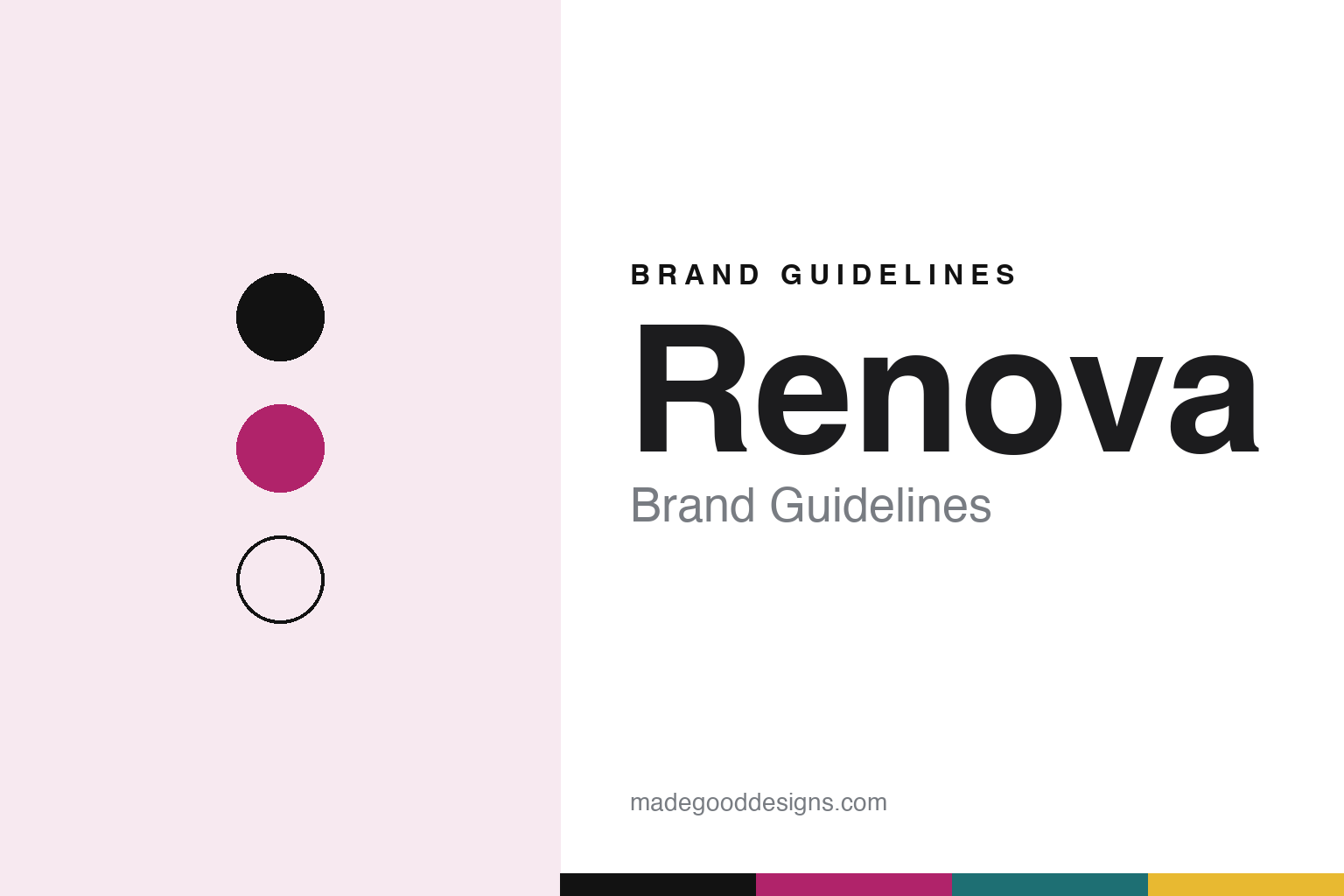
Renova Brand Guidelines
A paper mill by a river spring that made toilet paper black.
Aa
Two constants: a jet black with fuchsia, teal and yellow palette and a high-contrast serif register. Abstract homage — not a Renova product or mark; no pack, roll or logo is reproduced.
The mill at the Almonda spring
A watermark from 1818, a company from 1939.
Renova is a Portuguese maker of tissue products based at Zibreira, in the municipality of Torres Novas, beside the spring of the River Almonda. The company behind it, Renova – Fábrica de Papel do Almonda, S.A., was founded in 1939, a year given by Público in April 2015 and by Le Journal des Entreprises in November 2024. The name is older than the company. Renova says paper bearing a Renova watermark is recorded from 1818 at the site where it still has its headquarters, and Portuguese Wikipedia says a simple paper mill was founded there that year by Domingos Ardisson, making sheets by hand.
Portuguese Wikipedia fills in the nineteenth and early twentieth centuries from a December 1912 report by Joseph Leipold, technical director of the Bank of Portugal’s printing works, who toured the country’s paper mills to judge whether Portugal could make its own banknote paper. He recorded the Torres Novas mill as the Real Fábrica de Papel do Rio Almonda, then owned by the firm Carvalho e Commanditários, driven by the river’s water and lacking a direct road. His general conclusion was that the mills he visited were not yet ready for that work, though he thought suitable plant could make such paper in Portugal.
Until the end of the 1930s, the same article says, paper at the Almonda mill was still made by hand from rags and waste paper and dried in the air. In 1939 the limited company Fábrica de Papel do Almonda, Lda was formed, with a hydroelectric turbine at the spring supplying power. Portuguese Wikipedia says new shareholders joined in 1943 and began a modernisation that led to the mill’s first industrial paper machine, inaugurated in 1951.
Tissue came next. Renova says its first years were devoted to writing, printing and packaging paper, and that it began making tissue for household and sanitary use in the late 1950s; Portuguese Wikipedia dates the first toilet roll made in Portugal to 1959. In 1972, citing a 2005 profile in the Semanário Económico, it says the company chose to put new capacity into tissue rather than writing and printing paper. Construction of a second factory at Zibreira began in 1981.
Colour
Black rolls and a slogan about paper.
Renova’s international reputation rests on colour. Portuguese Wikipedia, citing the 2005 Semanário Económico profile, dates the launch of Renova Black toilet paper to 2005 and says it was first sold online before reaching ordinary shops. Renova presents it as the first black toilet paper and as a product that broke the idea of the “unthinkable.” Público wrote in April 2015 that the company had become known around the world when it made black toilet paper, and the trade site Paper Industry World described Renova that June as noted for its “gaudy and unusually coloured toilet rolls.” Its online shop still sells black toilet paper, kitchen rolls, napkins and pocket tissues alongside white and coloured ranges.
The tone of voice is part of the product. Renova’s website calls it “The Sexiest Paper On Earth” and promises “Colour, Light and Movement,” and Portuguese Wikipedia names three principles behind its marketing: sophistication, sustainability and playfulness. Paper Industry World reported in 2015 that Renova kept its premium lines for selective outlets such as concept stores and museums, and that in 2013 it had begun more accessible products for mass retail; Portuguese Wikipedia names Renova Olé as one such line. Renova also lets customers design their own printed napkins, and it runs an arts programme it calls Renova Art Commissions.
The brand has taken its colours into public washrooms. ECO reported in May 2024 that “The Sexiest WC on Earth by Renova” had reopened at Terreiro do Paço in Lisbon, combining a washroom, temporary art installations and a shop for the brand’s products, and that the concept had earlier appeared at the Louvre in Paris and in museums and shops in Portugal, Spain and Belgium. Portuguese Wikipedia says an INSEAD teaching case, “Renova Toilet Paper: Avant-garde Marketing in a Commoditized Category,” was the overall winner of the 2012 ECCH Case Awards.
Materials have become a second theme. Renova says it launched, at the start of the 2000s, the first range of paper products certified with the EU Ecolabel, and that its Renovagreen products are made from 100% recycled paper; more recently it has moved packs from plastic to paper. In July 2025 Tissue Online reported the launch of TextilPapier, a toilet paper and paper-towel line made from recycled textile waste such as T-shirts and jeans combined with natural fibres, and Renova’s entry into Norway with it.
Typography
Design and documentation.
Tissue and hygiene-paper makers mostly sell under names that are not their own. The corporate group is often a holding name, and shoppers meet it through a portfolio of consumer brands: Essity’s brands page lists TENA, Tork, Libero, Lotus and Zewa, each with a short category label and a link to its own website, while Sofidel puts Regina first and runs separate Regina sites for seven European countries alongside national names such as Sopalin, Le Trèfle and Hakle.
Consumer pack design follows those brand families rather than the parent. Brand names travel across toilet paper, kitchen towels and handkerchiefs, and some identify themselves by a physical detail: Sofidel says its KittenSoft tissue is recognisable by a heart-shaped embossing. Many brands came to their current owners through acquisitions, so a group’s portfolio often mixes a home-grown house brand with bought national names that keep their local identities.
The away-from-home side looks different again. Here the product is often a system for washrooms and other busy places, pairing paper with dispensers. Essity describes Tork as tissue and dispenser systems for professional and high-traffic environments and says more than 30 million Tork dispensers are refilled regularly; Sofidel lists away-from-home products as one of four business lines, next to its consumer brands, private label goods for retailers and parent reels, the large semi-finished reels sold to other converters.
The corporate websites then speak to a different audience: investors, job seekers, suppliers and journalists. Their pages typically set out the brands, the mills and the owners. Sofidel tells its story decade by decade from its first facility in 1966, and Essity explains its business areas and its 2017 origin as a spin-off from SCA. Sustainability sections on forests, water and plastics sit alongside those histories, written in each company’s own words.
Aa
A high-contrast serif for a brand built on colour and wit. (Specimen set in Playfair Display, a serif STAND-IN; NOT the Renova logo.)
Renova
Two factories at home, one in the Allier.
Renova still makes its paper at Zibreira, where Portuguese Wikipedia describes two industrial complexes: the founding factory and the second factory begun in 1981, which houses papermaking, converting and logistics. Renova says its No. 7 paper machine raised its papermaking capacity by half; Portuguese Wikipedia dates its installation to 2018. In January 2023 Distribuição Hoje reported that Renova had completed a fully automated pallet warehouse at Torres Novas, built with Körber and linked to both production areas by a monorail. Renova said it had about 620 employees in 2021, and Portuguese Wikipedia gives 664 at the end of 2023.
Exports began close to home. Portuguese Wikipedia, citing the Semanário Económico, says Renova entered Spain in 1990, starting in Andalusia, moved its Spanish base to Madrid in 1994 and gradually brought products sold under other names under the Renova brand; a Paris subsidiary, Renova France, followed in 2002. Público reported in April 2015 that the company exported about half of its output.
That same month Público reported that Renova had bought a former Candia milk-packaging plant at Saint-Yorre in the Allier, France, which had closed in December 2013. Paper Industry World added in June 2015 that the site was sold by the dairy group Sodiaal, that it would be Renova’s first production site outside Portugal and that it would make toilet and kitchen rolls for France, Belgium and Luxembourg. Portuguese Wikipedia says the plant converts paper made in Portugal rather than making its own. Le Journal des Entreprises reported in November 2024 that the site had opened in 2016, employed 47 people and was adding a third production line to reach 30,000 tonnes of toilet paper and kitchen towels; it put Renova’s share of those categories in France at about 8 to 10%.
The home mill is also a visitor site. Portuguese Wikipedia says Renova has run free guided factory tours for decades, receives about 8,000 visitors a year and joined the European Route of Industrial Heritage in 2025. Renova describes itself as a 100% Portuguese company.
For a design guide, Renova shows how a commodity paper maker can build a brand on colour, a provocative slogan and its own washrooms. Compare Sofidel and Lucart, two tissue makers from Porcari in Tuscany. For this guide we use jet black with fuchsia, teal and a sun yellow with a serif, an unofficial interpretation; no product or logo is reproduced.
Explore & save
Keep Renova’s identity on hand — save it to a board in the Made Good inspiration library.
Renova identity set
Pin the Renova jet black, fuchsia, teal and yellow palette and the high-contrast serif register to your own board.


