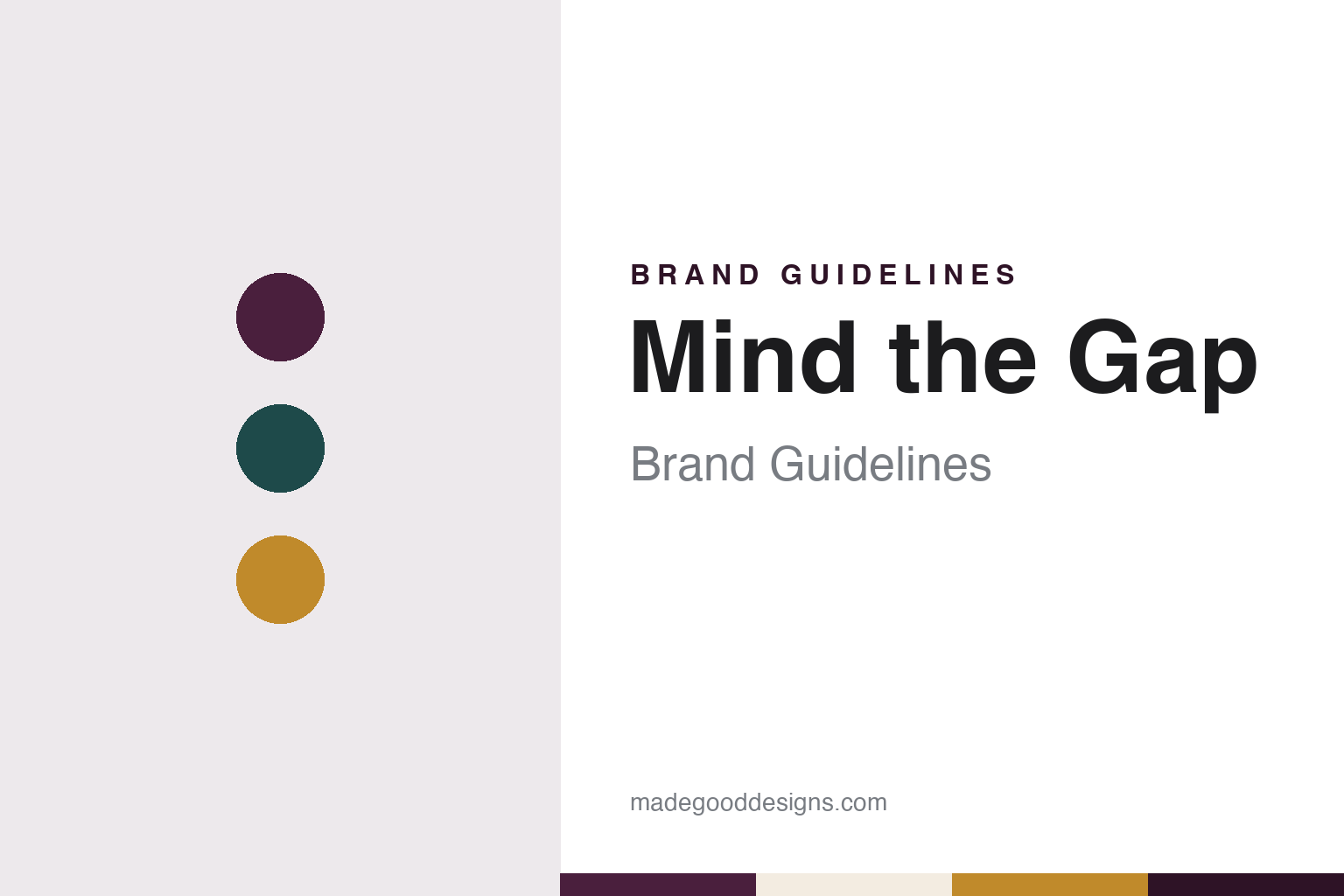
Mind the Gap Brand Guidelines
A Transylvanian studio that turned private-label wall art into its own maximalist brand.
Aa
Two constants: a plum, teal and ochre palette and a display serif register. Abstract homage — not a Mind the Gap product or mark; no pattern, logo or room set is reproduced.
Târgu Mureș
A Transylvanian studio with a London name.
Mind the Gap is a Romanian interiors brand with an English name. Its designs are drawn by a team in Târgu Mureș, a city in Transylvania, in the centre of Romania, and most of what it makes is sold abroad. The Romanian arts site Curatorial, in a long profile published in October 2025, called it a company with a British name and a Transylvanian identity, and named its founders as Ștefan Ormenișan and Victor Șerban.
Its starting date depends on the source. Business of Home, the American trade magazine, reported in April 2021 that the brand was founded in 2009 and at first supplied wall art for other European brands, with a focus on the private-label market in England. Curatorial says the two founders set up the company at the end of 2015 and heads its account of the brand’s journey “2016, at Târgu Mureș.” The same profile also speaks of nearly two decades of work behind the founders, which sits closer to the earlier date. Both dates appear here because the two publications give different ones.
The two accounts agree on the turn that made the brand. According to Business of Home, after the Brexit vote in 2016 the company decided to stop relying on private-label work for British clients and to establish itself as an independent design brand. Ormenișan, described by the magazine as founder and creative manager, called it “our only chance to keep the business alive.” Curatorial describes the division of roles between the two founders in simple terms: Ormenișan as the artistic lead and designer, Șerban as the strategist responsible for growth and expansion.
Colour
Maximalism with a regional accent.
The brand’s look is pattern on pattern. Business of Home described its wallcoverings and textiles as maximalist, with mixed patterns, colours and nature motifs, and Ormenișan linked that approach to Transylvania’s history as a meeting place of peoples, cultures and traditions. Curatorial quotes the founders’ own phrase for it, a “maximalism full of personality,” and lists the ingredients: floral motifs, simple geometries, rich textures, bright colours and bold combinations, drawing on traditional patterns from Europe, Asia and South America.
Wallpaper and fabric are the core of the business, Ormenișan told Business of Home in 2021. Around them sits a wider range that the magazine described as handmade textiles, embroidery, weaving and printing, from handmade upholstery and multicoloured linens to light fixtures forged locally. The company said it employs local Romanian artisans, and Curatorial reports that its textile collections use traditional weaving and embroidery techniques, made by young artisans in Târgu Mureș whom the founders describe as co-creators rather than contractors.
The brand does not present one fixed house style. Curatorial says each collection has its own story and that the company avoids a rigid template, looking instead to apparently distant cultures for themes and textures it can turn into objects. Ormenișan told the site that every space is unique and that the aim is to bring accents that bring out its story.
Television gave the brand a wider audience in Britain. According to Curatorial, the winning room in the BBC interior-design competition Design Masters in summer 2025 centred on an exotic wallpaper with Italian motifs, and the closing credits named Mind the Gap of Târgu Mureș as its maker.
Typography
Wallpaper and wallcovering makers.
Wallpaper and wallcovering makers sell surfaces that are hard to judge from a small sample, so most of them present their work through finished rooms. Company sites typically pair each design with a flat pattern image and a room set, and many add project stories from hotels, shops and private houses. Fromental’s pages group bespoke designs by collection, by collaboration and by colour family, while Muraspec’s home page runs a series of short project stories from hotels, bars and homes.
Naming does a lot of the work. Makers organise their output into named collections, and the names often signal a source or a mood rather than a technical detail: Fromental lists collections such as Chinoiserie and Modern Chinois, and Muraspec trade write-ups from 2013 describe ranges named Artemis, Osaka and Verona. Collaborations with designers and other houses are usually given collection names of their own, as with Hirondelles, made by Fromental with Lalique and reported by Tatler in 2019.
Technique is described in plain terms. Makers set out how a design is produced, whether by hand painting, hand embroidery, screen printing or digital printing, and where the work is done. Fromental’s craftsmanship page explains how silk is sized, painted and backed with rice paper in its Chinese studios, and Muraspec states that its wallcoverings are designed and manufactured in the UK; trade magazines often repeat the specification details, such as backing and weight, that contract buyers ask for.
Corporate pages fill in the rest: who founded the business, who owns it now and where its studios and showrooms are. Some firms are still run by their founders, while others have passed through several owners; Muraspec, for example, now describes itself as employee-owned. The guides in this group set those facts out from dated sources, alongside each maker’s own account of its collections.
Aa
A high-contrast display serif for a brand built on bold pattern. (Specimen set in DM Serif Display, a serif STAND-IN; NOT the Mind the Gap logo.)
Selling abroad
Designed in Romania, shown in London.
Mind the Gap has grown as an export business. Business of Home reported in April 2021 that the brand had retail representation in more than 70 countries on six continents, that the bulk of its business was still done in the United Kingdom, and that some corporate activity had moved to an office in Dublin. By October 2025, Curatorial put the number of countries it exports to at 80, and said that from the start the founders had aimed at markets abroad, chiefly Britain and the United States, rather than at Romania.
London is where the brand is shown to the trade. Curatorial describes its space in the Design Centre, Chelsea Harbour, in London, as a room of patterned wallpapers, tactile textiles and decorative objects, with every product designed by the team in Târgu Mureș. Its account frames the brand as a Romanian business that chose to make its name in the British interiors trade before turning to Romania.
The home market came later. Ormenișan told Business of Home in 2021 that Romania had little history in interior design or home decor products, and Curatorial says the company remained relatively little known in Romania as a deliberate choice. That began to change in 2025: the brand took part in Romanian Design Week that year, which Curatorial describes as one of the country’s main events for contemporary design.
The way the brand presents itself follows from that history. Its pattern language, according to both publications, draws on Transylvania’s mixed cultures and on traditional motifs from much further afield; and its products are shown in room settings that layer wallpaper, fabric and objects together rather than one roll at a time.
For a design guide, Mind the Gap shows how a small studio can build an identity on pattern, colour and a regional story while selling almost entirely abroad. Compare Designers Guild, another house that works in colour and pattern, and Timorous Beasties, a design studio working in wallpaper and textiles. For this guide we use plum, forest teal, ochre and a faded rose on linen with a serif, an unofficial interpretation; no product or logo is reproduced.
Explore & save
Keep Mind the Gap’s identity on hand — save it to a board in the Made Good inspiration library.
Mind the Gap identity set
Pin the Mind the Gap plum, teal and ochre palette and the display serif register to your own board.