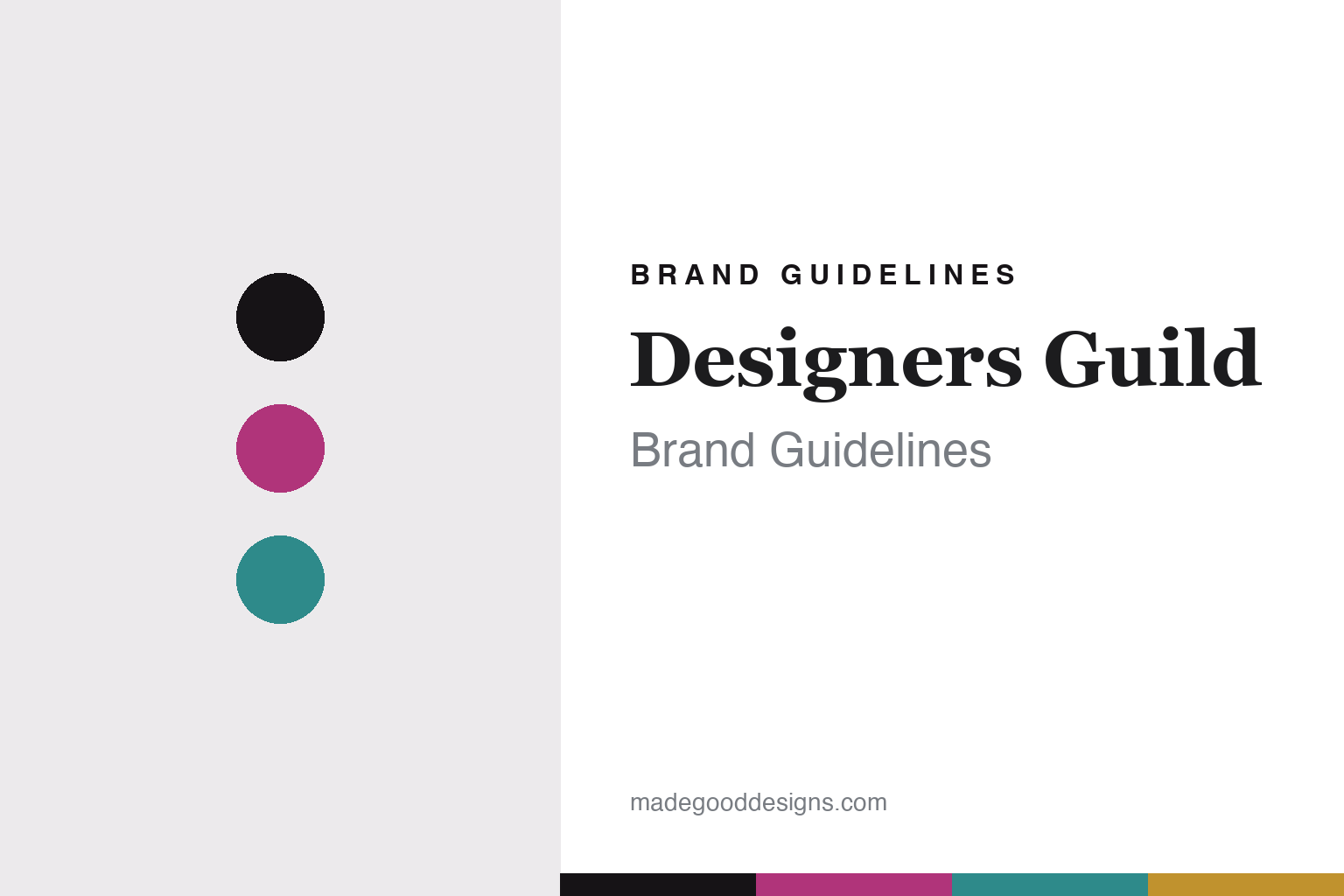
Designers Guild Brand Guidelines
The colour.
Aa
Two constants: a fuchsia-and-turquoise palette and a colour serif register. Abstract homage — not the Designers Guild prints, fabrics or packaging.
The colour
Designers Guild built a house on colour.
Designers Guild is a lesson in colour as the identity. Founded in 1970 in London by Tricia Guild, it turned a fearless, maximalist use of colour into a home-textiles house recognised worldwide.
Its identity is colourful fabrics. Designers Guild makes bold, colourful printed and woven furnishing fabrics, wallpapers, upholstery, and bed and bath collections, all led by Tricia Guild’s distinctive colour philosophy — florals, saturated brights, unexpected pairings. It also distributes and licenses other houses (Christian Lacroix Maison, Ralph Lauren, William Yeoward, the Royal Collection). Colour, as a whole language.
(Honest notes: Tricia Guild founded Designers Guild in 1970 (co-founded with her first husband, Robin Guild; she has led it since 1973) and remains creative director, with her brother Simon Jeffreys as chief executive; she was made an OBE in 2008. The Lacroix, Ralph Lauren, William Yeoward and Royal Collection arrangements are distribution or licence deals — not Designers Guild’s own IP — so we don’t conflate them with ownership. We couldn’t confirm where its fabrics are made, so we don’t claim a country, and we don’t call Tricia Guild a Royal Designer for Industry, which we couldn’t verify. “Designers Guild” is one company — Tricia Guild’s — not a guild of designers. There’s no official brand hex, and we reproduce no actual print — these tones are an unofficial interpretation. This is design commentary and does not promote any product.)
Colour
Designers Guild lives in a fuchsia-and-turquoise palette. Click a swatch to copy the hex.
Designers Guild’s identity is bold, colourful and British — a fuchsia, an ink, a turquoise, a gold, and a chalk. The palette pairs a fuchsia with a turquoise — the register of a fearless colour house. It signals joy and confidence rather than restraint. The honest caveat: with no published brand hex, these tones are an original, unofficial interpretation, not first-party values.
The lesson is a fuchsia with a turquoise signals a colour-led house. Designers Guild’s world is a saturated, patterned interior. For designers, it is a reminder that a fearless, personal way with colour can be a whole identity. Because a bright fuchsia can fail as small text, keep type dark and let the colour live in the accents, palette and band. The takeaways: make colour the language; be fearless with pairings; lead with a personal vision; and treat any single hex as unofficial.
Typography
The register is a colour serif — bold, joyful, British.
Designers Guild’s identity carries a bold, joyful, British spirit — a saturated, colourful interior. A warm, expressive serif captures the mood: it is characterful and confident, the register of a colour-led house. Set in a fuchsia-and-turquoise palette, the colour serif feels bold and joyful — exactly the personality Designers Guild carries. It is expressive rather than restrained, mirroring fearless colour. (Designers Guild’s real prints, fabrics and wordmark are works we describe but do not reproduce, and the exact typeface is not ours to use.) Because it is not ours to use, the honest description is “a colour serif spirit,” shown here in a stand-in. The type behaves like the brand: bold, joyful and British.
Aa
A colour serif spirit — bold and joyful. (Specimen set in Fraunces, a warm expressive serif STAND-IN; NOT the Designers Guild packaging.)
Colour as the identity
Designers Guild stands for colourful fabrics.
Designers Guild is a lesson in making colour the identity. A fuchsia-and-turquoise palette, a colour serif and a saturated interior make colour the whole brand — bold, joyful, British. The colour is the differentiator. The differentiator is a fearless, personal way with colour.
For designers and brand-builders, Designers Guild offers a clear takeaway: own a way of using colour. The lessons: make colour the language; be fearless; lead with a vision; and be honest about the story. It is also a reminder to stay accurate: it was founded in 1970 by Tricia Guild, who leads it with Simon Jeffreys; its Lacroix and Ralph Lauren links are distribution/licence, not ownership; and the palette here is an unofficial interpretation. Designers Guild made colour the brand — proof that colour can be the difference.
Explore & save
Keep Designers Guild’s identity on hand — save it to a board in the Made Good inspiration library.
Designers Guild identity set
Pin the fuchsia-and-turquoise palette and the colour-serif register to your own board.