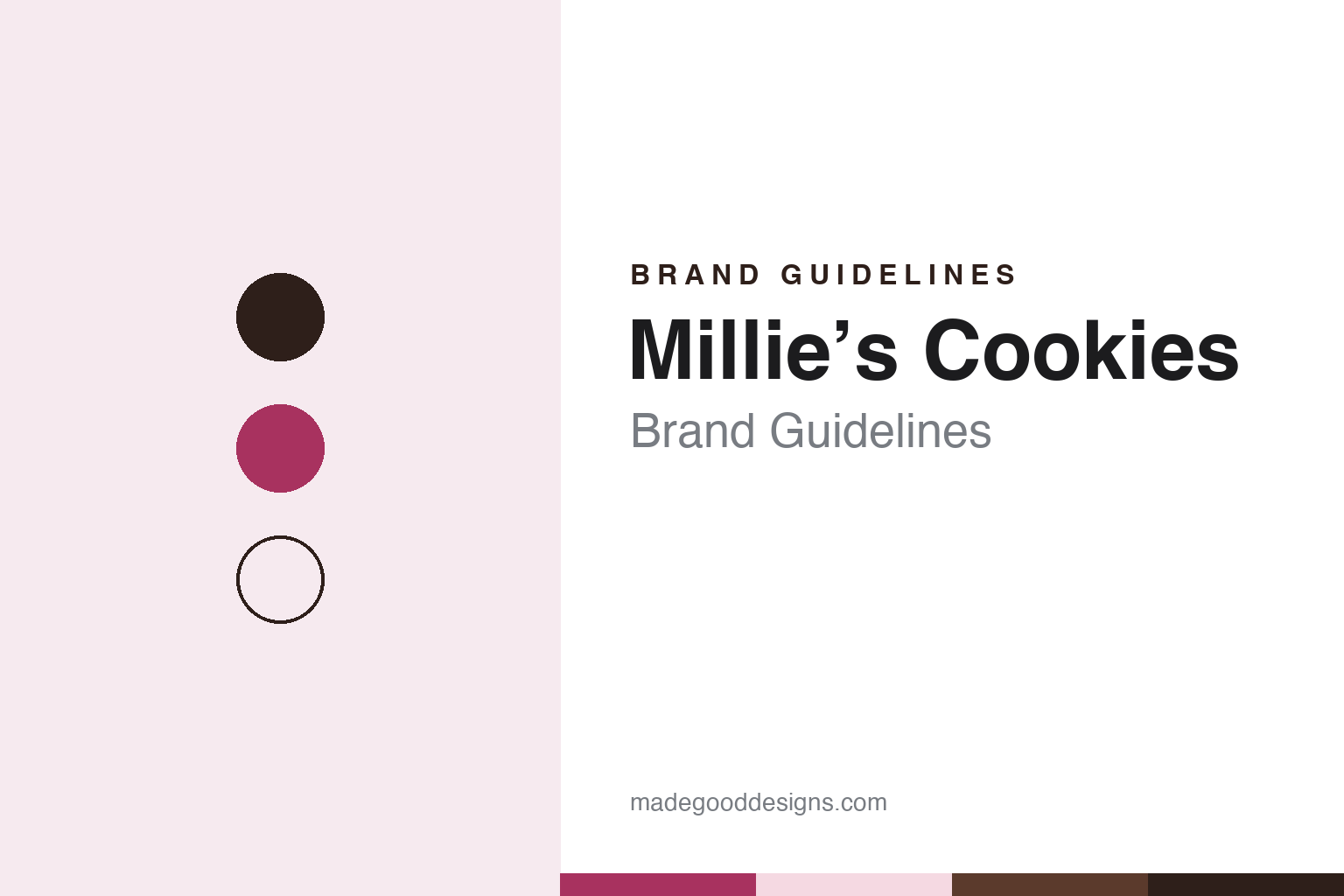
Millie’s Cookies Brand Guidelines
A 1985 Selfridges concession named after Mildred.
Aa
Two constants: a berry pink, cocoa and icing pink palette and a Rounded sans register. Abstract homage — not a Millie’s Cookies product or mark; no cookie, box or logo is reproduced.
Mildred’s cookies
A Selfridges concession in 1985.
Millie’s Cookies was founded in London at the end of 1985 by Mario Budwig, according to English Wikipedia, which says the first Millie’s cookie was baked by Stephen Singer and that the first store opened that year inside the Selfridges food hall on Oxford Street. The name is a family one. The Manchester Evening News reported in August 2004 that Budwig named the business after his grandmother, Mildred, and that it had begun as a concession in Selfridges in London.
Growth came from the north of England, where its managing director told the Manchester Evening News in 2004 that the team had brought the business to Manchester, a city he knew well, and grown it from there. In 1987, English Wikipedia says, Richard O’Sullivan joined as managing director and took the chain outside London for the first time, with openings in Sheffield, Manchester and Birmingham. Outlets followed in most major railway stations and airports in the UK and in many shopping centres. The Manchester Evening News described the company in 2004 as based in Bury, near Manchester, with more than 100 outlets around the country and a presence in all the major shopping centres; it named Budwig and the businessman Bill Holroyd as the two shareholders alongside O’Sullivan, and the Trafford Centre as one of the chain’s strongest sites. The same article said the business was a major donor to the Variety Club charity and funded community schemes around the country.
In June 1997, English Wikipedia says, Millie’s bought Cookie Jar, a competitor with about thirty outlets, and rebranded its stores as Millie’s Cookies. Companies House records show that the company now called Millie’s Cookies Limited was named Cookie Jar Limited from 1989 until February 1999, and The Original Cookie Company Limited from 1985 to 1989.
Colour
Into SSP.
The founders did not keep the business. English Wikipedia says Millie’s was bought in June 2003 by Select Service Partner (SSP), then a division of the catering group Compass Group, and the Manchester Evening News article of August 2004 described Millie’s as recently bought by Compass. In April 2006 Compass sold SSP to the investment firm EQT, according to English Wikipedia, and Millie’s went with it. By 2006, the same source says, the chain had grown to 121 outlets.
Under SSP the brand became one of a group of travel-catering names. British Baker called Millie’s “the SSP-owned brand” in May 2014, when the company was exploring standalone units in convenience stores, and listed SSP’s other businesses at transport hubs as Upper Crust, Delice de France and Caffè Ritazza. The trade paper reported that the units under consideration would sell cookies baked in store, singly or in packs of twelve, and that the company called the plan “early days”.
Millie’s has also been franchised abroad. When a Maltese franchise was announced in February 2010, the Times of Malta reported that its two local operators had signed the agreement in Manchester with Select Service Partner, which the paper named as owner of the brand, and listed muffins, cookie cakes, coffees, smoothies and ice cream alongside the cookies. The operators stressed that everything would be baked through the day at the outlet itself. English Wikipedia says outlets opened in Cairo and Malta that year.
The company records point the same way. Companies House lists the older Millie’s companies, including Millie’s Cookies Limited and Millie’s Cookies (Retail) Limited, as non-trading companies whose controlling shareholder chain leads to an SSP financing company, with their registered office in the same Camden building as that parent.
Typography
Design and documentation.
Doughnut, cookie and cupcake chains sell small things that are eaten quickly, so much of their identity has to work at the counter and in the hand. The box, the bag and the cup travel further than any shop sign in a takeaway trade. Crumbl is a clear case: its own history page calls its long pink box a signature, and Restaurant Business wrote in 2026 that the box makes the cookies look almost as if they are on display.
The product itself is often the second carrier. Glazed rings seen through a window, warm cookies on a counter and cupcakes stacked into towers are the images these companies choose to publish on their own sites and social channels. Some chains add a time or a temperature to the promise: Insomnia Cookies built its name around warm cookies sold late into the night, with shops near college campuses open until 3 a.m., as Restaurant Business reported in 2018.
Flavour naming tends to be plain and descriptive. A cookie or doughnut is usually named after the dessert or ingredient it borrows from, as with the Blueberry Muffin and Dubai Chocolate Brownie that Restaurant Business reported on Crumbl’s menu in 2026, and rotating or seasonal flavours are announced week by week so that the menu itself becomes news. Shops are generally identified by their town, street or campus rather than given names of their own.
Behind the shopfront, corporate pages tell a founder story and, more rarely, an ownership story. Several of the chains in this group began with one person or one family and one shop, then passed through franchising, a larger food company or a private-equity investor. Those changes are dated in trade and business press, and each guide here gives them as dated facts.
Aa
A rounded sans — for a brand named after a grandmother. (Specimen set in Nunito, a sans STAND-IN; NOT the Millie’s Cookies logo.)
Millie’s Cookies
A smaller estate and a supermarket range.
The shop estate has shrunk since its peak. English Wikipedia says that by 2022 Millie’s had 45 outlets in the UK, compared with 121 in 2006, while its range was available for home delivery as far as mainland Europe. Its stores are mainly in English shopping centres, the same source says, with others at Hong Kong International Airport, the Opéra métro station in Paris, Lyon-Saint Exupéry Airport and Berlin Hauptbahnhof, and in India, where the first shop opened in New Delhi.
The brand has also moved beyond its own counters into supermarket freezers. In February 2016 GoodtoKnow reported that ready-to-bake Millie’s Cookies had gone on sale at the frozen-food retailer Iceland, sold in boxes of six to be baked at home straight from frozen. The Grocer reported in July 2017 that Iceland had extended the tie-up with a Millie’s at Breakfast range of croissants, pains aux raisins and pains au chocolat, rolled out to 580 stores, and had added a party pack and a limited-edition milk and toffee dough to the Millie’s At Home cookie range launched the year before. In July 2018 Surrey Live reported that the discount chain B&M was selling a frozen Millie’s bake-at-home range, including milk chocolate cookies and cinnamon swirls.
That retail work echoes an idea British Baker reported in May 2014, when SSP was exploring standalone Millie’s units for convenience stores, selling cookies singly or in packs. The name that began on a Selfridges counter has since appeared on supermarket packs as well as on shopping-centre and station signs.
For a design guide, Millie’s Cookies shows how a brand born as a department-store concession and named after a grandmother can be carried through station kiosks, a large travel-catering group and supermarket freezers. Compare it with Ben’s Cookies, the Oxford cookie chain of the same decade, or with Auntie Anne’s, another snack-counter brand. For this guide we use berry pink, cocoa and icing pink with a sans, an unofficial interpretation; no product or logo is reproduced.
Explore & save
Keep Millie’s Cookies’s identity on hand — save it to a board in the Made Good inspiration library.
Millie’s Cookies identity set
Pin the Millie’s Cookies berry pink, cocoa and icing pink palette and the Rounded sans register to your own board.