DCM Brand Guidelines
Three regional home-centre chains under one three-letter name.
Aa
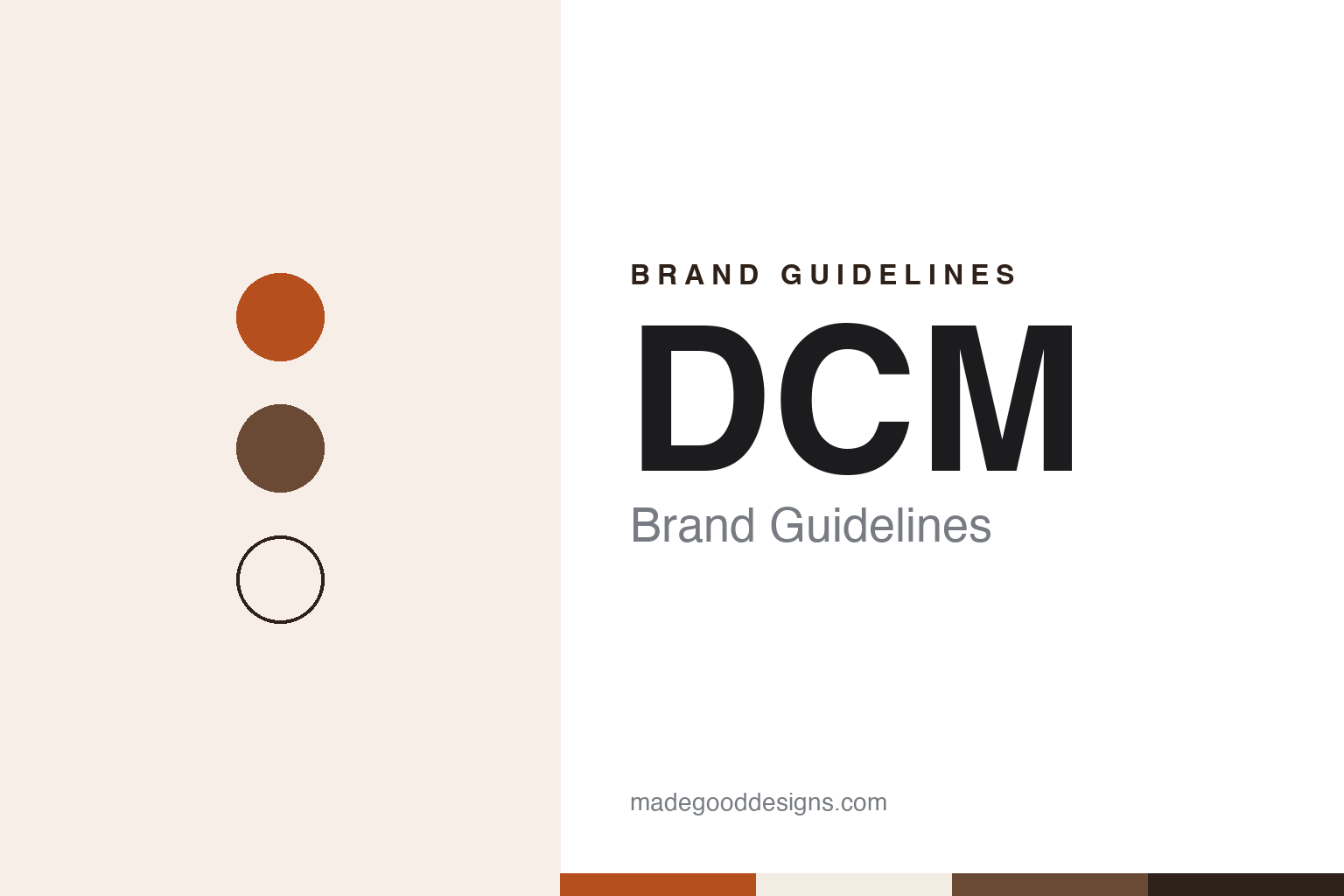
Two constants: a warm orange and brown palette and a rounded sans register. Abstract homage — not a DCM sign, product or mark; no logo or store fascia is reproduced.
Three chains
Nagoya, Matsuyama and Kushiro.
DCM is not one company’s story but three. The group’s own history page traces its roots to three regional retailers that moved into home centres in the 1970s. In October 1973 Kahma of Nagoya opened a home centre in the city’s Nishi ward; Japanese Wikipedia says the company had been set up in Nagoya in 1970 under the name Ohtaka Shoji. In April 1976 Ishiguro Shoten, a hardware wholesaler and retailer in Kushiro, on the east coast of Hokkaido, opened its own home centre in the town’s Nakazono district. In November 1978 Daiki of Matsuyama, on the island of Shikoku, set up a home-centre company called Dick and opened two stores in the city at once.
Each grew within its own region. Japanese Wikipedia says the Daiki name is a reading of the founding family’s surname, and that the business began with a shop in Matsuyama in 1958 and also made housing and environmental equipment, which it later split off. Ishiguro Shoten, incorporated in Kushiro in 1951 according to Japanese Wikipedia, renamed itself Ishiguro Homa in 1987, adopting a new corporate identity, and in August 1995 merged with two other companies to become Homac, moving its head office to Sapporo, the DCM history says. Japanese Wikipedia gives Homac as a short form of “Home Amenity Center.” Kahma, for its part, merged in 1990 with Oscar, a chain in the three Hokuriku prefectures on the Sea of Japan coast.
By the early 2000s the three were working together. Kahma and Daiki agreed a business tie-up in May 2002; in February 2003 the three signed a business and capital alliance; and in May 2003, with the trading house Mitsui & Co., they set up a joint purchasing company called DCM Japan. Japanese Wikipedia says the letters stood for “Demand Chain Management.”
Colour
A holding company, then one store name.
The three announced a full merger in July 2005, and in September 2006 they formed DCM Japan Holdings through a joint share transfer, according to the group’s history page. Japanese Wikipedia says the new holding company listed that month on the first sections of the Tokyo, Osaka, Nagoya and Sapporo exchanges, and gave up the three regional listings in 2009 while keeping Tokyo. In June 2010 it took its present name, DCM Holdings.
The group then added chains and kept their names for a time. In 2014 Kahma bought the home-centre business of the electronics retailer Edion, Japanese Wikipedia says. In March 2015 the three founding companies were renamed DCM Kahma, DCM Daiki and DCM Homac; Sanwado of Aomori joined by share exchange in July 2015 as DCM Sanwa, and Kuroganeya of Yamanashi in December 2016 as DCM Kuroganeya. In May 2016 the trade magazine DIY International reported that DCM aimed to acquire Keiyo, another home-centre chain, and named its store lines as DCM Kahma, DCM Daiki and DCM Homac. The outcome was more gradual: DCM took a stake in Keiyo in January 2017 that made it an equity-method affiliate, the group’s history says.
One larger approach did not succeed. In October 2020 DCM made a tender offer for the home-centre and furniture chain Shimachu; the furniture retailer Nitori then made a rival offer, Shimachu withdrew from its agreement with DCM in November, and Nitori’s offer succeeded at the end of December 2020, Japanese Wikipedia says.
Inside the group, the five operating companies were merged into one, DCM Co., Ltd., in March 2021. On 1 September 2022 the stores dropped their regional names: the trade site BCN+R reported that day that DCM Kahma, DCM Daiki, DCM Homac, DCM Sanwa and DCM Kuroganeya had all become simply “DCM.” In late 2023 a tender offer raised DCM’s holding in Keiyo to a majority; Keiyo became wholly owned in January 2024 and was absorbed in September 2024, when its Keiyo D2 stores also took the DCM name, according to the company and Japanese Wikipedia. In September 2025 the Shizuoka home-centre chain Encho became a wholly owned subsidiary by share exchange, and in December 2025 the group bought the renovation company Hometech, its history page says.
Typography
Roadside stores and own labels.
Japan’s big electronics, furniture and home-centre chains mostly grew from single regional shops, and their corporate pages still tell that story in the same order: a founding year and town, a founder, a date when the company was incorporated, and the dates when its shares were listed, now usually on the Tokyo Stock Exchange’s Prime Market. Many have since become holding companies, with the stores run by a subsidiary and the parent group named separately, so the name on the sign and the name on the share register are not always the same.
Store names carry much of the identity. Some groups keep a different name for each store format: Yamada Denki, for example, uses Tecc Land for its roadside stores, LABI for its large stores beside city stations and Tecc LIFE SELECT for stores that add furniture and household goods, according to Japanese Wikipedia. Others have done the opposite. Edion put four regional store names under one name, EDION, in October 2012, the company says.
The roadside store is the common type. Japanese Wikipedia describes Tecc Land buildings with the car park on the ground floor and the sales floors above, and Edion lists roadside stores alongside shopping-mall tenants and city stores. Point cards are part of the offer as well: Yamada tested its point system before rolling it out, and Edion has added several shared point programmes since 2015, Japanese Wikipedia records.
Own-label ranges are named plainly and sit beside the makers’ brands. Edion sells products under its e angle and e angle select names, and a line developed with the furniture retailer Nitori, while Yamada sells furniture under the IDC OTSUKA name after absorbing the retailer Otsuka Kagu in 2022. This guide sets out what can be checked about each chain, and marks what rests on the company’s own word.
Aa
A soft, rounded sans, as DCM describes its lettering. (Specimen set in Zen Maru Gothic, a rounded sans STAND-IN; NOT the DCM logo.)
DCM
Three circles, an orange and a brown.
The single store name came with a new mark. DCM says it began changing the logo on its store signs in March 2022, a changeover BCN+R reported would take about two years. The company’s corporate-brand page describes the symbol as three circles, drawn closer together and larger than in the earlier design, which it says stand for three words in the group’s company creed — service, creation and unity. It describes the open space in the lower-right circle as room for creation, meant for the do-it-yourself projects of its customers.
The same page explains the lettering and colours. It calls the “DCM” letterforms soft and clean, and assigns meanings to the two colours: orange for happiness and enjoyment, and brown for nature and sustainability. Alongside the mark the company uses the phrase “Do Create Mystyle,” adopted in September 2016, which spells out the three letters a second way; the original letters, as Japanese Wikipedia notes, came from the purchasing company’s “Demand Chain Management.”
Own-label goods carry the group name too. The history page dates the DCM brand own label to November 2009, and Japanese Wikipedia says the group’s private labels were brought under that name after the 2010 rename; Homac had earlier used its own label. DCM Holdings, which has its head office in Shinagawa, Tokyo, and closes its financial year at the end of February, now sits above DCM Co. and other group companies including the tool and work-wear retailer Hodaka and the online electronics seller Xprice, according to its website.
For a design guide, DCM shows how a group can retire several regional names it had kept for years and put them under one short mark with colours it explains in its own words. Compare Kohnan, another Japanese home-centre chain, and Hands, the Tokyo do-it-yourself and lifestyle store. For this guide we use a warm orange, timber brown and plaster white with a sans, an unofficial interpretation; no product or logo is reproduced.
Explore & save
Keep DCM’s identity on hand — save it to a board in the Made Good inspiration library.
DCM identity set
Pin the DCM warm orange and brown palette and the rounded sans register to your own board.