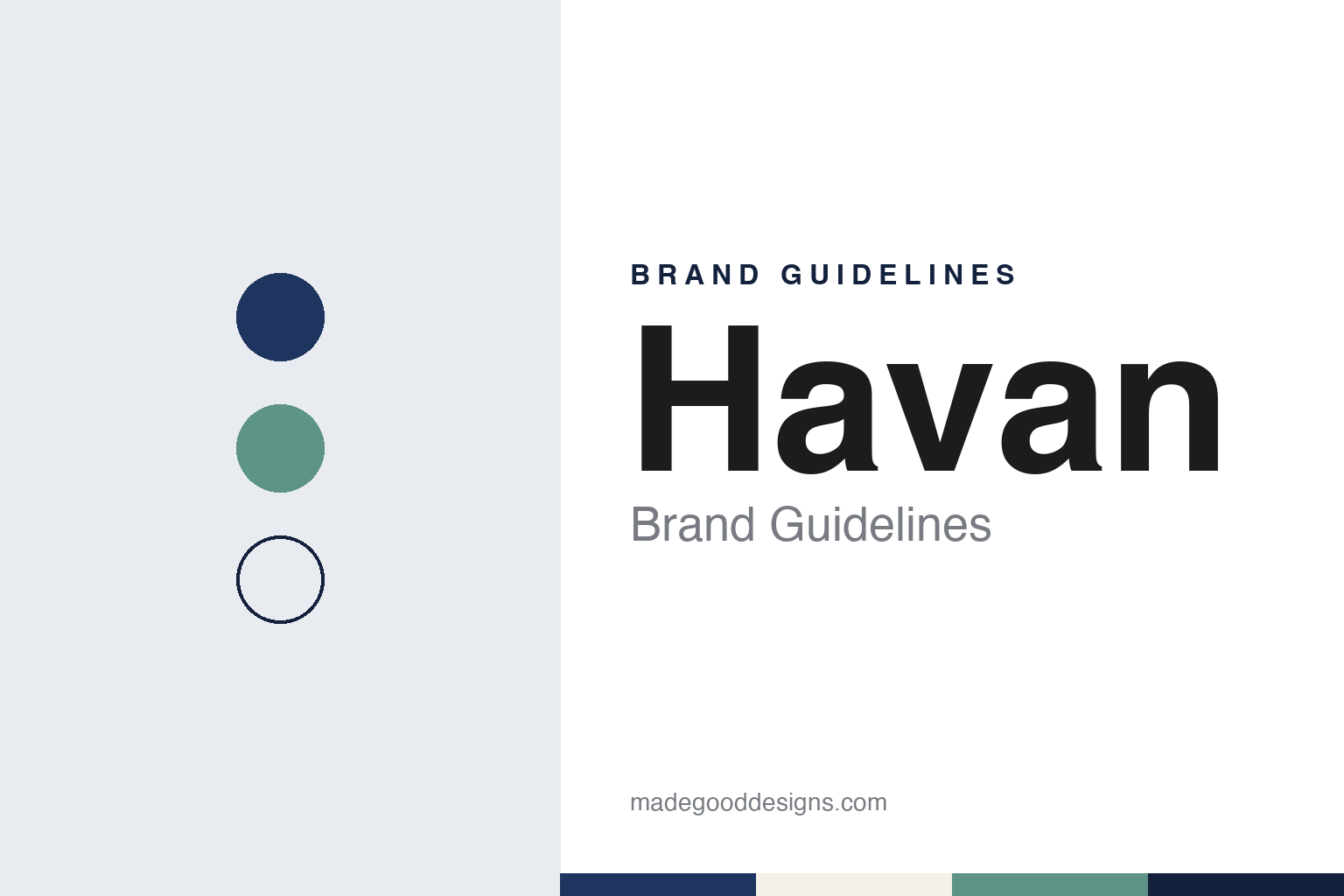
Havan Brand Guidelines
The Brusque fabric shop that became a chain of columned megastores.
Aa
Two constants: a Havan deep blue and patina green palette and a Bold sans register. Abstract homage — not a Havan product or mark; no façade, statue, logo or sign is reproduced.
HA + VAN
Two partners, two syllables.
Havan began in Brusque, in the southern Brazilian state of Santa Catarina, on 26 June 1986, Portuguese Wikipedia says. It opened as a small wholesale fabric shop, founded by Luciano Hang and Vanderlei de Limas, and its name joins the opening syllables of the two partners’ names: HA from Hang and VAN from Vanderlei. The name is pronounced roughly “ah-VAHN,” with a nasal ending, as Portuguese Wikipedia transcribes it.
In 1989 the business moved into premises of its own in central Brusque, on the site it still occupies. The building was enlarged several times, and Portuguese Wikipedia gives today’s sales floor there as about 30,000 square metres. In the early 1990s Havan began importing fabrics and low-cost goods to supply retailers across Brazil. In 1999 it opened two branches in Curitiba, the capital of neighbouring Paraná; a currency devaluation, the same article says, then led it to change course and become a department-store chain, with new branches in Florianópolis, Criciúma, Joinville and Balneário Camboriú.
The 2000s brought a run of openings around Santa Catarina. A Blumenau branch opened in the Shopping Neumarkt centre in 2005, followed by Chapecó and Jaraguá do Sul in 2007. In 2008 the company leased the Castelinho da Moellmann in Blumenau, a landmark building in the state, restored it and opened a themed store there, Portuguese Wikipedia says. The same year it opened in central Lages in June and, in November, in Cascavel, across the state line in Paraná.
Colour
Columns, a statue and a food court.
Havan’s look is architectural. During one of the enlargements of the Brusque store, Portuguese Wikipedia says, the company adopted a stylised version of the façade of the White House, which became the pattern for its building projects; the other element added to the concept was a replica of the Statue of Liberty. English Wikipedia describes the fronts as similar to Neo-Greek architecture and says replicas stand in front of most branches. Brazil Journal, visiting Brusque in February 2025, described megastores inspired by the White House, with Ionic columns on the façade and copies of the statue outside.
The format behind the façade is just as consistent. The chain grew, Brazil Journal reported in 2025, by choosing towns too small to have a large shopping centre and becoming the attraction of the region. Every store had a food court, and some a cinema, and about 300,000 product lines passed through the stores over a year, in a broad mix the publication compared with Wal-Mart. In February 2026 it reported 184 stores, all with a food court and free parking, positioned as the shopping centre of the inland town.
Events extend the brand. Portuguese Wikipedia lists the Expo Havan Noivas, a bridal fair, and Natal Luz Havan, a Christmas programme with free concerts, the arrival of Father Christmas and thousands of lights tracing the outlines of the store fronts. Havan sponsors Brusque Futebol Clube, which it had also backed from 1997 to 2001, and in June 2018 it announced an esports team, Havan Liberty Gaming, now called Liberty Esports, which holds a franchise place in Brazil’s CBLOL league.
The statue travels with the brand. In November 2026, as Havan marked its fortieth year, the trade title Mercado&Consumo reported that the chain was opening a megastore in Boa Vista, Roraima, a state where it had none before. The replica for that store travelled about 6,000 kilometres from Camboriú, in Santa Catarina: fifteen days by road and eight by barge, the publication and the Florianópolis news site ND Mais reported.
Typography
Design and documentation.
Brazilian retailers present themselves first through the shop. Many national chains grew by buying regional ones and then putting their own name over the door, so a single shop name, painted on façades in towns across the country, often carries decades of mergers behind it. Shop names are usually plain: a founder’s first name, a family name or, in the case of Casas Bahia, a tribute to the customers the business first served.
Characters do much of the talking. Several chains use a mascot or spokes-character in television advertising, on social media and in their apps. Magazine Luiza’s Lu began as a virtual sales assistant in 2003, according to Portuguese Wikipedia, and now appears in product videos; Casas Bahia’s Baianinho, a cartoon boy, was redrawn as a teenager in 2020 and restored to his classic look in 2026, trade press reported. Such characters can change with the company, and their redesigns are often discussed in public.
Screens now sit beside the shop. Apps and websites carry the same name and colours as the stores, and many retailers run marketplaces that sell goods from outside sellers under the retailer’s own banner. Television campaigns, seasonal sales events with their own names and printed or online catalogues complete the picture, as the companies publish them on their own channels.
Behind the shop fronts sit corporate pages. These usually give a founding story, name founders and owners, and, for listed companies, link to investor pages with filings on the B3, the São Paulo stock exchange. Restructurings, renamings and changes of control appear there as dated notices, which is often the clearest record of how a shop name has passed from one owner to the next.
Aa
A bold sans for a columned front. (Specimen set in Archivo, a sans STAND-IN; NOT the Havan logo.)
Havan
One owner, one distribution centre.
Havan is privately held. In February 2026 Brazil Journal reported that the founder was the company’s sole shareholder, and that direct imports made up about eight per cent of the goods it sold, by his account. A year earlier the same publication reported that the accounts had been audited since 2012, that the company had had an advisory board since 2015, and that work by banks on a stock-market listing, begun at the end of 2020, did not go ahead.
Its supply chain is centralised. Rather than renting several regional warehouses, Brazil Journal reported in 2025, Havan runs one highly automated distribution centre that supplies every store; Mercado&Consumo places that centre, the CDH, at Barra Velha in Santa Catarina, with the head office still in Brusque. The workforce stood at about 22,000 in February 2025, the publication said. In 2024, it added, the founder visited every store, as well as the sites of stores under construction. Portuguese Wikipedia notes that Havan still sells both Brazilian and imported goods, wholesale as well as retail.
Its store count has moved quickly. Brazil Journal gave 177 megastores in February 2025 and 184 a year later, after seven openings in 2025; English Wikipedia, in an article updated in October 2026, gives 199 stores in 24 states and the Federal District as of 2026, and the Boa Vista store was numbered 200 that November.
For a design guide, Havan shows how a retailer can make the building itself the brand: the same columned front and the same statue repeated from town to town. Compare Magazine Luiza, another Brazilian retail chain, and Pernambucanas, a department-store chain with roots in textiles. For this guide we use a deep blue, a column white and a patina green with a sans, an unofficial interpretation; no product or logo is reproduced.
Explore & save
Keep Havan’s identity on hand — save it to a board in the Made Good inspiration library.
Havan identity set
Pin the Havan deep blue and patina green palette and the Bold sans register to your own board.