Big C Brand Guidelines
A Central Group superstore of 1993, renamed “Big Central” and kept for three owners.
Aa
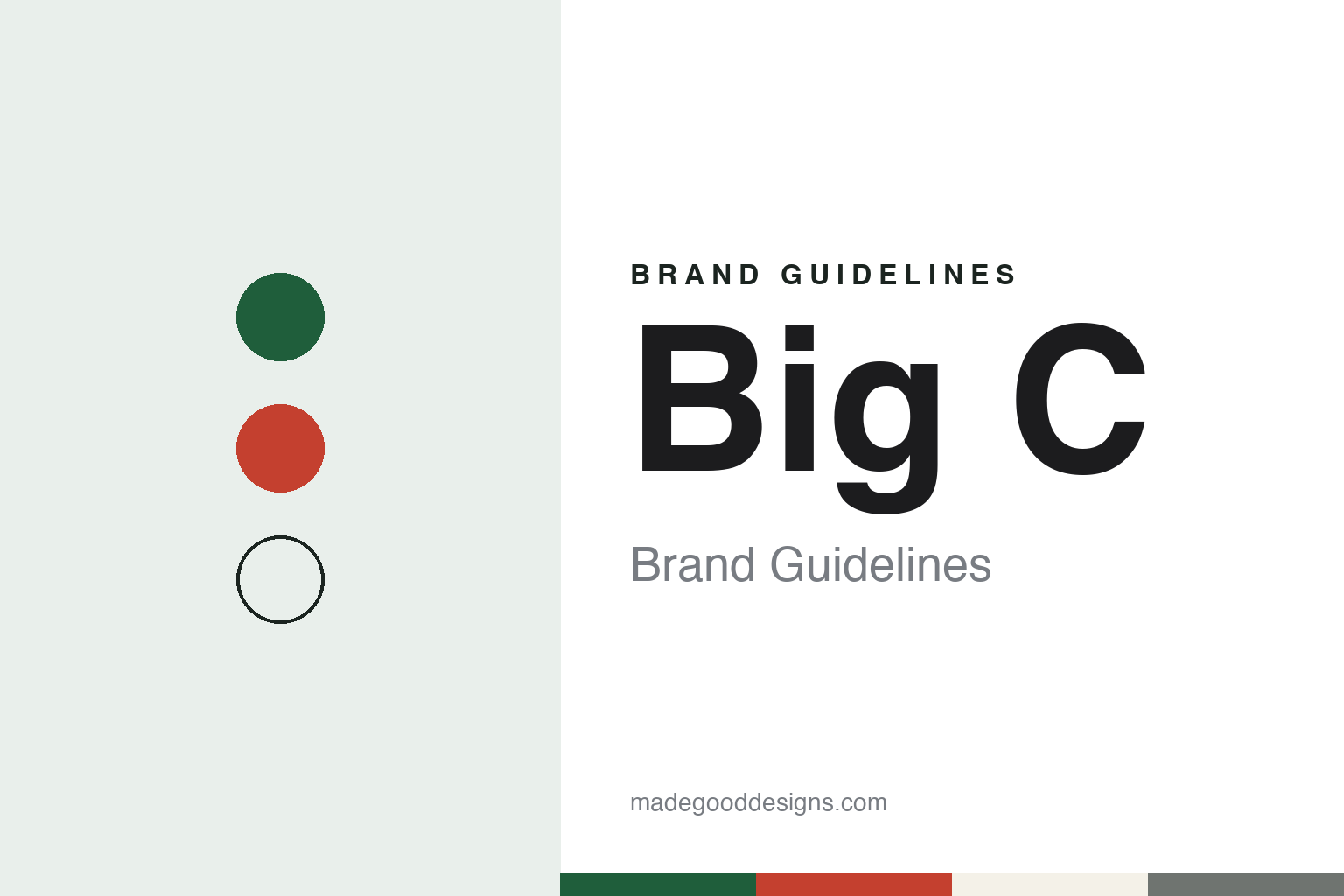
Two constants: a market green, chili red and rice white palette and a hypermarket sans register. Abstract homage — not a Big C product or mark; no logo, sign or shopping bag is reproduced.
Central Superstore
A Central Group box store, then “Big Central”.
Big C began inside Central Group. English Wikipedia says the group opened Central Superstore at the Wong Sawang intersection in Bangkok in 1993, as a subsidiary of Central Department Store, selling groceries from Central Supermarket and own-label clothing in a self-service format. Thai Wikipedia dates that opening to 26 April 1993, in the building of Central’s Wong Sawang department store, and says that on 2 July 1993 Central formed a joint venture with the Imperial group under the name Big C Supercenter.
The first store under the new name opened on Chaengwattana Road in Bangkok in January 1994; Thai Wikipedia gives the date as 5 January and English Wikipedia gives 15 January as the launch of the brand. English Wikipedia says the name was an abbreviation of “Big Central,” and that the company later gave the letters a new reading, with “Big” standing for a large store carrying a wide range and “C” for customers. Thai Wikipedia says Central Superstore itself took the Big C name the following year. English Wikipedia dates the conversion of the Save One store at Rangsit, the chain’s first Big C outside Bangkok, to 1995; Thai Wikipedia links that change to Central’s purchase of the Robinson group, which ran Save One.
Growth was quick and then stopped. Thai Wikipedia says the chain reached 20 stores, the twentieth opening in Phetchaburi on 26 January 1998, before the Asian financial crisis of 1997 and the cost of its expansion loans brought new openings to a halt. English Wikipedia says the company then formed an alliance with the French retailer Groupe Casino, which bought new shares in a capital increase in 1999 and became the main shareholder; Thai Wikipedia puts the stake at 66 per cent. Casino then sold Big C’s clothing business so that the company could concentrate on retailing, English Wikipedia says.
Colour
Formats, Carrefour and a French parent.
Big C worked through many store sizes. English Wikipedia says it opened a single-floor hypermarket at Bangphlee in 1996, launched the hard-discount Leader Price by Big C in 2002 and renamed it Mini Big C in 2006, and added Big C Junior, sized between a compact store and a supermarket, in July 2010. Thai Wikipedia places the first Big C Junior in Saraburi on 5 July 2010 and the first Big C Foodplace at Gateway at Bang Sue in 2018. The name also travelled with its French owner: English Wikipedia says Big C was first used outside Thailand at the end of 2003, when three Cora hypermarkets in Vietnam, owned by Vindemia, a company Casino came to control, were rebranded.
A large change to the store map came from a rival. English Wikipedia says that in November 2010 Big C won the bid for Carrefour’s 42 Thai branches, and that Carrefour Suwintawong became the first Carrefour store rebranded as Big C, in March 2011. Thai Wikipedia says the merger was completed in January 2011 and the conversions in 2013, with the larger Carrefour stores split between Big C Supercenter, Big C Extra and a single Big C Jumbo at Samrong, and the Carrefour Market stores turned into Big C Market.
English Wikipedia, using figures as of the end of 2022, sets out the formats. Big C Supercenter hypermarkets aim at mid- to low-income shoppers, with 138 in Thailand and one in Poipet, Cambodia; Big C Extra, aimed at mid- to high-income shoppers, had 15 stores; Big C Foodplace urban supermarkets numbered 11; and Mini Big C proximity stores, open around the clock, numbered 1,430. The same source lists Big C Place, a mall-style format, and Big C Marché, a supermarket at One Bangkok and at Bluport in Hua Hin.
Typography
Department stores and hypermarkets.
Department stores and hypermarkets in Thailand, Malaysia and Indonesia are usually met inside a larger building. Many sit as anchor tenants in shopping malls, so the store name appears twice: on the fascia above the entrance and again on the mall directory, the car-park signs and the shopping bags carried through the concourse. Some groups also run the malls themselves, which lets one family of names cover both the centre and the store inside it.
The calendar shapes much of what customers see. Retailers in the region publish their own campaigns around Chinese New Year, Hari Raya, Songkran, Deepavali, Christmas and year-end sales, and the store name is often paired with a seasonal theme for a few weeks before returning to its everyday colours. Shopping bags, price tags and in-store signs carry the same palette, so a chain’s colours can be read from across a mall.
Own-label ranges and loyalty programmes extend the name beyond the fascia. Several groups publish house brands for groceries, clothing or homeware, and many describe member cards and apps that collect points across the group’s stores. Store naming is usually plain: a chain name followed by the mall or district, so that a branch is known by its location as much as by its owner.
Corporate pages fill in the rest. Most of these companies set out their founders, founding dates, parent groups and stock-exchange listings on their own investor or corporate sites, and the national business press records acquisitions, renamings and closures as they happen. The guides in this set draw on those dated records and describe each name as its owner and the press present it.
Aa
A heavy, rounded sans for a short two-part store name. (Specimen set in Rubik, a sans STAND-IN; NOT the Big C logo.)
Berli Jucker
A Thai owner from 2016.
Casino sold the Thai business in 2016. English Wikipedia says the French group agreed in February 2016 to sell its 58.6 per cent stake in Big C Thailand to the TCC Group of Charoen Sirivadhanabhakdi, and that Big C is now operated and managed under Berli Jucker (BJC), part of TCC Group. Thai Wikipedia says the share purchase was completed in March 2016, that Central Group, which had also bid, sold its remaining Big C shares to TCC, and that Central took Casino’s Vietnamese Big C business instead. English Wikipedia says Central rebranded those Vietnamese stores as GO! and Tops Market between late 2020 and early 2021, so the Big C name is no longer used on stores in Vietnam.
The company then left the stock market. Kaohoon International, a Thai business news site, wrote in February 2026 that Big C was taken private and delisted in 2017, after Berli Jucker had acquired the majority stake from Casino, and that it then operated as a subsidiary within the TCC Group. Thai Wikipedia says that in 2023 BJC placed Big C and its other retail businesses in a new company, Big C Retail Corporation. Thai Wikipedia says BJC’s board approved a public offering of shares in the new company on 27 March 2023, and that the offering was put on hold on 29 August 2023 because of volatile market conditions; Kaohoon International reported in February 2026 that the plan to bring the retailer back to the market had been halted in late 2023.
Under BJC the chain has moved into neighbouring markets. Thai Wikipedia says M-Point Mart convenience stores in Laos were renamed Mini Big C, a change completed in 2019, that the first Cambodian store opened in Poipet on 4 December 2019, and that the first Lao hypermarket opened in Vientiane on 2 April 2024. In Hong Kong, Thai Wikipedia says, Big C Retail bought the 24-branch AbouThai supermarket chain on 26 September 2023, began converting its shops to Big C and renamed AbouThai Group as Big C (HK); English Wikipedia dates the purchase to 23 August 2023. In February 2026, Kaohoon International reported, Big C presented The Color, a lifestyle mall concept with shopping, dining and rental space, as a new format alongside its hypermarkets.
For a design guide, Big C shows how a name cut down from “Big Central” can outlast the group that coined it, passing from Central to Casino and then to BJC with its two letters intact. Compare Lotus’s, the Thai hypermarket chain once run by Tesco, and The Mall, whose Bluport centre in Hua Hin holds a Big C Marché. For this guide we use a market green, a chili red and a rice white with a sans, an unofficial interpretation; no product or logo is reproduced.
Explore & save
Keep Big C’s identity on hand — save it to a board in the Made Good inspiration library.
Big C identity set
Pin the Big C market green, chili red and rice white palette and the hypermarket sans register to your own board.
Source & notes
Frequently Asked Questions
What font can I use to match the Big C look?
This guide describes Big C’s type as “A heavy, rounded sans for a short two-part store name”. Its type specimen is set in Rubik from Google Fonts as a stand-in; Rubik is not Big C’s own lettering.
What colours are in the Big C palette?
This guide’s Big C palette is Market green #1F5E3B, Chili red #C4402F, Rice white #F4F1E8, Aisle grey #6F7470 and Paper #FAF9F6. The tones are the guide’s own unofficial interpretation, not official Big C hex codes.
When was Big C founded?
Big C was founded in 1993 (as Central Superstore), in Bangkok.
Who founded Big C?
Big C was founded by Central Group in 1993 (as Central Superstore).
Who owns Big C?
Big C today: Big C Supercenter PCL, part of Berli Jucker (BJC).