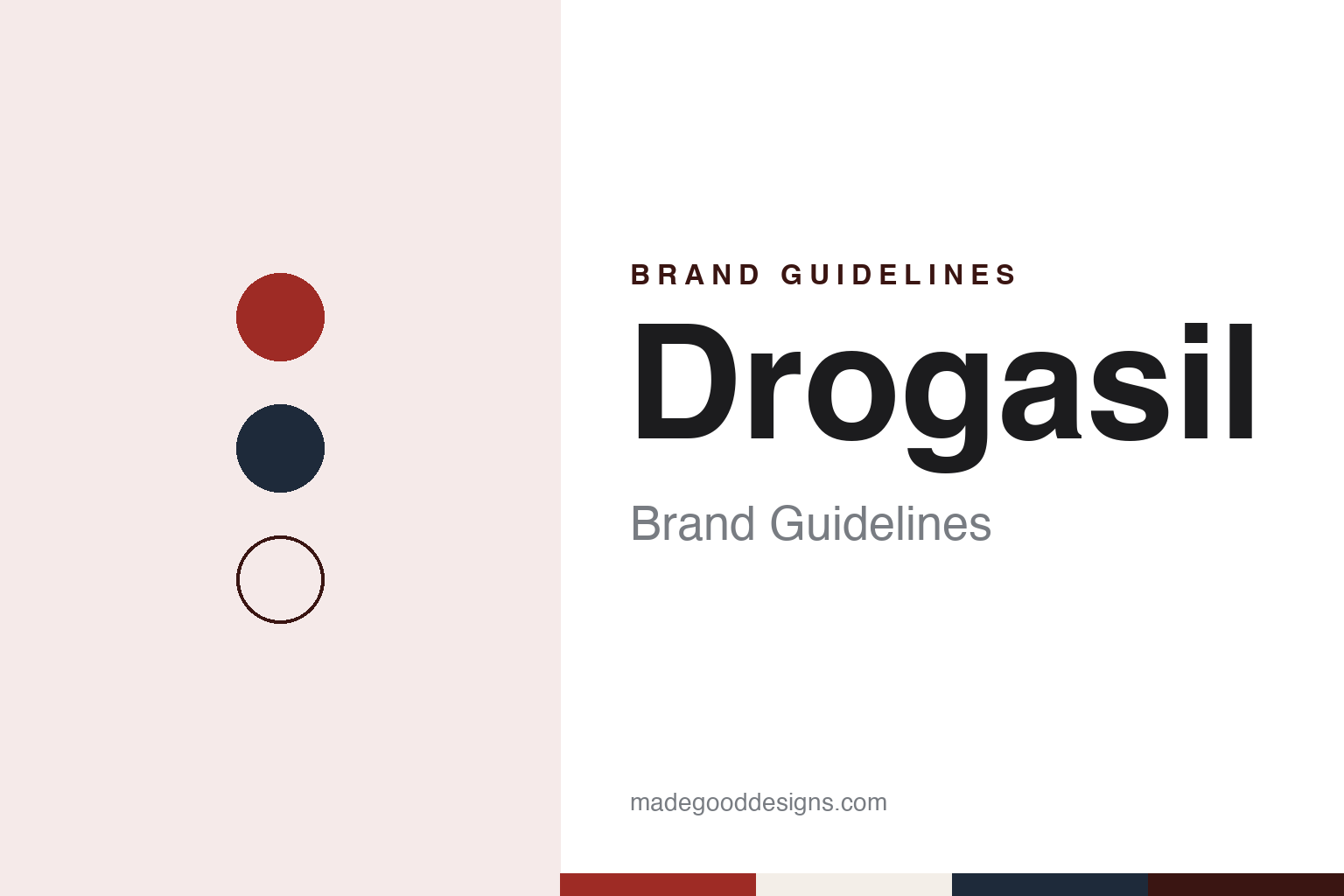
Drogasil Brand Guidelines
A 1935 merger of two pharmacy groups that kept on merging.
Aa
Two constants: a brick red, ink blue and warm stone palette and a grotesque sans register. Abstract homage — not a Drogasil or RD Saúde product or mark; no logo, sign or pack is reproduced.
Bráulio and Brasil
A chain built from other chains.
Drogasil was born from a merger rather than a single shop. On 28 March 1935, Portuguese Wikipedia says, the owners of two small groups of São Paulo pharmacies, Drogaria Bráulio and Drogaria Brasil, combined their businesses, and the new partnership traded as Drogasil. RD Saúde, the company that owns the chain today, gives the same month and the same two names in its own history of the brand.
The habit of joining forces continued. In 1937, Portuguese Wikipedia says, Drogasil absorbed five other long-established pharmacies of the day — Drogaria Sul América, Amarante, Ypiranga, Orion and Morse — and began to operate as a network, with 31 branches between them in the city of São Paulo and the interior of the state. RD Saúde describes the same step as the moment, two years after its founding, when Drogasil adopted the strategy of forming a chain by associating with other pharmacies.
The legal form changed with the business. Drogasil became a sociedade anônima, a Brazilian joint-stock company, in 1972, and on 20 July 1977 it obtained its registration with the CVM, the Brazilian securities regulator, according to Portuguese Wikipedia. In 1994 three of its shareholders became its controlling group, holding 60% of the share capital between them, the same article says.
Colour
From São Paulo to Brasília, and into RD.
Drogasil moved beyond its home state by buying other chains. On 13 February 2008, Portuguese Wikipedia says, it acquired Drogarias Vison, a chain established in Brasília since 1986. A Brazil Journal report from June 2023 shows how visible those purchases still were: on a Brasília street known locally as the “Rua das Farmácias,” where some 20 pharmacies share about 400 metres, three of the shops were Drogasil’s. The company told the paper that none of those points had been opened from scratch; all came from its acquisitions of the Vison and Santa Marta chains.
In 2011 Drogasil joined the other São Paulo chain with a century behind it. On 2 August 2011, Exame reported, Drogasil and Droga Raia announced an association creating Raia Drogasil, with more than 700 pharmacies in nine states. Drogasil’s shareholders were to hold the larger share, 57%, and Drogasil’s director-general, Claudio Roberto Ely, was named chief executive of the combined company. Both shop names were kept, the companies said, because each was well received in different regions. Portuguese Wikipedia dates the completed merger to 11 November 2011.
The combined group kept adding names and businesses. In September 2012 it announced a third pharmacy brand, Farmasil, alongside Droga Raia and Drogasil, and in July 2015 it bought 55% of 4 Bio, a distributor of specialty medicines, Portuguese Wikipedia says. English Wikipedia adds that the company joined the Ibovespa, the main São Paulo share index, in 2015. In 2019 it bought the Onofre chain from the American pharmacy group CVS, after Brazil’s competition authority, CADE, cleared the deal without restrictions in May, Suno reported; Portuguese Wikipedia says the Onofre shops were folded into the Raia and Drogasil banners. The group sold 4Bio in 2026, Eu Quero Investir reported.
Typography
Brazil’s retail registers.
Brazilian retail brands are read most easily through their store formats. The food format at the centre of this group is the atacarejo, a word that joins atacado, wholesale, and varejo, retail. In 2009 the consultant Alberto Serrentino told Estadão that it is a Brazilian hybrid: about half the shoppers are small food businesses and half are households, entry is open without a membership card, and the range is built on basic branded goods sold in bulk. Chains such as Assaí and Atacadão present themselves through big warehouse stores, large signs and services added inside them, such as butchers, bakeries and wine sections.
Group ownership shapes these brands as much as design does. Banners are bought, converted and spun off: Assaí left GPA in 2021, Carrefour bought Atacadão in 2007, and stores from Extra, Makro and Grupo BIG have been converted to other banners. For the pharmacy, home, stationery and book chains in this set, each guide names the owner, any merger and the dates as published sources give them.
Logos and campaigns are documented unevenly. Some changes are reported in detail by marketing titles, as with Assaí’s redrawn sun of 2024, made with Troiano Branding; for many banners the official colours and typefaces are not published at all, so the palettes in these guides are our own interpretations. Own-label ranges, loyalty programmes and apps appear here only as the companies or the press describe them.
Corporate pages fill in the rest: founders, owners, stock-market listings and delistings, and, for at least one bookseller in this set, judicial recovery, the Brazilian court-supervised restructuring process. These guides state such events plainly, with their dates, and say when a chain closed or changed hands rather than implying that it still trades as before.
Aa
A grotesque sans — for a name that joins “drogaria” and “Brasil.” (Specimen set in Work Sans, a sans STAND-IN; NOT the Drogasil logo.)
Drogasil
One banner of two under RD Saúde.
Drogasil now trades as one of two pharmacy banners of RD Saúde, the São Paulo company formerly called Raia Drogasil. The group adopted the corporate brand RD in 2017, English and Portuguese Wikipedia say, and on 18 March 2024 it announced the corporate brand RD Saúde, effective that month, Mercado&Consumo reported. The identity was drawn by Tátil Design, the magazine said, with the cross associated with pharmacies redrawn as a star carrying a “pulse”. The Drogasil name itself stayed as it was, while its partner banner, Droga Raia, began trading as simply Raia from June 2022, Mercado&Consumo reported.
The chain’s shops sit close together in big cities. In June 2023 Brazil Journal counted eight of the group’s stores along São Paulo’s Avenida Paulista, and reported that the group then had about 2,800 shops across Brazil. The company’s investor-relations head told the paper that most customers still walk into the nearest pharmacy, and that the three Drogasil shops on the Brasília street each sold in line with the company average. In June 2025 Mercado&Consumo reported that Raia and Drogasil shops had offered vaccination since 2017, and that more than 2,500 of the group’s 3,300 pharmacies had rooms set aside for consultations on simple cases.
Online selling became part of the shop network. In February 2019 Brazil Journal reported that the group had launched an app and a multichannel strategy in mid-2018, and that its “compre e retire” service, ordering online and collecting in a shop, already accounted for half of its online sales, according to an executive. As of September 2026, RD Saúde ran 3,770 pharmacies in 697 cities under the Raia and Drogasil names, Eu Quero Investir reported in November 2026.
For a design guide, Drogasil shows how a name formed by a 1935 merger can carry through a long run of further mergers, with the signs left unchanged above a new corporate parent. Compare Droga Raia, its partner in the 2011 merger, and Pague Menos, another Brazilian pharmacy chain. For this guide we use a brick red, ink blue and warm stone with a grotesque sans, an unofficial interpretation; no product or logo is reproduced.
Explore & save
Keep Drogasil’s identity on hand — save it to a board in the Made Good inspiration library.
Drogasil identity set
Pin the Drogasil brick red, ink blue and warm stone palette and the grotesque sans register to your own board.
Source & notes
Frequently Asked Questions
What font can I use to match the Drogasil look?
This guide describes Drogasil’s type as “A grotesque sans — for a name that joins “drogaria” and “Brasil.””. Its type specimen is set in Work Sans from Google Fonts as a stand-in; Work Sans is not Drogasil’s own lettering.
What colours are in the Drogasil palette?
This guide’s Drogasil palette is Brick red #9E2B25, Oxblood #3A1512, Ink blue #1E2A3A, Warm stone #D9D2C7 and Paper #F8F6F2. The tones are the guide’s own unofficial interpretation, not official Drogasil hex codes.
When was Drogasil founded?
Drogasil was founded in 28 March 1935, in São Paulo, Brazil.