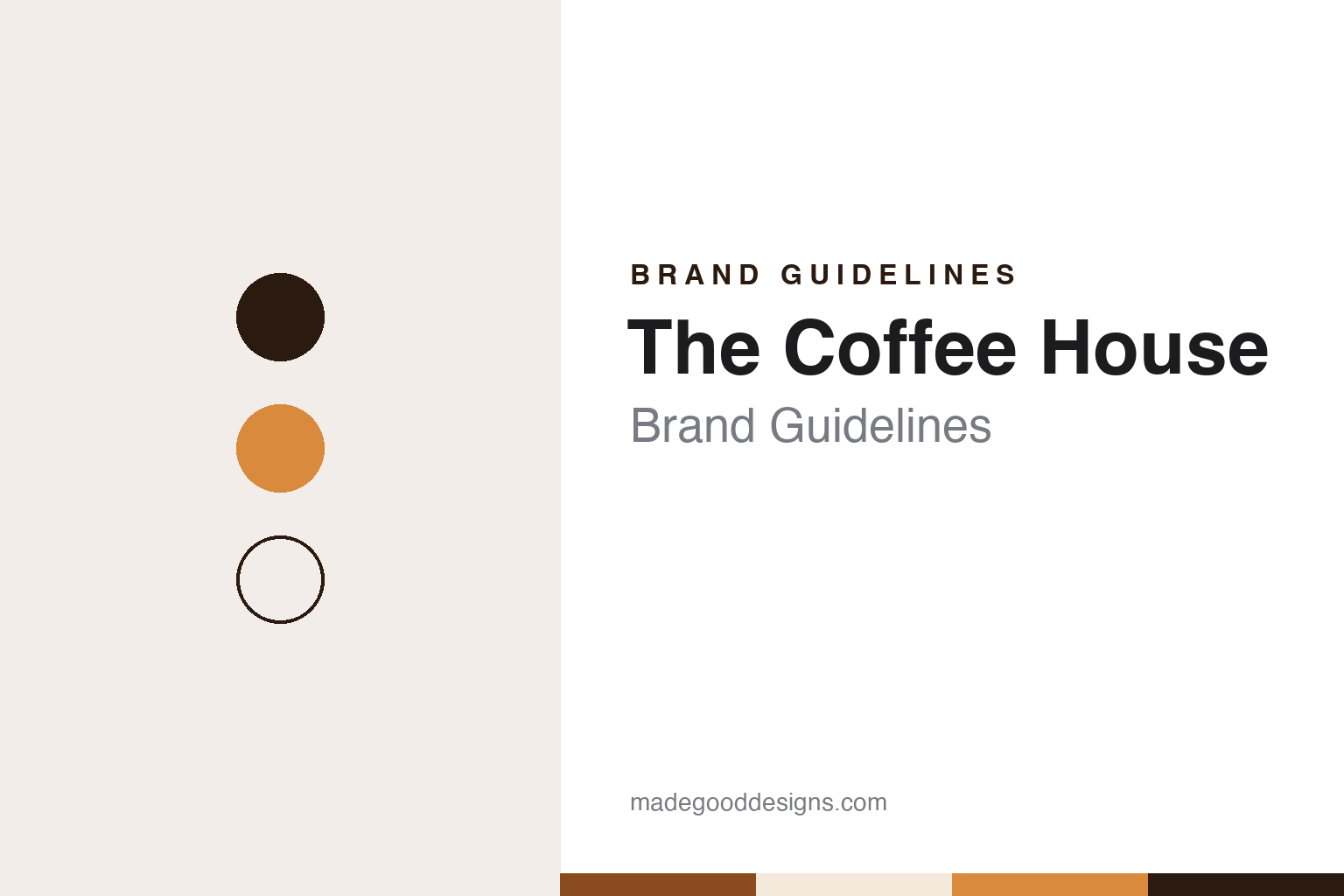
The Coffee House Brand Guidelines
A Saigon café chain built for sitting, then rebuilt around an app.
Aa
Two constants: a roast brown, amber and cream palette and a geometric sans register. Abstract homage — not a The Coffee House product or mark; no cup, logo or sign is reproduced.
Saigon, 2014
A café chain built around sitting and staying.
The Coffee House is a chain of coffee and tea shops that began in Ho Chi Minh City in 2014. English and Vietnamese Wikipedia both give that year and name its founder as Nguyễn Hải Ninh; Vietnamese Wikipedia adds that he had earlier set up another café chain, Urban Station, with a friend. In a June 2019 interview with Việt Nam News, Ninh said he first opened a coffee shop for a plain reason: he liked going to coffee shops.
He described meeting Đinh Anh Huân, founder of the Seedcom group and of the mobile-phone retailer Thế Giới Di Động, as the turning point. As Ninh told it, Huân’s view was that a trip to a café in Vietnam was less about the drink than about sitting with friends and family and building a network, and that idea became the plan for a “coffee house”.
That idea of the café as a room to stay in shaped the chain. VnExpress International wrote in February 2025 that The Coffee House was one of the chains that invested early in well-designed spaces, strong Wi-Fi and drinks suited to local tastes, and that it became a regular stop for freelancers and students who came to work or study.
Growth was fast. Vietnamese Wikipedia says the chain had 60 stores across Ho Chi Minh City by 2017. Việt Nam News reported in May 2019 that the company had opened 66 shops in 2018 alone and served about ten million customers that year, and English Wikipedia, citing VietNamNet, gives 140 locations in 2018. Vietnamese Wikipedia, citing VnExpress, says that in January 2023 it had 152 stores, the second-highest store count among Vietnamese coffee chains after Highlands Coffee. Not every venture lasted: Vietnamese Wikipedia says that in 2017 the company took the Vietnamese franchise of the Taiwanese tea brand Ten Ren, and that its 23 Ten Ren shops closed about two years later.
Colour
From Seedcom to Golden Gate.
For most of its life The Coffee House sat inside Seedcom, a retail group whose other businesses, according to English Wikipedia, include the shoe brand Juno and the delivery firms AhaMove and Giao Hàng Nhanh. English Wikipedia says that in June 2022 the company raised its charter capital and that Ficus Asia Investment, a Singapore-registered firm founded by Huân, took more than 23 per cent of the shares.
The top job changed hands several times. Vietnamese Wikipedia says Mai Hoàng Phương, a Seedcom co-founder, replaced Ninh as chief executive in 2019, and that Lê Bá Nam Anh followed in July 2021. Ngô Nguyên Kha, who told VnExpress International in January 2023 that he had been in charge since November 2021, had worked in technology and then run Seedcom’s fashion arm.
The network then shrank. VnExpress International reported in August 2024 that the chain had closed all its stores in Cần Thơ in July and was closing its last three in Đà Nẵng by the end of that month, leaving 117 outlets, about 30 fewer than at the end of 2023. Kha told the paper the closures were part of a change in business strategy aimed at cutting costs and improving performance across the system.
In February 2025 VnExpress International reported that Golden Gate, the restaurant group behind Kichi-Kichi, Gogi House and Manwah, had acquired The Coffee House from Seedcom, following a report by DealStreetAsia; neither side had made a statement at that point. In April 2025 Verdict Foodservice reported that Golden Gate had acquired a 99.98 per cent stake from Seedcom, and World Coffee Portal wrote that Golden Gate had confirmed the purchase. By then the chain ran 93 sites, mainly in Ho Chi Minh City and Hanoi, according to Verdict Foodservice, which described Golden Gate as a group founded in 2005 with about 500 restaurants across 22 brands.
Typography
Vietnamese café and restaurant chains.
Vietnam’s café and restaurant chains grew up in a country with a deep street culture of coffee, tea and noodle soup, and most of them present themselves through the shop itself. A chain’s identity is carried by its shopfronts and seating, by the cup a drink is handed over in, and by the bags of ground coffee and boxes of tea sold at the counter or in supermarkets.
Menus are built around named drinks and dishes rather than abstract promises. Coffee chains list house blends, iced coffee with condensed milk and ice-blended drinks; tea chains list fruit teas, milk teas and loose-leaf varieties from Vietnam’s highland growing areas; phở, pizza and hot-pot chains name their broths, toppings and set menus. Store formats vary too, from large flagship cafés to kiosks placed inside supermarkets, and the press has followed which formats the chains keep and which they close.
Ownership is often part of the story. Several of the chains in this set belong to wider groups: Highlands Coffee sits under SuperFoods, in which the Philippine group Jollibee Foods holds a stake, alongside Phở 24; Phúc Long is a subsidiary of the Vietnamese consumer group Masan; others covered here belong to the restaurant group Golden Gate or the retail group Seedcom, as their own guides set out. Store counts change quickly, so each guide gives its figures with the date and the publication that reported them.
Each guide sets out what can be checked about a brand from independent, dated reporting by publications such as VnExpress International, Tuoi Tre News, Viet Nam News and Vietnam Investment Review: who founded it, who owns it, how it trades and what its stores and products look like, with company statements marked as the company’s own word.
Aa
A clean geometric sans for a café chain’s menus and cups. (Specimen set in Montserrat, a sans STAND-IN; NOT The Coffee House logo.)
The Coffee House
Cups, a tea line and an app.
What the chain sells has shifted with its strategy. In the January 2023 interview Kha said The Coffee House had moved to more paper and plastic cups to make drinks faster, while still serving in glass and ceramic when customers ask, and that it was giving each drink line its own branding. He said customers’ liking for its Hi-tea drinks had turned them into a full-day tea line.
The larger change was online. VnExpress International reported in August 2024 that about half of the chain’s daily orders came through its own ordering app, which had been downloaded 1.8 million times, and that building that app had been a goal since the chain began; its leadership, the paper said, saw it as a way to keep control of customer data rather than rely on delivery platforms. The same report said the chain had earlier closed many stores in the 2020–21 period, including its Signature outlets designed for coffee lovers.
The company has also presented itself as a coffee producer. Việt Nam News described it in May 2019 as “a coffee shop chain and manufacturer” and reported its “From Farm to Cup” campaign, under which it said it bought beans from contract farms. Ninh told the paper that year that the company worked with growers at Cầu Đất, about 25 kilometres from Đà Lạt, and bought from farms in Gia Lai; those are the company’s own accounts of its sourcing.
For a design guide, The Coffee House shows how a café brand built on rooms and seating can move much of its business onto a phone screen and still keep a recognisable name through a change of owner. Compare Gogi House, another Golden Gate brand, and Highlands Coffee, another Vietnamese café chain. For this guide we use roast brown, amber and cream with a geometric sans, an unofficial interpretation; no product or logo is reproduced.
Explore & save
Keep The Coffee House’s identity on hand — save it to a board in the Made Good inspiration library.
The Coffee House identity set
Pin the roast brown, amber and cream palette and the geometric sans register to your own board.
Source & notes
Frequently Asked Questions
What font can I use to match the The Coffee House look?
This guide describes The Coffee House’s type as “A clean geometric sans for a café chain’s menus and cups”. Its type specimen is set in Montserrat from Google Fonts as a stand-in; Montserrat is not The Coffee House’s own lettering.
What colours are in the The Coffee House palette?
This guide’s The Coffee House palette is Roast brown #8A4B1F, Espresso #2B1A10, Milk foam #F4EADB, Caramel amber #D98A3D and Paper #FAF7F2. The tones are the guide’s own unofficial interpretation, not official The Coffee House hex codes.
When was The Coffee House founded?
The Coffee House was founded in 2014, in Ho Chi Minh City, Vietnam.
Who founded The Coffee House?
The Coffee House was founded by Nguyễn Hải Ninh in 2014.
Who owns The Coffee House?
The Coffee House is owned by Golden Gate (acquisition confirmed April 2025).