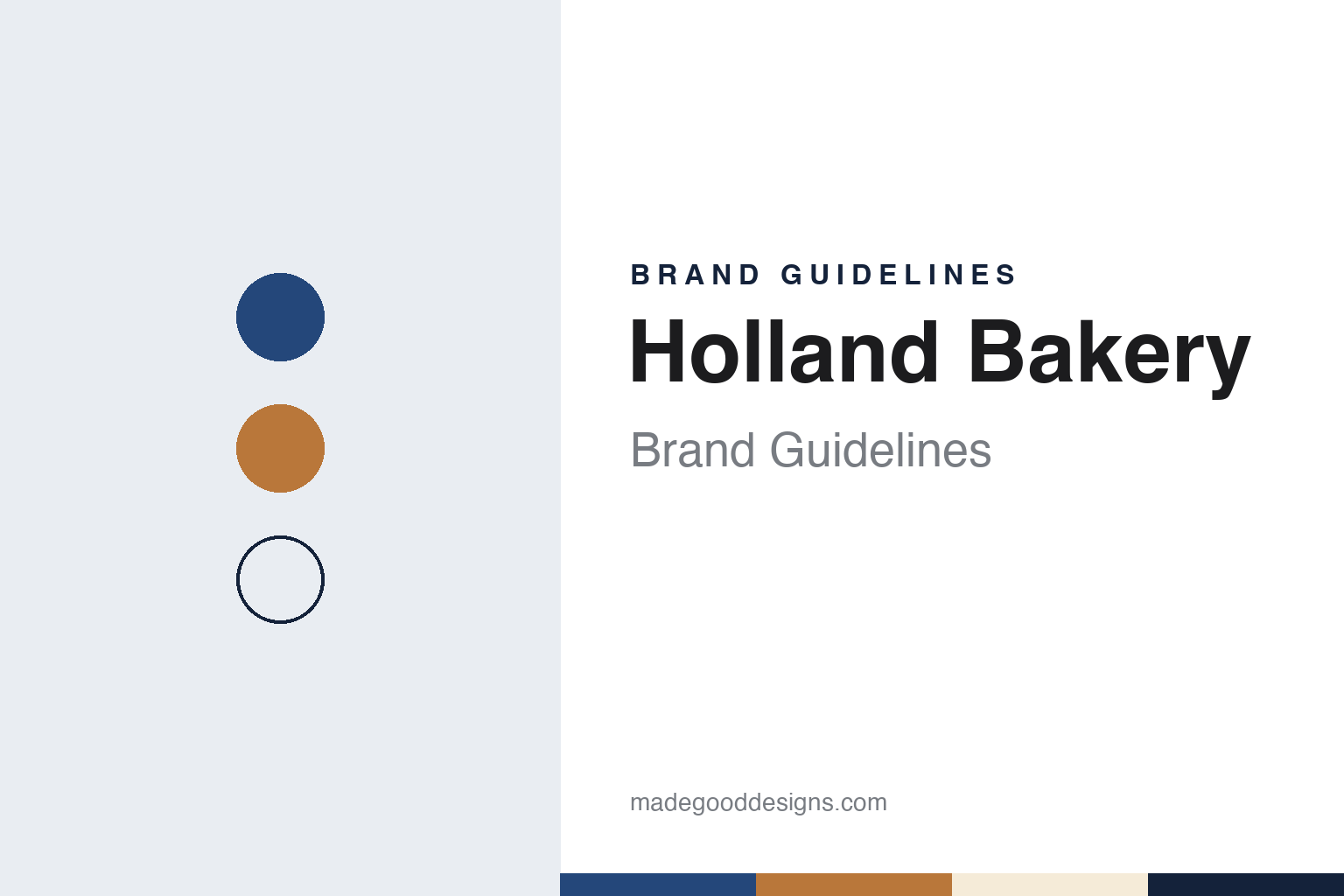
Holland Bakery Brand Guidelines
Jakarta’s 1978 windmill bakery chain.
Aa
Two constants: a Delft blue, crust brown and butter cream palette and a soft old-style serif register. Abstract homage — not a Holland Bakery product or mark; no cake, box, shopfront or logo is reproduced.
A Dutch name in Jakarta
An Indonesian bakery that borrowed a windmill.
Holland Bakery opened in Jakarta in 1978. The business is run by PT Mustika Citra Rasa, a Jakarta company, according to detikFinance in 2023 and 2024 and to Warta Ekonomi, which wrote in March 2025 that the firm set up the bakery that year with its first office in North Jakarta. Liputan6 reported in January 2023 that the chain was marking its 45th anniversary that month.
On the founding family, Medcom reported in June 2026 that Holland Bakery was founded by Boedyharto Angsono and is now run by the second generation of the family, and it linked the company to the family’s Asaba Group, whose main business is the distribution of stationery and office supplies. The same article describes the bakery’s early growth through the 1980s as demand for bread rose in Indonesia.
The name was a deliberate choice. Warta Ekonomi says “Holland” was chosen as a signal of quality associated with Dutch bread and cakes, and that the windmill was added as an easily recognised mark; it calls the name and the Dutch-style design of the shop buildings a deliberate trading strategy rather than a sign of Dutch ownership. Several Indonesian business articles, among them detikFinance in January 2023 and June 2024, open by explaining that the chain is not Dutch at all, because so many shoppers assume it is.
Growth beyond the capital came early. Warta Ekonomi dates the first expansion to 1981, three years after the first shop, with an outlet in Bandung, the capital of West Java, and describes that move as the start of a wider spread across Indonesia. Over the following decades the chain reached cities on Sumatra, Kalimantan, Sulawesi and Bali, and by the 2020s it was counting its shops in the hundreds, as the network figures below show. The brand name and the windmill stayed constant through that growth, and the company has kept its head office in North Jakarta, detikFinance reported in 2023.
Colour
A windmill on the roof and a counter of breads.
The windmill does double duty. detikFinance wrote in 2023 that a windmill in the Dutch style stands on top of Holland Bakery’s shop buildings, and in 2024 that the same symbol appears in the logo.
Inside, the range is wide. detikFinance listed breads, cakes, cookies and jajanan pasar, the traditional market snacks, naming items such as bika ambon, Black Forest cake, lemper ayam, pastel, nastar and plain sliced bread. Medcom adds arem-arem, pastries and puddings, and describes a self-service format in which shoppers pick the items they want themselves. The company’s own website sorts its menu into categories including Breads, Lapis, Traditional Snacks, Pastry and Danish, donuts, cakes, cookies and pudding, and calls Holland Bakery a “one stop bakery store.”
The brand voice leans on occasions. The website groups products under a “Choose Your Moment” heading, from coffee breaks and gatherings to breakfast and birthdays, and invites customers to share photos under the hashtag #HBmoment; the chain also runs a rewards app for online orders. detikFinance reported in 2023 that Holland Bakery holds a halal certificate from LPPOM MUI that applies to all of its outlets nationally.
The anniversary itself became a shop-floor event. Liputan6 reported that for its 45th birthday on 28 January 2023 the chain ran a one-day offer across all of its outlets in Indonesia, announced on its Instagram account, and that shoppers queued outside stores that morning; snacks such as donuts, pastries and lemper were sold in packs of three to five pieces of one kind rather than singly.
Typography
Design and documentation.
Indonesian restaurant, bakery, noodle, donut and café chains meet most of their customers in a small number of settings: the shopping mall, the airport, the railway station, the shophouse row and, increasingly, the rest areas along the toll roads. In each of these the shopfront has to work from a distance. A single dominant colour, a short name and a sign that can be read across a food court often do more of the identity work than any printed material.
Inside, the menu board is where a brand is defined. Chains in this category tend to name their dishes and drinks plainly, whether a fried rice, a noodle bowl, a bento set, a filled bun or an iced tea, and to group them into sets and children’s packages. Packaging follows the same logic: takeaway boxes, cups and bags carry the name and colours out of the room, and delivery-only kitchens and kiosk formats now let a brand trade with little more than a counter and its packaging.
The store network is itself part of the story the companies tell. Corporate pages often present history as a sequence of openings, a first outlet in a new city or on a new island, a numbered milestone store, and a running count of outlets and cities across the archipelago and, for some chains, abroad. Those counts change quickly, so each one needs its date attached.
Ownership is described in different ways. Some chains are run by a single private company that keeps every outlet in its own hands; others grow through franchise or partnership networks, and some sit inside larger food and drink groups. Founders’ stories, the operating company’s name and the halal certification a chain holds are commonly set out on the corporate pages, and the guides that follow give each of them only as the sources state them.
Aa
A soft old-style serif for a windmill bakery. (Specimen set in Fraunces, a serif STAND-IN; NOT the Holland Bakery logo.)
A name worth defending
A trademark case and a network of central kitchens.
The Dutch name brought a legal test. Warta Ekonomi reported in March 2025 that PT Mustika Citra Rasa applied to register “Holland Bakery” as a trademark in 1987, and that the trademark office of the day refused it because the mark used the name of a foreign country. After a dispute that went to a cassation appeal in 1988, the company registered the mark in 1990 for class 30, the class covering bread and cakes, the same report said.
The network is organised around regional branches that each supply a group of shops. Liputan6, citing the company in January 2023, counted 23 branches managing more than 450 outlets; detikFinance gave 25 branches and 470 outlets in June 2024, and Warta Ekonomi said there were more than 470 outlets by 2024. Medcom gave more than 540 in June 2026, naming cities from Greater Jakarta, Bandung and Surabaya to Medan, Makassar and Bali. For comparison, Indonesian Wikipedia, citing the company’s website in October 2013, gave a figure of more than 200 outlets at that time. As of November 2026, the company’s website says it runs 27 branches, which it describes as central kitchens, managing more than 581 outlets, in Greater Jakarta, Bandung, Surabaya, Lampung, Batam, Pekanbaru, Makassar, Manado, Bali, Solo, Semarang, Balikpapan, Samarinda and Pontianak.
For a design guide, Holland Bakery shows how a borrowed national symbol can become a local landmark: a windmill on the roof, a Dutch name over the door and a counter that mixes sliced bread with lemper and lapis. Compare Roti’O, the Indonesian bun chain, and J.CO Donuts & Coffee, another Indonesian bakery-café chain. For this guide we use Delft blue, crust brown and butter cream with a serif, an unofficial interpretation; no product or logo is reproduced.
Explore & save
Keep Holland Bakery’s identity on hand — save it to a board in the Made Good inspiration library.
Holland Bakery identity set
Pin the Holland Bakery Delft blue, crust brown and butter cream palette and the soft old-style serif register to your own board.
Source & notes
Frequently Asked Questions
What font can I use to match the Holland Bakery look?
This guide describes Holland Bakery’s type as “A soft old-style serif for a windmill bakery”. Its type specimen is set in Fraunces from Google Fonts as a stand-in; Fraunces is not Holland Bakery’s own lettering.
What colours are in the Holland Bakery palette?
This guide’s Holland Bakery palette is Delft blue #24477A, Ink blue #14223A, Crust brown #B9773A, Butter cream #F5EBD8 and Sail white #FBF8F2. The tones are the guide’s own unofficial interpretation, not official Holland Bakery hex codes.
When was Holland Bakery founded?
Holland Bakery was founded in 1978, in Jakarta, Indonesia. Holland Bakery is known for Breads, cakes, lapis, traditional snacks.