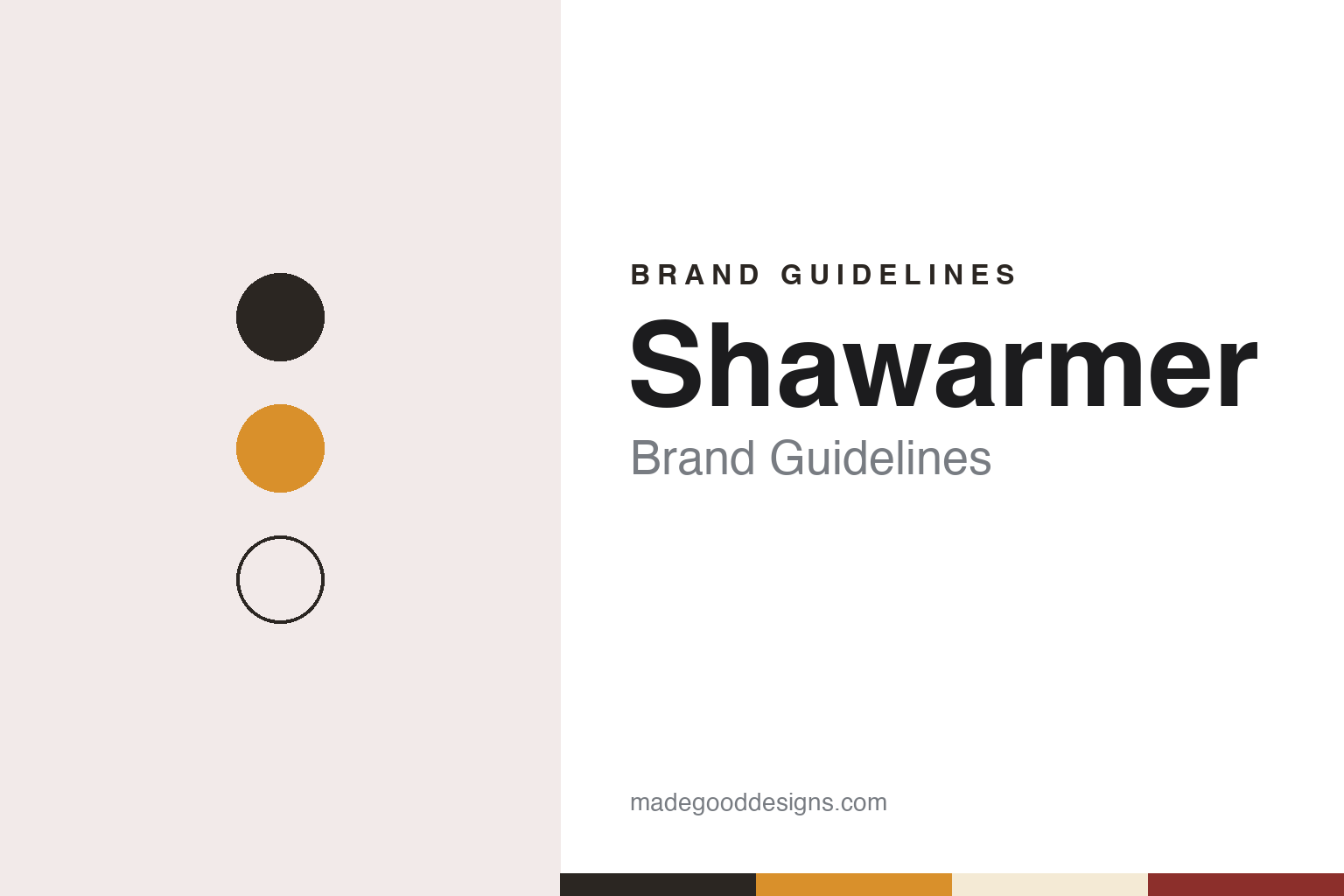
Shawarmer Brand Guidelines
The Riyadh chain that built a brand on one street food.
Aa
Two constants: a Shawarmer charcoal and saffron palette and a Rounded sans register. Abstract homage — not a Shawarmer product or mark; no packaging, logo or sign is reproduced.
From Two in One to Shawarmer
Two university friends in Riyadh.
Shawarmer is a Riyadh shawarma chain whose first branch opened in 1999. The company’s own website dates its founding to that year, and so do English and Arabic Wikipedia and the Saudi men’s magazine Arrajol, which profiled the chain in February 2020. Its founders were Abdulmohsin Al Rabiah and Ahmad Al Rasheed; the company’s website now lists Al Rabiah as chairman and Al Rasheed as co-founder and chief executive.
The founders had run a restaurant before. The columnist Ammar Bakkar, writing in the Saudi daily Al Watan in May 2013, described Al Rabiah as a co-founder, with three other university students, of a restaurant called “Two in One” before Shawarmer. Through Shawarmer, Bakkar wrote, Al Rabiah had brought a new concept to shawarma and extended it across many branches.
Arabic Wikipedia describes Shawarmer as launched as a modern alternative to the familiar shawarma sandwich. Arrajol wrote in 2020 that the chain set itself apart by its focus on shawarma, a meal long familiar in Saudi society, developed with fresh, natural ingredients and new flavours, and that these variations found favour with local diners before the chain moved from its starting point in Riyadh to Jeddah.
English Wikipedia’s timeline sketches the early years: after the first branch in 1999, a first main-street location followed in 2002, and in 2005 the chain opened its first location outside the traditional street-front format.
The company behind the brand is a holding group. Arrajol described Shawarmer in 2020 as wholly owned and run by Innovative Foods Holding, and English Wikipedia lists it as a private company. Arabic Wikipedia gives the operating company’s name as Shawarmer Food Company Limited.
Colour
Shawarma as the hero of the menu.
The concept is narrow by design. Shawarmer’s website says that since 1999 shawarma has been “the centrepiece of our menu,” and that the chain sets out to take a traditional street food and reinterpret it with new flavours, sauces, wraps and sandwich styles. English Wikipedia describes the concept as applying the Western fast-food chain’s emphasis on consistency to the traditional shawarma shop. The same page promises that shawarma “will always be the hero of our menu.”
The menu names carry the brand’s tone. The website names the Shawarmer’s Plate as the dish the chain grew from, alongside Arabo, an Arabic sharing plate; Shat’shaweesh, a spicy shawarma; and Bites, six small shawarma sandwiches. It says its chefs have added flavours such as pomegranate molasses, and that the names of its meals are meant to signal their ingredients and the way they are served. Arrajol counted about fifteen meal types in 2020, including Duo and Tannouri among other names, with chicken and beef versions and shared platters.
The look of the restaurants has changed at least once. English Wikipedia’s timeline records a major brand overhaul and a re-engineered menu in 2008, the year the chain first expanded beyond Riyadh and Jeddah; Arabic Wikipedia describes the same year as a rebuilding of Shawarmer’s identity and trade mark. The company’s website names open kitchens and restaurant design among the places where it applies what it calls innovation, and presents the open kitchen as a statement of transparency about how its food is prepared.
The same English Wikipedia timeline records the chain’s 20th restaurant and its first franchised branches, in Yanbu and Khobar, in 2011, along with a new menu structure and limited-time offers; Arabic Wikipedia adds that the same year the chain began to put more weight on talking with customers through social media. The website’s team list includes a chief marketing and brand officer and a chief culinary officer.
Typography
Design and documentation.
The fast-food chains of Saudi Arabia, the United Arab Emirates and Lebanon include several that began as a single restaurant in one city. ALBAIK dates itself to a Jeddah chicken shop opened in 1974 and took its present name in 1986; Kudu opened its first sandwich counter in Riyadh in April 1988. Their histories are told in two places: the companies’ own “our story” pages, and the business press of the Gulf and beyond.
What the companies publish about themselves is often bilingual: ALBAIK’s and Kudu’s websites, for example, run in English and Arabic, with the name set in Latin capitals. Menus are presented by named dishes and meals rather than by price lists: fried-chicken meals and garlic sauce, made-to-order sandwiches and burgers, shawarma wraps, falafel, man’oushe flatbreads and mixed grills, depending on the chain. Open kitchens, drive-throughs, food-court counters and petrol-station units appear as formats in their own right.
Restaurant networks are often counted by the companies themselves, so the numbers change with the date of the page. Expansion abroad often runs through partners: ALBAIK entered the UAE in 2021 with an Abu Dhabi operator, and Kudu opened its first franchise outside Saudi Arabia, in Kuwait, in 2026. Ownership can change too: Kudu passed from family ownership to private-equity investors in 2015 and to a regional investment group in 2022.
This guide sets out what can be checked about each chain — who founded it, who owns it, where it trades and which dishes it names — and attributes what rests only on the company’s word. The palettes and typefaces shown are unofficial interpretations, and no logo, sign or packaging is reproduced.
Aa
A rounded sans — named dishes as the voice. (Specimen set in Rubik, a sans STAND-IN; NOT the Shawarmer logo.)
Shawarmer
A national network in dated snapshots.
The network’s growth is recorded in dated snapshots. English Wikipedia’s timeline counts five stores in 2003, twelve in 2005 and twenty in 2011, and records the 100th restaurant in 2019, citing the Saudi Gazette. In February 2020 Arrajol counted 110 branches in 21 Saudi cities, after the chain spread from Riyadh to Jeddah and beyond. Arabic Wikipedia, citing the company’s website in 2021, gives more than 160 branches in 17 cities, while the company’s current “Our Story” page says it has grown to “more than 90 restaurants and counting.” English Wikipedia also records a first branch in Egypt in 2022, and Arabic Wikipedia gives a staff of 1,340 as of August 2020. Arabic Wikipedia lists branches in more than twenty Saudi cities, from Riyadh, Jeddah and Dammam to Tabuk, Jazan and Najran.
The brand also reaches beyond the counter. In January 2020 the Saudi gaming site True Gaming reported that a Shawarmer branch in Riyadh would host a three-day launch event for the video game Dragon Ball Z: Kakarot, from 16 to 18 January, open to all, with a costume contest, giveaways and a draw for a special edition of the game. Entrants were asked to post photos taken inside the branch under the hashtag “Shawarmer gamers” in Arabic.
For a design guide, Shawarmer shows how a chain can build an identity around a single street food and a set of named dishes. Compare Herfy, another Riyadh chain with a national network, and Kudu, a Riyadh fast-food chain. For this guide we use a charcoal, a saffron and a flatbread cream with a sans, an unofficial interpretation; no product or logo is reproduced.
Explore & save
Keep Shawarmer’s identity on hand — save it to a board in the Made Good inspiration library.
Shawarmer identity set
Pin the Shawarmer charcoal and saffron palette and the Rounded sans register to your own board.
Source & notes
Frequently Asked Questions
What font can I use to match the Shawarmer look?
This guide describes Shawarmer’s type as “A rounded sans — named dishes as the voice”. Its type specimen is set in Rubik from Google Fonts as a stand-in; Rubik is not Shawarmer’s own lettering.
What colours are in the Shawarmer palette?
This guide’s Shawarmer palette is Charcoal grill #2B2622, Saffron #D9902B, Flatbread cream #F4EAD5, Sumac #8C2F2B and Paper #FBF8F2. The tones are the guide’s own unofficial interpretation, not official Shawarmer hex codes.
When was Shawarmer founded?
Shawarmer was founded in 1999, in Riyadh, Saudi Arabia. Shawarmer is known for Shawarmer’s Plate, Arabo, Bites.
Who founded Shawarmer?
Shawarmer was founded by Abdulmohsin Al Rabiah and Ahmad Al Rasheed in 1999.
Who owns Shawarmer?
Shawarmer is owned by Innovative Foods. Shawarmer is known for Shawarmer’s Plate, Arabo, Bites.