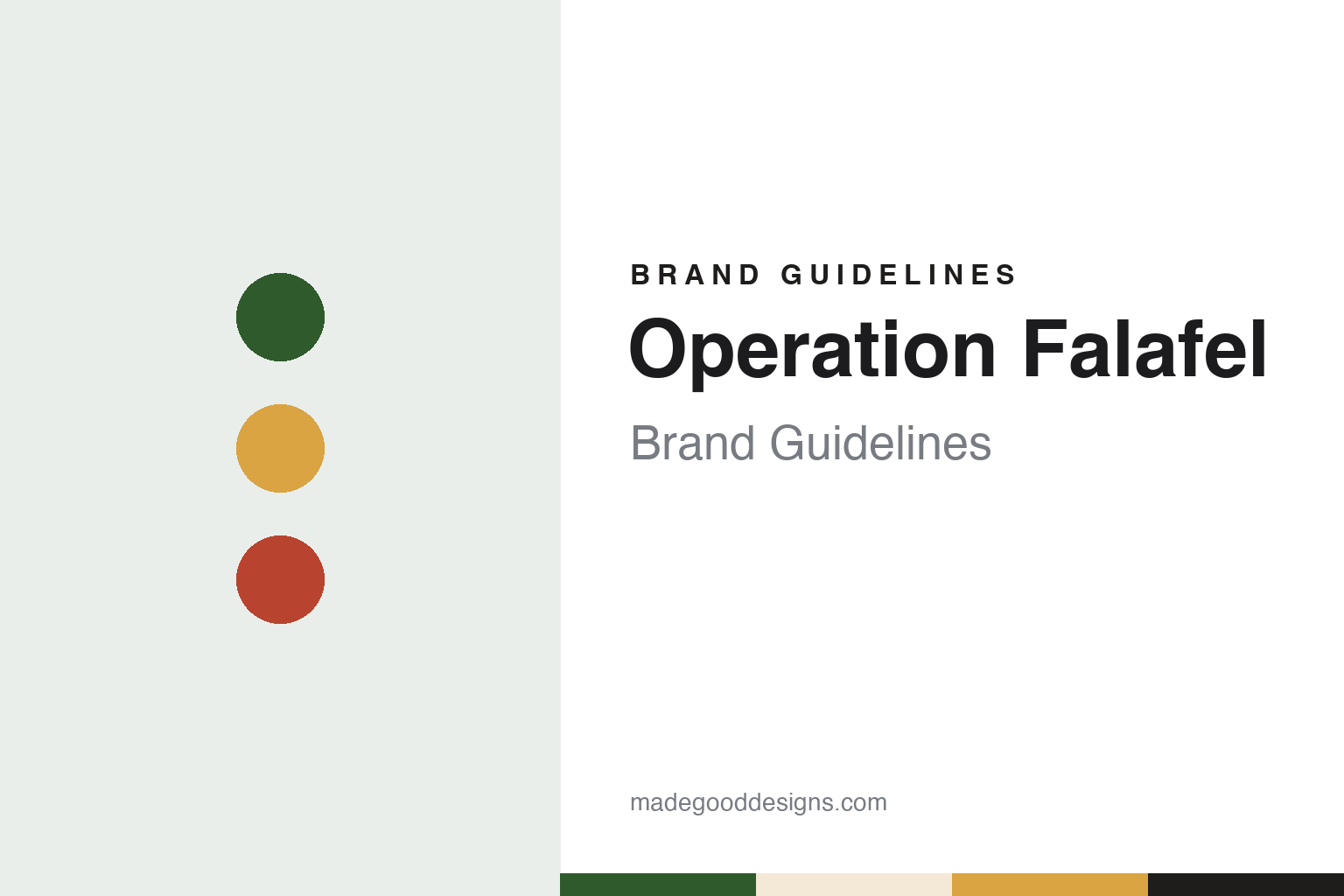
Operation Falafel Brand Guidelines
The Dubai street-food chain born at JBR in 2014.
Aa
Two constants: a green, cream and chickpea-gold palette and a heavy street sans register. Abstract homage — not an Operation Falafel product or mark; no logo, sign or packaging is reproduced.
The Beach, 2014
A falafel counter on The Walk at JBR.
Operation Falafel, which the company and much of the press write as Operation: Falafel and sometimes shorten to O:F, is a Dubai chain built around Arabic street food: falafel, hummus and shawarma. Its first restaurant opened in March 2014 inside The Beach, the retail and dining development along The Walk at Jumeirah Beach Residence, Images RetailME reported in May 2022. Other dated coverage gives the same year. Fast Casual, the American restaurant trade title, described the brand in June 2021 as founded in 2014, and Gulf News wrote in March 2023 that its parent group had opened its first outlet in Dubai in 2014.
The founder named in that coverage is Manhal Naser, who led the parent company, AWJ Investments, as group chief executive. In his 2022 interview with Images RetailME, Naser said that he and his partner had noticed traditional Middle Eastern food being reworked with new ingredient combinations, and that they saw room for a brand serving fresh street food in the older style. He explained the unusual name in the same interview: “The ‘Operation:’ stood for our mission to bring back the authenticity of the traditional foods that we grew up on.”
Entrepreneur Middle East called Operation Falafel the flagship of AWJ in June 2022, and Gulf News listed it first among the group’s restaurants in March 2023, ahead of Catch 22, Awani and Sushi Do.
The group grew out of the falafel brand. In the Entrepreneur Middle East profile, Naser said AWJ had started in 2014 with five food concepts, of which Operation Falafel was the first, and that by mid-2022 it ran 13 concepts across the UAE and Saudi Arabia, among them Awani, Catch22, Smoky Beach, Murjan Cafe, SushiDo and SurfBite. He named Operation Falafel alongside Awani Express, Habibi and SushiDo as the group’s strongest delivery brands.
Colour
Pita, hummus and a delivery map.
The menu stays close to the dishes in the name. When the chain opened in New York in 2021, Fast Casual described freshly baked pita bread, falafel fried to order and house-made hummus, served for dine-in, takeaway and delivery. In its May 2022 profile, Images RetailME described pitas packed with falafel, salty pickles and fries, and quoted the company’s account of food that is “handcrafted and presented by chefs” in a contemporary room rather than simply cooked and plated.
Delivery became a large part of the business. Images RetailME reported in May 2022 that the chain delivered to 118 areas of Dubai, and that it had reached 46 outlets in total by then. Naser told the magazine that after the UAE the brand had grown into Saudi Arabia, naming Riyadh, Al Khobar and Dammam, and then into New York and London.
The American opening came in June 2021. Fast Casual reported the debut in New York that month, and Entrepreneur Middle East later described it as the first international branch of the chain. The interiors are where the brand’s look is described most directly. Naser told Fast Casual that the New York room was “edgy and industrial”, designed to draw guests into the culture of the food, with energetic graphics painted on the walls in a graffiti style to tell the brand’s story. The same report quoted him describing the food as simple Middle Eastern cooking “served with a side of street credibility”. The New York branch offered takeaway, delivery and dine-in service and seated up to 57 guests, the trade title reported.
The group also built kitchens for delivery alone. Entrepreneur Middle East reported in June 2022 that AWJ had opened DKitchen, a delivery kitchen at Dubai Silicon Oasis, in mid-2021, built to house a number of the group’s food concepts under one roof.
Typography
Design and documentation.
The fast-food chains of Saudi Arabia, the United Arab Emirates and Lebanon include several that began as a single restaurant in one city. ALBAIK dates itself to a Jeddah chicken shop opened in 1974 and took its present name in 1986; Kudu opened its first sandwich counter in Riyadh in April 1988. Their histories are told in two places: the companies’ own “our story” pages, and the business press of the Gulf and beyond.
What the companies publish about themselves is often bilingual: ALBAIK’s and Kudu’s websites, for example, run in English and Arabic, with the name set in Latin capitals. Menus are presented by named dishes and meals rather than by price lists: fried-chicken meals and garlic sauce, made-to-order sandwiches and burgers, shawarma wraps, falafel, man’oushe flatbreads and mixed grills, depending on the chain. Open kitchens, drive-throughs, food-court counters and petrol-station units appear as formats in their own right.
Restaurant networks are often counted by the companies themselves, so the numbers change with the date of the page. Expansion abroad often runs through partners: ALBAIK entered the UAE in 2021 with an Abu Dhabi operator, and Kudu opened its first franchise outside Saudi Arabia, in Kuwait, in 2026. Ownership can change too: Kudu passed from family ownership to private-equity investors in 2015 and to a regional investment group in 2022.
This guide sets out what can be checked about each chain — who founded it, who owns it, where it trades and which dishes it names — and attributes what rests only on the company’s word. The palettes and typefaces shown are unofficial interpretations, and no logo, sign or packaging is reproduced.
Aa
A heavy street sans for a name with a colon in it. (Specimen set in Archivo Black, a sans STAND-IN; NOT the Operation Falafel logo.)
Operation Falafel
From AWJ to Kitopi.
The chain changed hands in 2023. On 1 March 2023, Gulf News reported that Kitopi, the Dubai cloud-kitchen company, had bought AWJ, the operator behind Operation Falafel, Catch 22, Awani and Sushi Do. The value was not disclosed. At the time of the sale AWJ had more than ten brands and more than 32 outlets in the UAE and Saudi Arabia, ran franchises in New York and London, and employed more than 1,300 people, the newspaper reported. Wamda, the regional start-up publication, reported the deal the same day.
Kitopi itself was founded in Dubai in January 2018, Gulf News noted, and began as a kitchen-as-a-service business before describing itself as a multi-brand restaurant group. Under the deal, AWJ took a new chief executive but kept its own team and was run as a separate part of Kitopi, apart from its on-demand delivery business, Gulf News reported. The newspaper added that Kitopi then had more than 100 brands in more than 200 locations across five markets, offices in Saudi Arabia, the UAE, Kuwait, Qatar and Bahrain, and an engineering hub in Kraków, Poland, and that AWJ’s brands would gain access to Kitopi’s own kitchen software, which it calls the Smart Kitchen Operating System. As of March 2023, then, Operation Falafel was the flagship of a Kitopi-owned restaurant group whose outlets were concentrated in the UAE and Saudi Arabia.
For a design guide, Operation Falafel shows how a name with a twist of punctuation can carry a whole identity, leaving the food itself plain and familiar. Compare Shawarmer, a Saudi chain built around a single street dish, and Zaatar w Zeit, a Lebanese chain that also grew through the UAE. For this guide we use a parsley green, a tahini cream, a chickpea gold and a chilli red with a heavy sans, an unofficial interpretation; no product or logo is reproduced.
Explore & save
Keep Operation Falafel’s identity on hand — save it to a board in the Made Good inspiration library.
Operation Falafel identity set
Pin the Operation Falafel green, cream and chickpea-gold palette and the heavy street sans register to your own board.
Source & notes
Frequently Asked Questions
What font can I use to match the Operation Falafel look?
This guide describes Operation Falafel’s type as “A heavy street sans for a name with a colon in it”. Its type specimen is set in Archivo Black from Google Fonts as a stand-in; Archivo Black is not Operation Falafel’s own lettering.
What colours are in the Operation Falafel palette?
This guide’s Operation Falafel palette is Parsley green #2F5A2C, Tahini cream #F3E9D6, Chickpea gold #D9A441, Chilli red #B8432F and Street ink #1E1D1B. The tones are the guide’s own unofficial interpretation, not official Operation Falafel hex codes.
When was Operation Falafel founded?
Operation Falafel was founded in First outlet March 2014, in Dubai, UAE.
Who founded Operation Falafel?
Operation Falafel was founded by Manhal Naser in First outlet March 2014.
Who owns Operation Falafel?
Operation Falafel is owned by AWJ, a Kitopi company (since 2023).