Grill’d Brand Guidelines
The Hawthorn burger chain founded in 2004.
Aa
Two constants: a charcoal, ember and leaf palette and a bold grotesque sans register. Abstract homage — not a Grill’d product or mark; no logo, burger or pack is reproduced.
Hawthorn, 2004
A brand manager leaves Foster’s to open a burger restaurant.
Grill’d opened in Hawthorn, a suburb in the inner east of Melbourne, in 2004. Its founder, Simon Crowe, had worked in marketing at Procter & Gamble, Davenport and Foster’s, where he was an international brand manager, Dynamic Business reported in September 2008. He left Foster’s towards the end of September 2003 intending to open the first restaurant straight away, but a prospective lease fell through at the last minute, and he used the gap to develop the business plan further, the magazine reported.
While travelling for Foster’s, Crowe told Dynamic Business, he had seen what he called the “rise of burgers” in the United Kingdom and New Zealand, and concluded that Australia had room for a new kind of burger restaurant. English Wikipedia adds that he was drawn to the service style he had seen in Milwaukee while working for the brewer. He called on two young chefs he knew to settle the menu, and the recipes were worked out over many weekends of tasting with friends, the magazine said.
Growth was gradual at first. By September 2008 there were nine Grill’d restaurants, three of them franchises, all built from a base in Victoria, Dynamic Business reported. SmartCompany profiled Crowe in September 2010 as founder and managing director, then in his sixth year of running the business, and described him adjusting the décor himself during an interview at the chain’s Degraves Street restaurant in central Melbourne.
The business has stayed under its founder’s leadership. retailbiz called Crowe the founder and managing director in August 2025, and the Guardian described him as chief executive in June 2026. English Wikipedia describes Grill’d as mainly company-owned, with some franchised locations.
Colour
From Melbourne to Bali, drive-throughs and supermarket shelves.
From Victoria the chain spread to the other states. In December 2019 it opened its first restaurant outside Australia, in Seminyak on Bali, according to English Wikipedia, and Business Franchise Australia & New Zealand counted more than 150 restaurants across Australia plus the Bali site in September 2024. retailbiz gave a figure of 174 restaurant locations in August 2025, and the Guardian reported in June 2026 that the chain operated 180 stores.
Formats have widened. The first two Grill’d restaurants with drive-through lanes opened at Mount Ommaney, in Brisbane’s south-west, and at Chadstone, in Melbourne’s south-east, Business Franchise Australia & New Zealand reported in September 2024; English Wikipedia dates them to June 2023 and August 2024. The magazine reported that Crowe wanted drive-through customers to get the full menu rather than a reduced one. In May 2023, English Wikipedia says, the chain opened a halal-certified restaurant at Blacktown in western Sydney, and from May 2024 it supplied halal meat, bacon aside, to all its restaurants.
The menu has moved with the market. English Wikipedia records meat-free burgers made with Beyond Meat patties from April 2019, an Impossible burger from November 2021, and a fried-chicken line that began in 2020 and grew to burgers and tenders. On 6 August 2025 Grill’d launched its first retail range, burger patties sold only at Coles supermarkets in a signature beef version and a wagyu version with caramelised onion, retailbiz reported; English Wikipedia says seven sauces joined the range in May 2026.
Limited editions do much of the visual work. English Wikipedia lists a burger with a pink bun released alongside the Barbie film in July 2023, a “Storm Burger” with a purple bun for the Melbourne Storm rugby league club, a partner since 2020, and a burger co-designed with a Formula One driver in February 2025. The Melbourne Demons football club named Grill’d a major partner in January 2025, English Wikipedia says.
Typography
The Australian burger trade.
Australian and New Zealand food chains usually present themselves through a small set of repeated parts: a shopfront and sign that can be read from across a car park, a menu built around a few named products, and a story about the suburb where the first shop opened. Roast and charcoal chicken, burgers, pies, muffins, juice, pizza and patisserie each have their own version of that formula, but the structure is shared.
Many of these brands are franchised, and their own pages say so plainly. A typical corporate site explains that each restaurant or café is run by a local franchisee, lists stores by suburb and state, and keeps a separate page for prospective franchise partners. Store formats are named rather than described: drive-thru, shopping centre, strip store, express counter. Store counts appear in trade press with a date attached, and they move as shops open and close.
Ownership is often layered. Several chains sit inside larger groups or private equity portfolios, so one parent may hold more than one brand in the same category; Craveable Brands, for example, owns Red Rooster, Oporto and Chicken Treat. Founders tend to stay in the brand story long after a sale, and company pages keep the founding year, the first shop and the first signature product in view.
Expansion abroad is a recurring chapter, from New Zealand to Asia, the Middle East, Britain and the United States, and the record is uneven, with some markets opened and later left. For designers, these brands are useful studies in how a local takeaway turns its name, colours and a handful of signature items into a system that franchisees can repeat from one suburb to the next.
Aa
A bold grotesque sans for a short, contracted name. (Specimen set in Archivo, a sans STAND-IN; NOT the Grill’d logo.)
Grill’d
Restaurants drawn by designers from outside food.
The look of the restaurants was meant from the start to stand apart from the multinational chains. When it came to designing the stores, Crowe told Dynamic Business in September 2008, the company deliberately chose creatives from outside the food sector: “We wanted somebody who was a non-food-based designer so they could look at this with different eyes.” In a category dominated by multinationals, he said, “we didn’t want to be confused with them in the slightest.” He described the chain’s real neighbours as the cafés, Thai restaurants, noodle bars and contemporary Australian food places around each site, which together made “a destination for convenience food.”
Grill’d was not his first business idea. Crowe told Dynamic Business that it took ten years and five ideas, among them pet insurance, an energy drink and car washing, before the burger chain came together, and that he had been wary of starting a food business because it lay outside his own experience. SmartCompany reported in September 2010 that he had drawn up many business plans before settling on Grill’d.
People and property were the two things he named as the backbone of the business. In the 2008 interview he praised his two business partners. He also described team leaders’ budgets for rewarding staff with time off and an annual party for all team members, and said that store locations, alongside staff, were the main challenge in growing the chain.
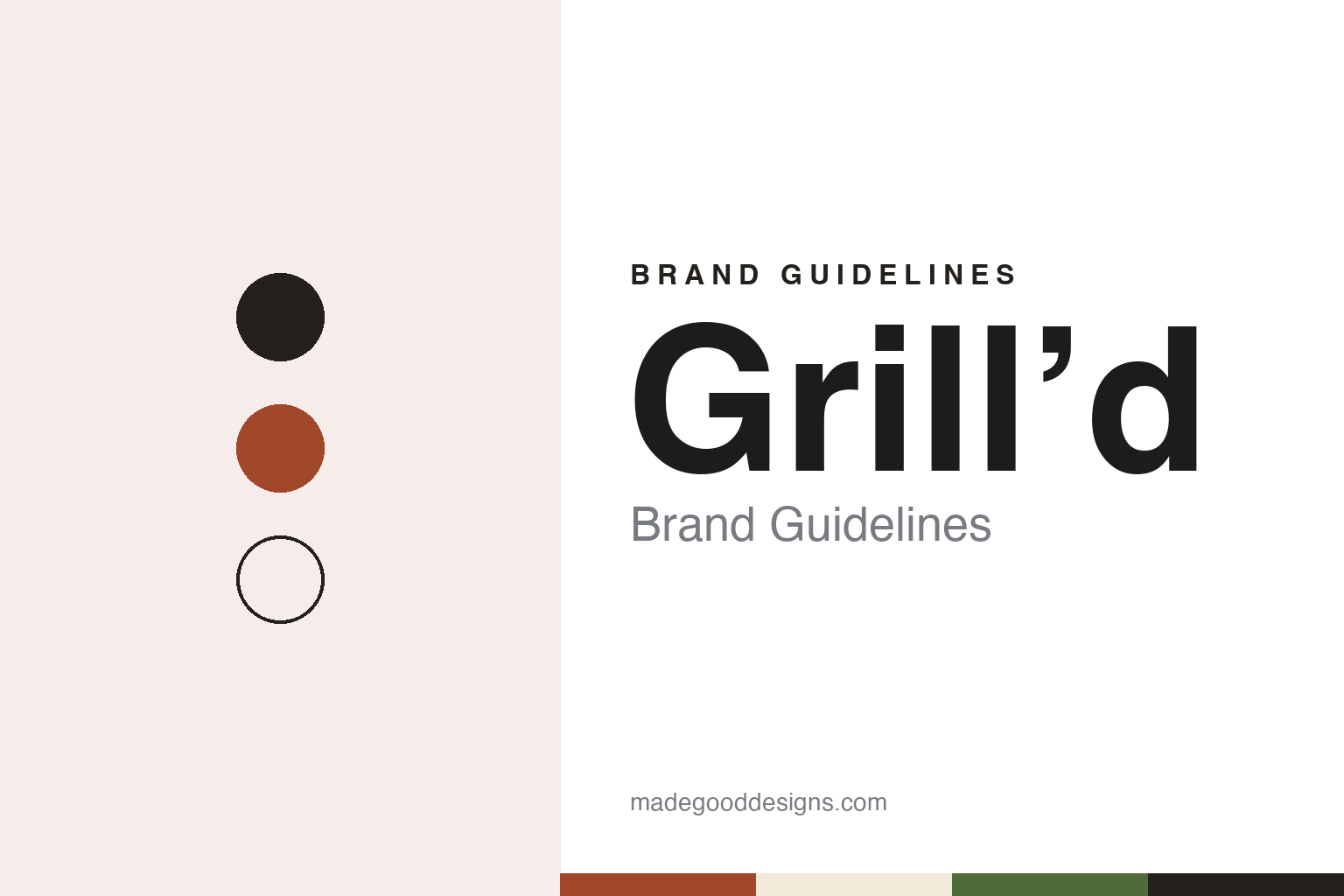
For a design guide, Grill’d shows how a founder-led chain can keep one short, contracted name across city restaurants, drive-through lanes, a Bali outlet and supermarket packs, with interiors briefed to designers from outside the food trade. Compare Hungry Jack’s, the Australian burger chain that trades in place of Burger King, and Red Rooster, another Australian quick-service chain from this series. For this guide we use charcoal, ember orange, leaf green and bun cream with a bold sans, an unofficial interpretation; no product or logo is reproduced.
Explore & save
Keep Grill’d’s identity on hand — save it to a board in the Made Good inspiration library.
Grill’d identity set
Pin the Grill’d charcoal, ember and leaf palette and the bold grotesque sans register to your own board.
Source & notes
Frequently Asked Questions
What font can I use to match the Grill’d look?
This guide describes Grill’d’s type as “A bold grotesque sans for a short, contracted name”. Its type specimen is set in Archivo from Google Fonts as a stand-in; Archivo is not Grill’d’s own lettering.
What colours are in the Grill’d palette?
This guide’s Grill’d palette is Charcoal grill #24201C, Ember orange #A2482A, Leaf green #4F6B3A, Bun cream #F3EADB and Paper #FAF7F2. The tones are the guide’s own unofficial interpretation, not official Grill’d hex codes.
When was Grill’d founded?
Grill’d was founded in 2004, in Hawthorn, Melbourne. Grill’d is known for Burger restaurants, drive-throughs, a Coles patty range.
Who founded Grill’d?
Grill’d was founded by Simon Crowe in 2004. Grill’d is known for Burger restaurants, drive-throughs, a Coles patty range.