Kesko Brand Guidelines
The retailers’ own wholesaler, and a K that once counted store sizes.
Aa
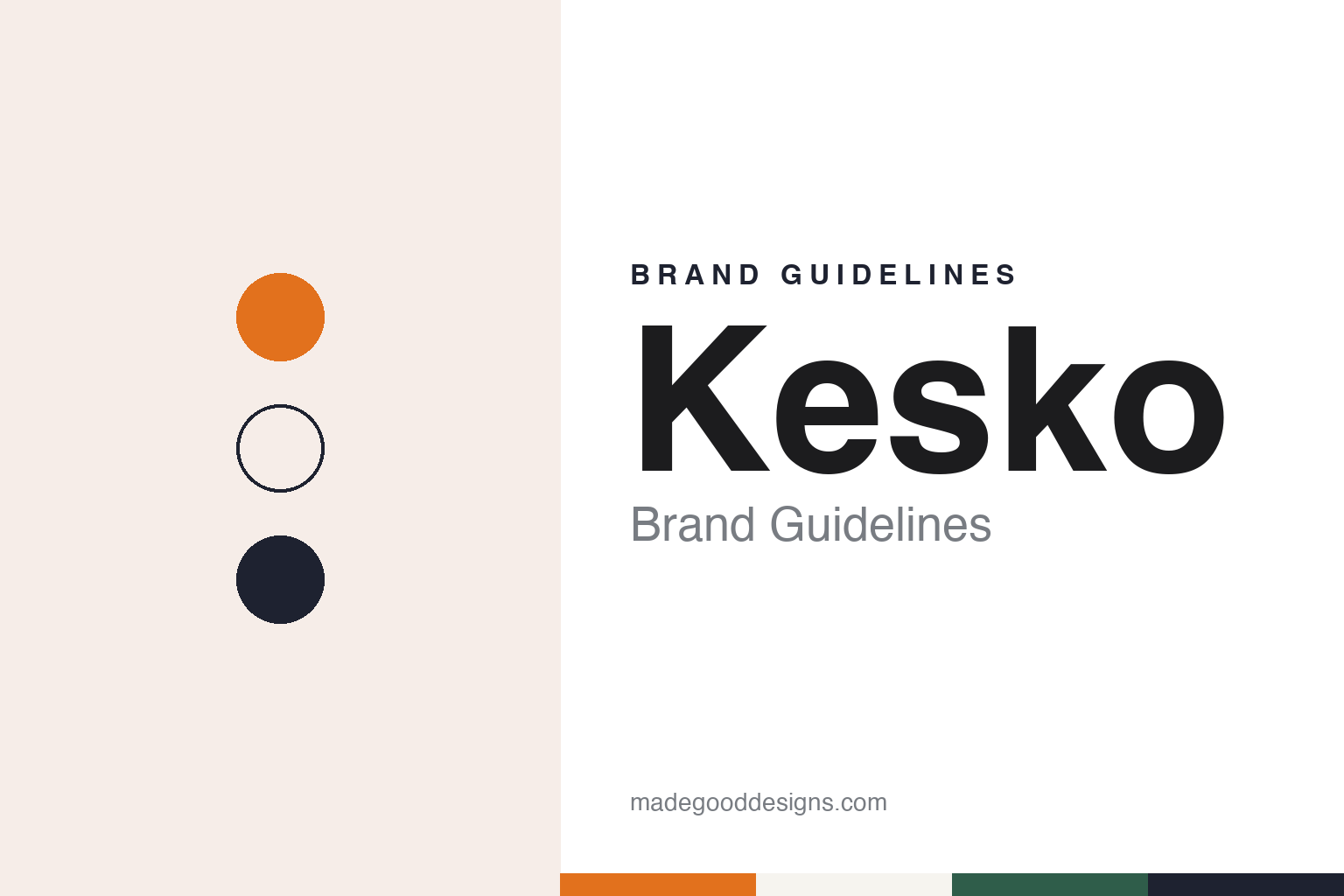
Two constants: a Kesko orange, birch white and deep ink palette and a rounded geometric sans register. Abstract homage — not a Kesko or K-Group mark; no logo, store sign or own-label pack is reproduced.
Four wholesalers
A wholesaler set up by the retailers it served.
Kesko was formed in October 1940, when four regional wholesale companies that had been founded by retailers were merged into one national wholesaler. Finnish Wikipedia names them as Maakauppiaiden Oy, Oy Savo-Karjalan Tukkuliike, Kauppiaitten Oy and Keski-Suomen Tukkukauppa Oy. The new company began trading at the start of 1941. English Wikipedia says the need to buy goods for the shareholder-retailers, support their businesses and get them working together is what produced the K-retailer group.
The name was chosen with care. Finnish Wikipedia says Kesko was picked partly because the word did not mean anything widely known, and that the first managing director was Kalle Heikki Lehtinen. The company’s first head office was a red-brick building on Katajanokka in Helsinki, designed by the architect Toivo Paatela and completed in 1940, which also housed a coffee roastery and a banana-ripening plant, the same article says.
For its first decades Kesko also made goods. Finnish Wikipedia lists a match and margarine factory, a flour mill, a bakery, a meat-processing plant, several clothing factories and a bicycle assembly plant among its early operations. By the mid-1980s it had given up all of them except its coffee roastery, known in its last years as Viking Coffee, which it sold to Paulig in 2003.
Getting goods to the stores shaped the company’s buildings. Because Katajanokka was linked to the mainland by a single narrow bridge, Finnish Wikipedia says, Kesko built a central warehouse at Hakkila in Vantaa, on land owned by the state railways, which opened on 1 March 1966. The site added a banana-ripening plant, a coffee roastery and a machinery service centre, and the warehouse used conveyors and electronic data transfer; it was extended in 1973–1974, and a second building, Hakkila II, followed in 1986.
Colour
Kesko, the K-retailers and the store banners.
Kesko and the K-retailers together form the K-Group, Finnish Wikipedia says. Kesko Oyj is listed on Nasdaq Helsinki with two share series: each A share carries ten votes and each B share one, and the A shares are held mainly by K-retailers and organisations close to Kesko, according to the same article. The grocery stores are run by retailer entrepreneurs, many of them family businesses; in a K-Citymarket the food side is run by a private retailer and the home and speciality goods side by Kesko itself. English Wikipedia says that in 2021 the grocery chains comprised 1,200 stores run by some 1,000 independent K-retailers.
The grocery banners are graded by size. As of November 2026, Finnish Wikipedia describes K-Citymarket as the hypermarket format with about 80 stores, K-Supermarket as medium-sized and large supermarkets numbering about 250, and K-Market as the neighbourhood format with about 750. Between 1994 and 2002, the same article says, the store logos carried a number of K letters according to the size of the store, from K Extra and K Lähikauppa through KK Market and KKK Supermarket to KKKK Citymarket. The private labels include Pirkka and K-Menu, and the K-Plussa loyalty programme began on 1 November 1997.
Kesko is not only a grocer. English Wikipedia describes a building and technical trade division with Onninen, which serves technical professionals, and the K-Rauta, Byggmakker and K-Bygg chains in Finland, Norway and Sweden, and a car trade division in which K-Auto imports Volkswagen group brands, including Volkswagen, Audi and Porsche, into Finland. Intersport and Budget Sport sit in the same division.
The group’s newest building is its head office. K-Kampus in Helsinki’s Kalasatama district was completed in 2019 and houses nearly 1,800 staff, according to its architects, JKMM, whose work on the project covered architecture, interiors, graphic design and the signage system. The practice describes light facades of brick laid on site, exposed concrete and large glazed panels, with timber in the atriums and on the roof terrace; the Finnish architecture review ARK described it in January 2020 as an activity-based office designed to encourage encounters between its 1,800 employees. Finnish Wikipedia says the old Katajanokka head office was converted into apartments.
Typography
Design and documentation.
Europe’s supermarket, discount and variety chains show themselves first through the shop sign. A short name, a monogram or a block of colour has to work on a high-street fascia, a carrier bag, a trolley and a staff uniform at once. When Rewe renamed its Austrian Merkur stores Billa Plus in April 2021, the Austrian broadcaster ORF listed exactly those items — logos, shop fronts, bags and work clothing — as the things to be changed over. Albert Heijn’s lower-case “ah” monogram has been used since 1966.
Own-label packaging carries the identity onto the shelf. Chains name their ranges in their own words, from organic lines to entry labels and delicatessen ranges, and heritage archives such as the Stichting Albert Heijn Erfgoed foundation keep older packs that show how those labels looked decades ago. A change of colour or logo usually reaches packs, shelves, store interiors and campaigns in stages, as Billa’s yellow-and-white scheme did in the Czech Republic from 2024.
Formats and networks are part of the picture too. Many chains run several store types under one name — a neighbourhood supermarket, a larger flagship, a convenience shop at a station or filling station, and home delivery — and publish their store and country counts on their own corporate pages. Those counts change often, so this guide gives each one with the date of its source.
Ownership varies widely. Some chains still carry a founder’s name; others belong to listed retail groups, to family holdings or to co-operatives owned by their members or retailers, and several have been bought, merged or renamed over the decades. Corporate pages on founders, owners and retail groups set out those structures, and each guide here states them as dated facts, separating what independent sources record from what the companies say about themselves.
Aa
A rounded geometric sans for a group of graded store banners. (Specimen set in Plus Jakarta Sans, a sans STAND-IN; NOT the Kesko or K-Group logo.)
Deals
Tuko, the Baltics and the Siwa stores.
Kesko has grown and shrunk through acquisitions. Finnish Wikipedia says it announced in May 1996 that it would buy the wholesaler Tuko; the Finnish competition authority referred the deal to the European Commission, which did not approve it as it stood, and in April 1997 the commission approved a version under which Kesko kept Tuko’s Anttila, Rautia and Carrols chains. Kesko sold the Carrols fast-food chain to Hesburger at the start of 2002 and the Anttila department stores to the German investor 4K Invest in 2015. In April 2001 the grocery and home-goods businesses moved into two subsidiaries, Ruokakesko and Keswell; Keswell was merged back into the parent at the end of 2006, the same article says.
Abroad, Kesko bought the Estonian discount chain Säästumarket in May 2001 and opened a Citymarket in Riga that autumn, according to Finnish Wikipedia. At the start of 2005 its Baltic grocery stores were combined with those of the Swedish retailer ICA in a joint venture, Rimi Baltic, and in the autumn of 2006 ICA bought Kesko’s share; since then Kesko’s grocery trade has been in Finland only.
A major change at home came with the neighbourhood chains of Suomen Lähikauppa. In April 2016 the Finnish competition authority approved the sale, Yle News reported in November 2016, bringing 640 Siwa and Valintatalo shops under the K-Group, of which 200 had been turned into K-Markets that year; Kesko then had about 400 K-Market stores. Finnish Wikipedia says most remaining Siwa and Valintatalo stores became K-Markets during 2016–2017, and that Kesko also bought Onninen in January 2016.
The building trade has driven later growth. Finnish Wikipedia records the Swedish chain Fresks in 2019, the Norwegian hardware company Carlsen Fritzøe Handel in July 2020, and the Danish company Davidsen, whose purchase was approved and completed in January 2024. English Wikipedia says Kesko ended its Neste K convenience stores at Neste service stations in 2024.
For a design guide, Kesko shows how one letter can carry a whole group of independently run stores, once even counting their size. Compare S Group, the Finnish co-operative group behind Prisma and S-market, and Lidl, the German discounter that also trades in Finland. For this guide we use an orange, birch white and a deep ink with a sans, an unofficial interpretation; no product or logo is reproduced.
Explore & save
Keep Kesko’s identity on hand — save it to a board in the Made Good inspiration library.
Kesko identity set
Pin the Kesko orange, birch white and deep ink palette and the rounded geometric sans register to your own board.
Source & notes
Frequently Asked Questions
What font can I use to match the Kesko look?
This guide describes Kesko’s type as “A rounded geometric sans for a group of graded store banners”. Its type specimen is set in Plus Jakarta Sans from Google Fonts as a stand-in; Plus Jakarta Sans is not Kesko’s own lettering.
What colours are in the Kesko palette?
This guide’s Kesko palette is K orange #E2711D, Deep ink #1E2230, Birch white #F6F4EF, Spruce green #2F5D4A and Brick #A8553A. The tones are the guide’s own unofficial interpretation, not official Kesko hex codes.
When was Kesko founded?
Kesko was founded in October 1940 (trading from 1941), in Finland.