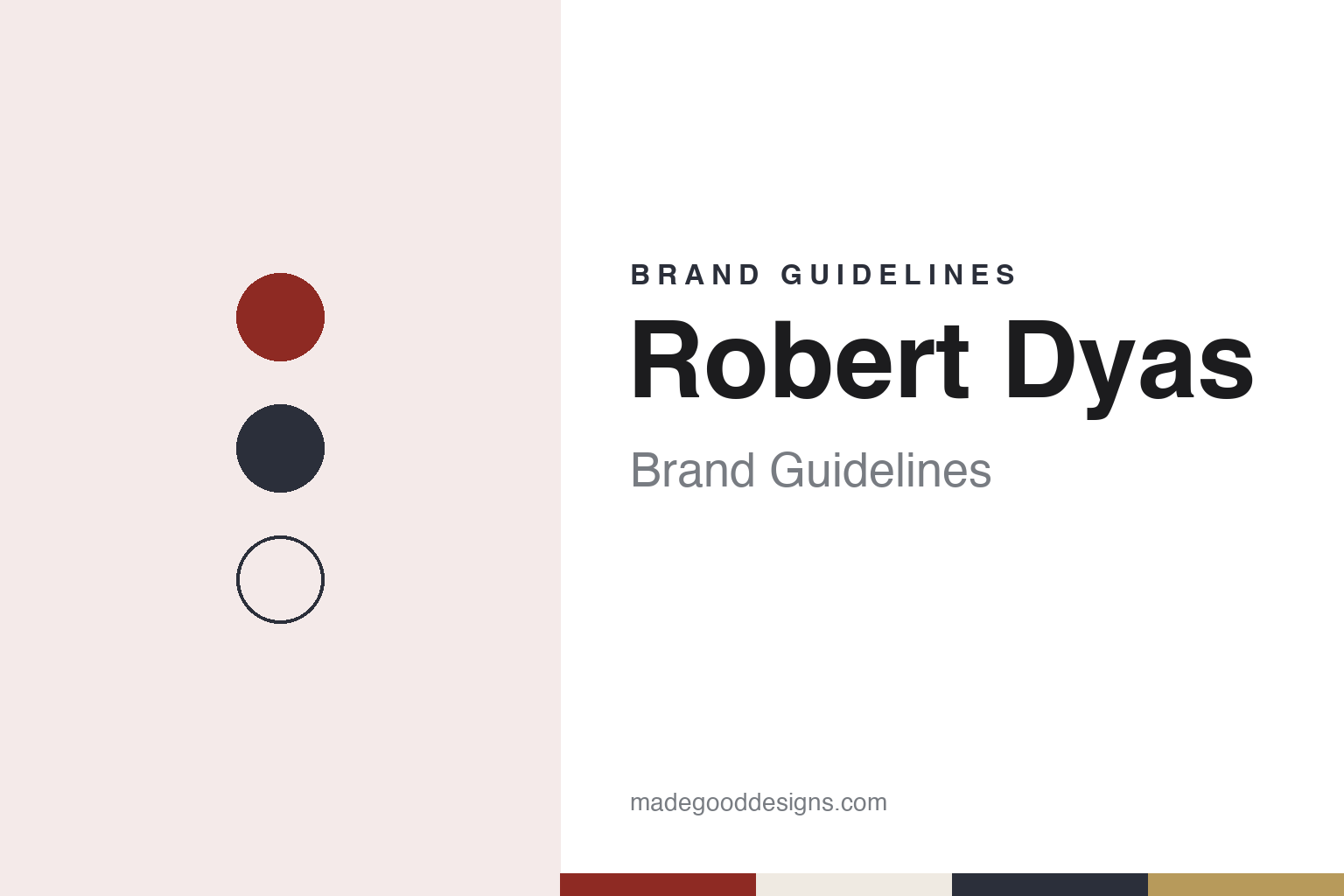
Robert Dyas Brand Guidelines
An 1872 London ironmonger that became a high-street home store.
Aa
Two constants: a red, iron grey and brass palette and a grotesque sans register. Abstract homage — not a Robert Dyas product or mark; no logo, fascia or packaging is reproduced.
An ironmonger in 1872
A founder from County Meath and a London shop.
Robert Dyas is a British chain of hardware and home stores, founded in London in 1872 as an ironmonger. Its owner, Theo Paphitis Retail Group, says the founder, Robert Dyas, came to England from County Meath in Ireland with a small sum to invest, opened his first shop in London in 1872, and built it into a family business of 18 shops. English Wikipedia says his sons and then his grandsons ran the company after him.
The ironmonger’s trade still shapes the range. Retail Gazette described the company in April 2026 as a business founded as an ironmongery in 1872 that now sells kitchenware, DIY products, electricals and homewares; the group’s own description adds garden items and outdoor furniture. English Wikipedia lists core departments including kitchenware, vacuum cleaners and kitchen appliances, cleaning and laundry products, garden care, outdoor leisure, DIY tools and materials and home-office goods, with seasonal gift ranges at key times of the year.
The shops are mostly on high streets in London and the south-east of England. The group says Robert Dyas has 92 stores across the south of England, ranging from about 9,000 square feet down to 1,250; English Wikipedia gives 93 standalone shops, reaching as far as Bristol in the west and Solihull and Kenilworth in the West Midlands. In August 2026 Retail Gazette reported 90 stores in the delivery partnership described below, including branches in London, Bristol, Oxford and Brighton.
Colour
Private equity, the banks and a new owner.
The family era ended in the 2000s. English Wikipedia says that in March 2004 the chain was bought by Change Capital Partners, a private equity firm headed by Luc Vandevelde, the former chairman of Marks & Spencer; BBC News described the firm the same way in April 2009.
That ownership did not last. BBC News reported on 5 April 2009 that Robert Dyas, which then had 99 electrical and hardware stores and about 1,250 staff, was to be bought by its senior management. English Wikipedia says the management buyout went ahead with backing from Lloyds Banking Group in April 2009, and that a debt-for-equity deal later that year gave the lenders, Lloyds and Allied Irish Banks, a majority stake. BBC News confirmed in 2012 that the two banks had been the majority shareholders since the restructuring.
In 2012 the banks sold. Lloyds had hired the adviser Cavendish Corporate Finance to run the process, The Guardian reported, and on 10 July 2012 Theo Paphitis, the retailer known to television audiences from the BBC series Dragons’ Den, announced that he had bought the chain through his company Gladys Emmanuel. He broke the news on Twitter, BBC News reported, writing that he was now in the ironmongery business. Before the sale Lloyds held a 40 per cent stake and Allied Irish Banks a further holding, The Guardian said, and the chain employed about 1,100 people in its stores and head office. BBC News put the estate at 97 stores and more than 1,000 staff, describing Robert Dyas as an electrical and hardware retailer originally set up as an ironmonger 140 years earlier; The Guardian counted 96 stores and gave the head office as Leatherhead in Surrey. Paphitis became chairman, the chief executive stayed in post, and the chief executive of Ryman joined the board. At the time Paphitis already chaired the stationer Ryman and owned the lingerie chain Boux Avenue.
Typography
Design and documentation.
Discount, home and hobby retailers in Europe, Britain, Australia and Malaysia tend to present themselves first through the store itself. The sign over the door, the logo on the bags and the layout of the aisles carry most of the identity, and many of these chains repeat one standard format from town to town, so a shopper meets the same look in a high street, a retail park or a shopping centre.
Own-label ranges are a second layer. Many of these retailers sell established consumer brands alongside goods under their own names, and they publish those range names on their websites, packaging and shelf cards. For a design guide, the useful facts are the ones the companies state themselves: what each range is called, what it covers and how it sits beside branded stock, rather than any claim about quality or price.
Store networks are the third. Chains in this group publish their store counts, the countries they trade in and the mix of company-run and franchise branches, and those figures move quickly as new sites open and others close. Any count is only as good as its date, so the guides in this series give each figure with the year of the source that reports it.
Ownership is the fourth. Some of these businesses began as a single shop run by a founder or a family, and later passed to private-equity firms, listed parent groups or stock-market investors. Their corporate pages usually tell that story, from the first store to the current owner, and the guides here describe family and group ownership plainly, with dates, as the sources set it out.
Aa
A grotesque sans for a hardware shop on the high street. (Specimen set in Libre Franklin, a sans STAND-IN; NOT the Robert Dyas logo.)
Robert Dyas
Inside Theo Paphitis Retail Group.
Robert Dyas now sits inside Theo Paphitis Retail Group, alongside Ryman and Boux Avenue, Retail Gazette reported in April 2026. The group has created store formats that combine Robert Dyas with Ryman, including a flagship on the Strand in London, the same report said. It also reported that Paphitis had taken on the role of interim chief executive after increasing his direct involvement in the business in 2025. Paphitis told the title he had stepped in to “steady the ship” and refocus the brand’s strategic direction.
The chain’s customer programme is MyDyas, a loyalty scheme launched in May 2023 that offers member pricing on everyday home and garden items, personalised offers and points on purchases, according to Retail Gazette; existing online account holders were moved into it automatically. By April 2026 the title reported 1.9 million members.
Delivery has followed. In August 2026 Robert Dyas launched on Deliveroo, its move into on-demand delivery, with around 6,000 products across homeware, electricals, DIY, garden and small appliances available from 90 stores, Retail Gazette reported. Ryman, its sister chain, is also on the platform, alongside retailers such as The Entertainer and Accessorize, the title said.
For a design guide, Robert Dyas shows how a founder’s surname over a shop door can carry a business through more than 150 years and a long run of owners, from the family to private equity, the banks and an entrepreneur. Compare Wilko, another British hardware and home chain that grew from a single shop, and Clas Ohlson, a hardware and home retailer from Sweden. For this guide we use an ironmonger red, a cast-iron grey and a brass with a grotesque sans, an unofficial interpretation; no product or logo is reproduced.
Explore & save
Keep Robert Dyas’s identity on hand — save it to a board in the Made Good inspiration library.
Robert Dyas identity set
Pin the Robert Dyas red, iron grey and brass palette and the grotesque sans register to your own board.
Source & notes
Frequently Asked Questions
What font can I use to match the Robert Dyas look?
This guide describes Robert Dyas’ type as “A grotesque sans for a hardware shop on the high street”. Its type specimen is set in Libre Franklin from Google Fonts as a stand-in; Libre Franklin is not Robert Dyas’ own lettering.
What colours are in the Robert Dyas palette?
This guide’s Robert Dyas palette is Ironmonger red #8E2A23, Cast-iron grey #2B2F3A, Brass #B79A5B, Ink blue #2C4466 and Shop-paper #EFEAE2. The tones are the guide’s own unofficial interpretation, not official Robert Dyas hex codes.
When was Robert Dyas founded?
Robert Dyas was founded in 1872, in London, England. Robert Dyas is known for Hardware, kitchenware, electricals and homewares.
Who founded Robert Dyas?
Robert Dyas was founded by Robert Dyas in 1872. Robert Dyas is known for Hardware, kitchenware, electricals and homewares.
Who owns Robert Dyas?
Robert Dyas is owned by Theo Paphitis Retail Group (since 2012).