Sklavenitis Brand Guidelines
The Athens family grocer that took over Marinopoulos.
Aa
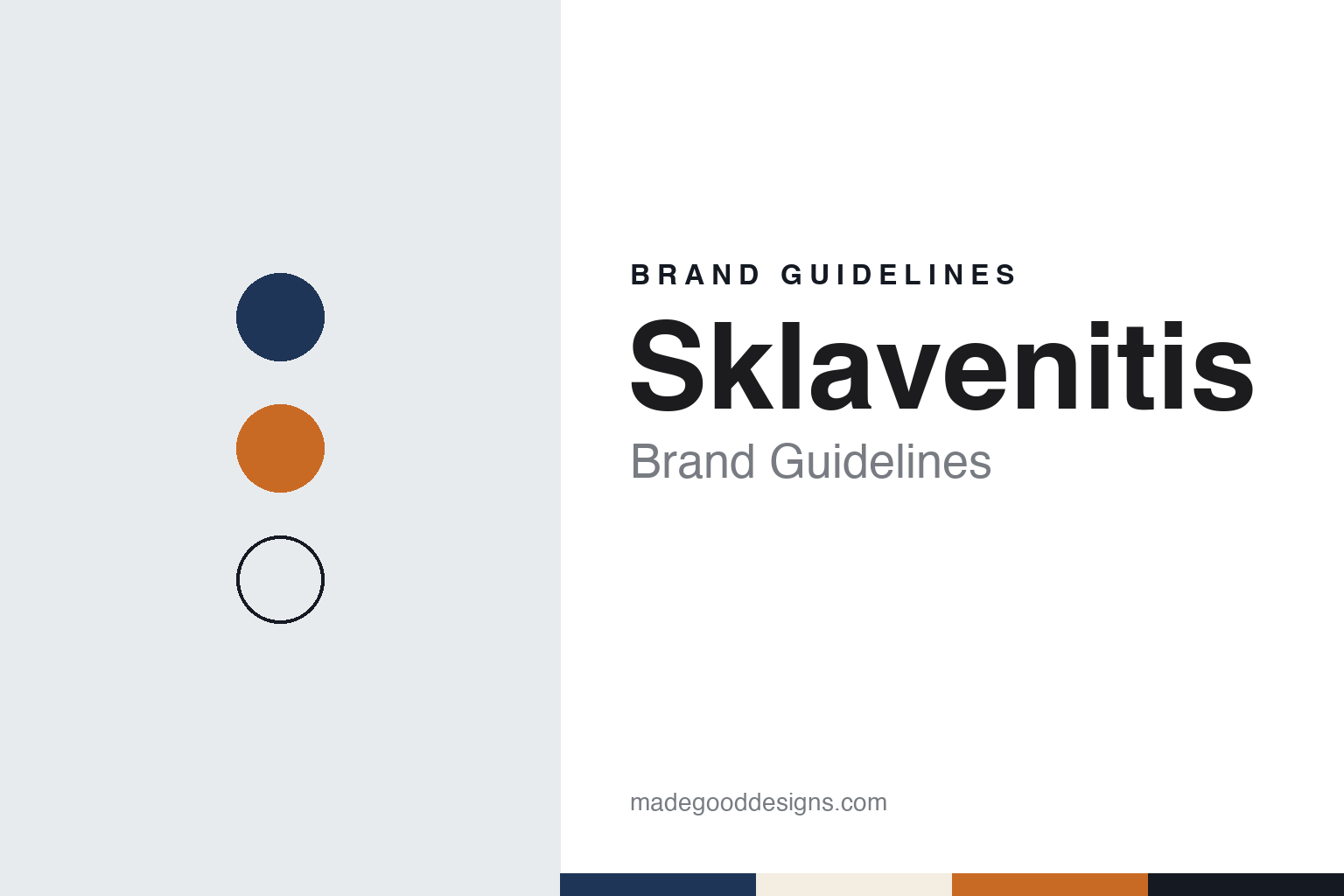
Two constants: a navy, orange and cream palette and a plain grocer’s sans register. Abstract homage — not a Sklavenitis product or mark; no sign, logo or carrier bag is reproduced.
Ano Petralona
Two brothers and a wholesale business.
Sklavenitis began in Athens as a family wholesale business. English Wikipedia dates the start to 1954, when the brothers Yiannis and Spyros Sklavenitis set up in Ano Petralona, and says the business soon moved to its own premises on Kifisou Avenue in Peristeri, in the west of the city. It was registered as a general partnership in 1967, according to the same account. The financial site OT.gr, writing in December 2022, counted 52 years since the company was established in Petralona as a general partnership.
The move into retail came in 1969, when the family opened its first supermarket in Peristeri, English Wikipedia says. A younger brother, Nassos Sklavenitis, joined the business in 1975, the year the chain opened a large store in the Kaminia district of Piraeus, its first outside Peristeri. Central warehouses followed in 1979, with a packing line for rice, sugar and other dry goods, and the original Peristeri store was rebuilt and enlarged in 1992, gaining a display area of 3,050 square metres. The same account credits the company with setting up TELEXYP, a service that took grocery orders by telephone. The company opened its first hypermarket, at Nea Chalkidona, in 1998.
Ownership has stayed with the family. In 2006, according to English Wikipedia, 95 per cent of the shares passed to the four children of Spyros Sklavenitis. A June 2022 announcement from Ahold Delhaize gives the operating company’s name as I&S Sklavenitis S.A.
Colour
Growth by acquisition.
English Wikipedia describes the early 2000s as a period of stagnation; from 2007 the chain grew largely by buying other grocers, adding eleven former Atlantic stores in 2010 along the way. OT.gr listed the deals in December 2022: 18 stores of the Papageorgiou chain in 2007, most of them in the southern suburbs of Attica; 18 stores from the Doukas, Extra-First, Fthina and Balaskas chains in 2013; and, in 2014, all the shares of Makro Cash & Carry Greece, which then ran nine wholesale stores in Athens, Thessaloniki, Patras, Larissa, Volos, Heraklion and Xanthi. A year later the Makro stores took the name The Mart. English Wikipedia gives 2015 for the Makro purchase itself, so the two sources differ by a year. In the same period Sklavenitis took 60 per cent of the Cretan chain Chalkiadakis from Veropoulos; English Wikipedia dates that to December 2013 and puts the chain at 38 stores and 940 staff at the time. New warehouses of 30,000 square metres opened at Elefsina, west of Athens, in 2014, the same account says.
The deal that changed the company’s scale was Marinopoulos. English Wikipedia says Sklavenitis announced the agreement on 3 September 2016, that a court approved it on 16 January 2017 and the Hellenic Competition Commission on 26 January. On 1 March 2017 Marinopoulos ceased trading, and most of its business passed to a new subsidiary, Hellenic Hypermarkets Sklavenitis S.A., which took over the Carrefour Marinopoulos and Carrefour Express stores, except those in northern Greece that belonged to a separate operator. OT.gr put the number of stores added that day at 400.
Smaller purchases continued. In 2017 the company took 55 per cent of the Kronos chain and completed the purchase in 2019, according to English Wikipedia. In 2022 it absorbed 9 of the 11 SEP Markets stores in Ioannina and agreed to take four Gegos stores in East Attica, at Porto Rafti, Markopoulo and Loutsa; OT.gr reported that the new signs there would also carry the Gegos name, with the handover set for January 2023 and the 130 people working in those four stores moving to Sklavenitis. English Wikipedia adds the AS Agora stores in Larissa and Pieria in 2023, a first store on Lesbos, at Mytilene, the same year, and nine stores of the Papantoniou chain in Cyprus in 2024.
Typography
Signs, owners and formats.
Greek retail chains range from family supermarket groups to department stores and specialist chains for toys, cosmetics, electronics, books and mobile phones. Many of them carry a founder’s surname on the shop sign, as Sklavenitis and AB Vassilopoulos do, so the name over the door often doubles as a piece of company history.
Ownership takes several forms. Some chains have stayed with their founding families; others are listed on the Athens exchange; others belong to international groups, as AB Vassilopoulos has belonged first to Delhaize and now to Ahold Delhaize. This guide describes each owner plainly, with dates, and attributes any claim a company makes about itself to that company.
The trade has also been reshaped by takeovers. When Marinopoulos ceased trading on 1 March 2017, most of its stores, including those under the Carrefour name, passed to a Sklavenitis subsidiary; smaller regional chains have since been bought in turn, and some keep their own names on the sign after a sale. Store counts change quickly, so the figures given here are tied to the date and source that gave them.
Shop signs, logos, carrier bags and colour schemes are described only as the companies publish them, and own brands, loyalty schemes and online shops are named as the companies name them. Where a company publishes pages about its founders and owners, those pages are treated as its own account. The palettes and typefaces shown alongside each guide are an unofficial interpretation chosen for this site, not official brand colours or logo lettering.
Aa
A plain grocer’s sans, read from a distance. (Specimen set in Manrope, a sans STAND-IN; NOT the Sklavenitis logo.)
Sklavenitis
A family name over many doors.
Online selling arrived in 2020. OT.gr reported that at the start of that year Sklavenitis bought the online supermarket caremarket.gr, on which it built its own eMarket shop. In December 2022 the same site counted 441 stores, four eMarket order distribution centres and six distribution centres in Greece, plus stores in Cyprus. English Wikipedia, read in November 2026, gives 459 stores in Greece and 27 in Cyprus.
The group trades under more than one name. Besides the Sklavenitis supermarkets and hypermarkets, it runs the cash-and-carry stores that became The Mart, and some of the chains it has bought keep their own name on the sign, as the Gegos stores in East Attica did after the 2022 deal, according to OT.gr.
The visual task for a chain like this is legibility at many sizes, from a hypermarket fascia on a main road to a shelf label or the header of an online order page. That is why this guide pairs a dark, steady navy for text and structure with a warm orange used sparingly for highlights such as section markers, and a cream ground that reads as paper rather than screen white. The specimen face is a plain, open sans that stays clear at small sizes.
For a design guide, Sklavenitis shows how a family surname can hold a network together while some acquired chains keep their own signs. Compare AB Vassilopoulos, the Athens grocer now owned by Ahold Delhaize, and Carrefour, whose Greek stores under Marinopoulos passed to Sklavenitis in 2017. For this guide we use a deep navy and a warm orange on cream with a sans, an unofficial interpretation; no product or logo is reproduced.
Explore & save
Keep Sklavenitis’s identity on hand — save it to a board in the Made Good inspiration library.
Sklavenitis identity set
Pin the Sklavenitis navy, orange and cream palette and the plain grocer’s sans register to your own board.
Source & notes
Frequently Asked Questions
What font can I use to match the Sklavenitis look?
This guide describes Sklavenitis’ type as “A plain grocer’s sans, read from a distance”. Its type specimen is set in Manrope from Google Fonts as a stand-in; Manrope is not Sklavenitis’ own lettering.
What colours are in the Sklavenitis palette?
This guide’s Sklavenitis palette is Market navy #1E3557, Ink #141922, Shelf cream #F3EDE2, Petralona orange #C96A24 and Paper #FAF8F4. The tones are the guide’s own unofficial interpretation, not official Sklavenitis hex codes.
When was Sklavenitis founded?
Sklavenitis was founded in 1954 (wholesale), in Ano Petralona, Athens.
Who founded Sklavenitis?
Sklavenitis was founded by Yiannis and Spyros Sklavenitis in 1954 (wholesale).
Who owns Sklavenitis?
Sklavenitis today: Family-owned, Athens. Sklavenitis is known for Supermarkets, The Mart, eMarket.