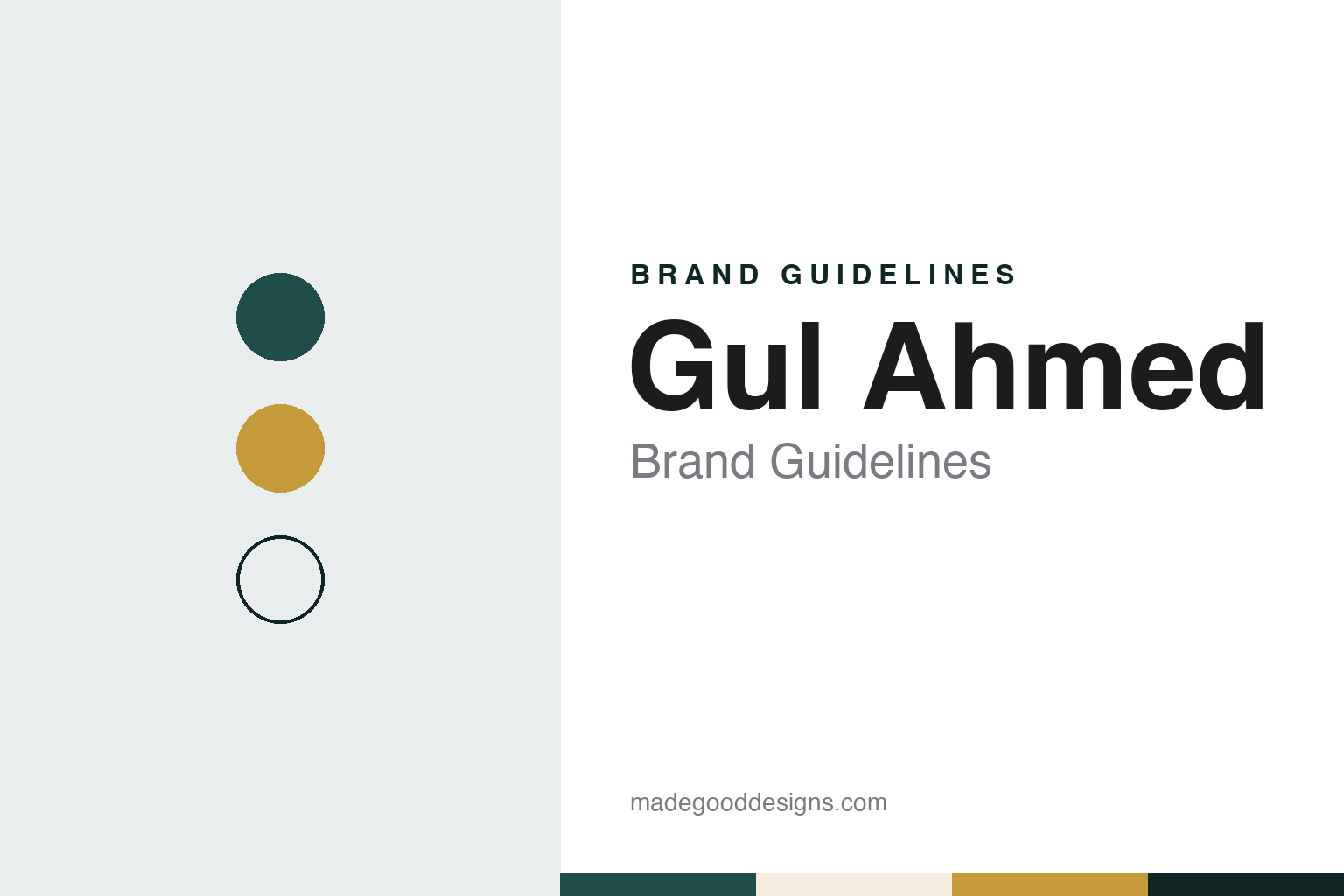
Gul Ahmed Brand Guidelines
The Karachi textile mill behind the Ideas retail chain.
Aa
Two constants: a teal, cream and marigold palette and a classical serif register. Abstract homage — not a Gul Ahmed product or mark; no garment, print or logo is reproduced.
A trading house becomes a mill
Textiles in Karachi since the early 1900s.
Gul Ahmed is a Karachi textile business that sells under its own name and through the Ideas by Gul Ahmed shops. The company says the group began trading in textiles in the early 1900s and moved into manufacturing in 1953 by setting up Gul Ahmed Textile Mills Ltd. English Wikipedia, citing the Pakistan Stock Exchange, says it was incorporated as a private company in 1953 and became a public limited company in January 1955. The company dates its listing on the Karachi Stock Exchange to 1970; the business magazine Profit gave 1955 for the listing in November 2021. It trades on the Pakistan Stock Exchange under the symbol GATM. English Wikipedia gives the mill company’s founding date as 1 April 1953 and places its head office in Landhi, an industrial district of Karachi.
Profit names Bashir Ali Mohammad as the founder of the mill company. His son Zaki Bashir joined in 2005 and became chief executive in 2014, the magazine reported in December 2019 and again in November 2021. The News reported in October 2016 that, according to the company’s annual report, Gul Ahmed Holdings (Private) Limited held 66.78 percent of the listed company and was the group’s ultimate parent.
The mill is a composite operation, making everything from cotton yarn to finished goods, the company says. In 2021 Profit described more than 130,000 spindles, 300 weaving machines and yarn-dyeing, processing and stitching units, with four business segments: spinning, weaving, retail, and processing and distribution for home textiles and apparel. It listed subsidiaries in the United States, the United Arab Emirates and Britain, and said Gul Ahmed reached customers in more than 44 countries, with Germany, the United States, France, the Netherlands, Britain and Italy among its main markets abroad.
Colour
Lawn, then Ideas.
Lawn, a light cotton cloth sold printed as suit lengths, is central to the name. Profit called Gul Ahmed “the original manufacturers of lawn” in December 2019, in an article on how the mill had turned towards selling to shoppers in Pakistan. The company says the opening of its flagship store, Ideas by Gul Ahmed, marked the group’s entry into retail, starting in Karachi. Aurora, the Dawn group’s marketing magazine, dates the Ideas chain to 2003 and in October 2019 described it as an early large-scale concept store, selling clothes alongside home textiles; Khaadi, founded in 1999, followed with home textiles a few years later, the magazine said.
The shops grew quickly. Aurora, citing its September–October 2015 cover story, counted Gul Ahmed Ideas at 65 stores in 17 cities; by October 2019 it put the chain at more than 100 stores in more than 60 cities. Profit also gave a figure of more than 100 stores in November 2021. Ideas sells women’s and men’s clothing and home textiles for the bedroom, kitchen and bathroom, and English Wikipedia lists in-house monogramming, embroidery and tailoring.
The move into retail was a stated strategy. Profit reported in 2019 that Zaki Bashir decided, around 2014, that retail could become the core of the company, at a time when unreliable gas supplies made tight export deadlines hard to meet and the home market for clothes such as lawn was growing. The same magazine noted that the company also kept a large export business.
Typography
Design and documentation.
Pakistani and Bangladeshi fashion and retail brands present themselves through a few recurring touchpoints: the shop sign over a mall unit, the logo on a carrier bag, the seasonal look-book and the corporate page that names a founder or a parent company. Some marks point back to craft — Khaadi, for example, says the hands in its logo symbolise its heritage in handloom craft — while others set a short name in plain capitals, as Sapphire does.
The formats vary widely. Some of the brands in this group began as a single shop and grew into mall flagships at home and abroad; others are the retail arms of textile mills, and can draw on a parent’s own spinning, weaving and printing before cloth reaches a store, as Sapphire describes. Alongside them sit supermarket chains, craft-led lifestyle stores and online marketplaces, each with its own way of showing a name on a shopfront, a shelf or a screen.
Collections are named in the companies’ own terms. Lawn, prêt and unstitched fabric appear again and again in their catalogues, and the balance between them has shifted: Profit by Pakistan Today reported in 2017, from Pakistan Bureau of Statistics data, that ready-made clothes took 13 percent of household clothing spending in 2002 and 33 percent in 2016, while unstitched cloth and accessories fell from more than 68 percent to 50 percent.
Ownership is set out plainly in each guide: family-owned, founder-owned, mill-owned or group-owned, with dates where a dated source gives them. Each guide separates what independent press and official filings record from what the company says about itself, and the palettes and type pairings shown are an unofficial interpretation rather than a reproduction of any brand’s colours or marks.
Aa
A high-contrast classical serif, suited to a textile house with a long trading history. (Specimen set in Cormorant Garamond, a serif STAND-IN; NOT the Gul Ahmed logo.)
Ideas by Gul Ahmed
A listed mill with its own shops.
The board has twice looked at separating the shops from the mill. In October 2016 The News reported a stock-exchange filing in which the board authorised a study of carving out the local businesses, including retail, into one or more companies. In February 2020 Profit reported a further filing in which the board authorised the company to set up a wholly owned subsidiary and propose terms for moving the local business segment, including retail and related assets, into it. The company’s website now lists Ideas (Private) Limited as a wholly owned subsidiary of Gul Ahmed Textile Mills, alongside a trading company in the United Arab Emirates and GTM Europe Limited in Britain.
Recent openings include a large flagship. On 16 January 2025 Ideas by Gul Ahmed opened a flagship of 30,000 square feet at Dolmen Mall Clifton in Karachi, Geo News reported. It sells women’s ready-to-wear, men’s stitched and unstitched clothing, bedding, cushion covers, towels and fragrances, with an Ideas Home section, wide walkways and interactive displays; English Wikipedia adds that an Ideas Cafe opened in the same mall in 2025. The online shop, branded Gul Ahmed Ideas, groups unstitched fabric, ready-to-wear and men’s eastern wear by style, piece and season, with named cloths such as cambric, jacquard and dobby.
The name is used on two levels. Gul Ahmed is the listed mill company; Ideas is the retail format, written as Ideas by Gul Ahmed on the stores and as Gul Ahmed Ideas in the shop’s online title and in some press reports.
For a design guide, Gul Ahmed shows how a mill name that customers know from printed cloth can carry a second retail name without losing its own. Compare Alkaram Studio, another textile mill’s retail arm, and Khaadi, a Karachi fashion and home-textile retailer. For this guide we use a deep teal, a lawn cream and a marigold with a serif, an unofficial interpretation; no product or logo is reproduced.
Explore & save
Keep Gul Ahmed’s identity on hand — save it to a board in the Made Good inspiration library.
Gul Ahmed identity set
Pin the Gul Ahmed teal, cream and marigold palette and the classical serif register to your own board.
Source & notes
Frequently Asked Questions
What font can I use to match the Gul Ahmed look?
This guide describes Gul Ahmed’s type as “A high-contrast classical serif, suited to a textile house with a long trading history”. Its type specimen is set in Cormorant Garamond from Google Fonts as a stand-in; Cormorant Garamond is not Gul Ahmed’s own lettering.
What colours are in the Gul Ahmed palette?
This guide’s Gul Ahmed palette is Loom teal #1F4D4A, Deep dye #0F2624, Lawn cream #F3ECDF, Marigold thread #C49A3A and Paper #F9F6F0. The tones are the guide’s own unofficial interpretation, not official Gul Ahmed hex codes.
When was Gul Ahmed founded?
Gul Ahmed was founded in 1953 (mill); trading from the early 1900s, in Karachi, Pakistan.
Who founded Gul Ahmed?
Gul Ahmed was founded by Bashir Ali Mohammad (mill) in 1953 (mill); trading from the early 1900s.