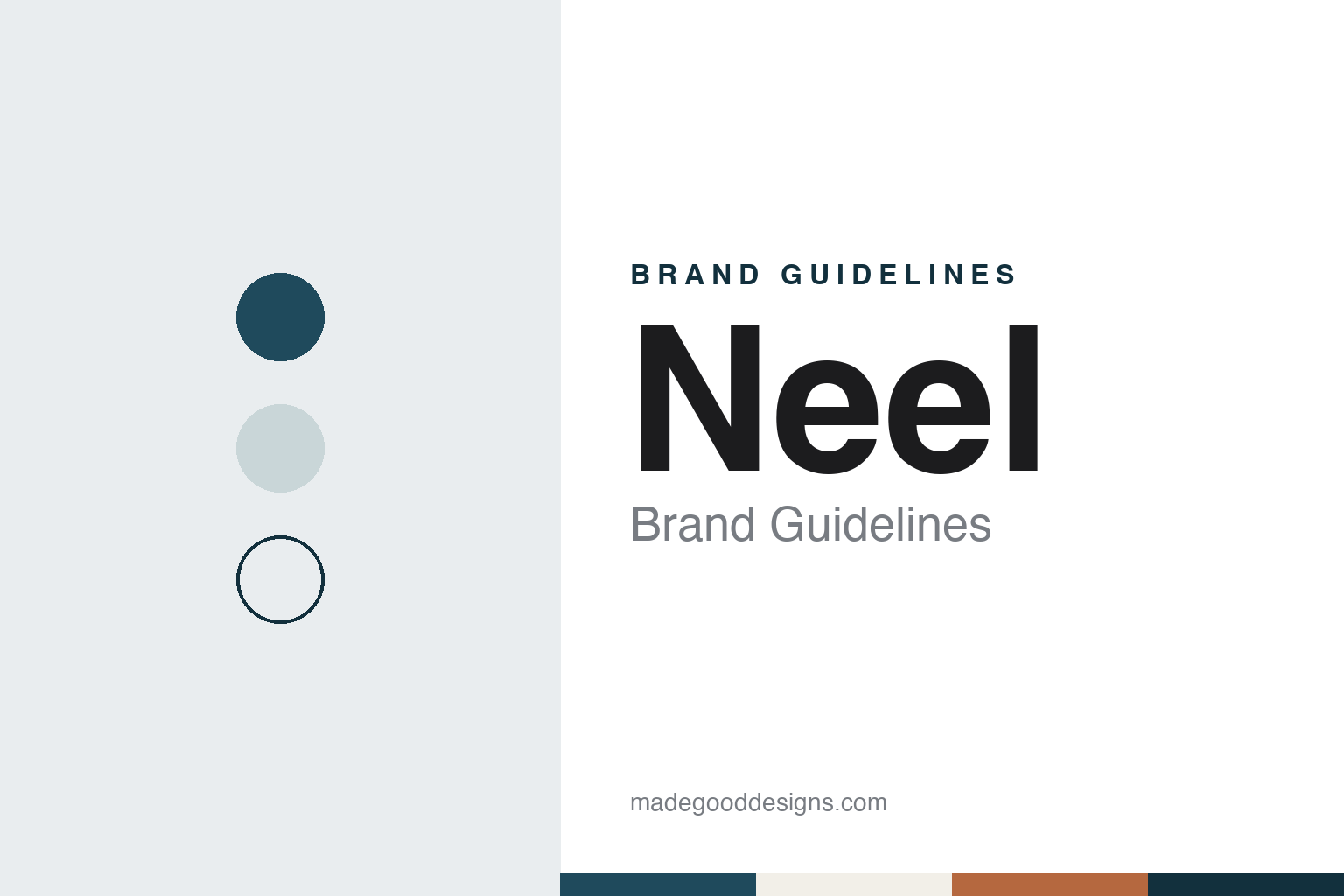
Neel Brand Guidelines
Three hulls from La Rochelle’s nautical quarter.
Aa
Two constants: a slate, sailcloth and stone palette and a nautical grotesque register. Abstract homage — not a Neel product or mark; no boat, logo or hull graphic is reproduced.
A trimaran yard
A multihull salesman’s three-hulled idea.
Neel builds cruising trimarans in La Rochelle, on France’s Atlantic coast. According to a 2020 review in Multihulls World, the Neel range was born in 2009 with a 50-foot prototype. The man behind it was Eric Bruneel, a specialist in selling multihulls who had for a long time been export sales manager at Fountaine Pajot, the catamaran builder based further up the same coast, and who had raced in the Multi 50 class.
The name is part of the story. Multihulls World explains that “Neel” comes from Bruneel’s own surname, with a nod to a small 1980s trimaran called the Corneel 26. The same magazine says Bruneel revisited the idea of the cruising trimaran with the naval architects of the Joubert-Nivelt team, drawing on the English and American multihull designers of earlier decades, among them Arthur Piver and Jim Brown, whom the magazine calls pioneers of the form.
That idea set Neel apart from the catamaran builders around it. Neel builds boats with three hulls, a central hull and two floats, where the catamaran yards around it build boats with two. The company presents its boats as long-distance cruising trimarans for people who live aboard.
The yard sits on what the company calls La Rochelle’s plateau nautique, the waterside quarter where several boatbuilders, sailmakers and riggers work side by side. On its construction page, Neel says it runs two production facilities there dedicated to its trimarans, and that its teams handle every stage from the first lamination to the launch of each boat.
Colour
Glass fibre, infusion and a range in feet.
Neel names its boats with a plain formula: the brand name in capital letters followed by the length in feet. Its website lists the NEEL 43, which it describes as the smallest model and which is also offered in a DUO version; the NEEL 48; and the NEEL 52, which it calls the largest current model. Earlier range pages on the same site also list the NEEL 47 and a NEEL 65 Evolution, which the company called the flagship of its fleet at the time. Multihulls World reviewed the NEEL 47 in April 2020, after its showing at the Multihull Show at La Grande-Motte.
The company says the hulls, floats, bridges and roof of its trimarans are built in a glass-fibre and isophthalic polyester sandwich, with resin infused through the fibreglass according to a lay-up worked out by finite-element structural analysis, with unidirectional or bidirectional glass chosen according to each part’s role in the structure. It says the interior foam is a closed-cell PVC sandwich that also gives sound and heat insulation, and that the rigging and sails are designed and made by multihull specialists in La Rochelle.
Design work is shared between an in-house office and outside studios. For the NEEL 48, the company says its own design office worked with the naval architecture firm Marc Lombard Yacht Design and the design firm Piaton; its range page also describes a Lombard-designed model with a move towards bio-sourced and recyclable materials. Those credits come from the company.
On its website the company sets the name as NEEL in capitals, often paired with the word “TRIMARANS.” The range is shown at events such as the Cannes Yachting Festival and the Grand Pavois boat show in La Rochelle, both listed on the company’s own news pages in 2026.
Typography
How multihull builders present themselves.
Catamaran and trimaran builders present themselves through a small set of public materials: the yard name, the model names, the hull graphics, the brochure and the boat-show stand. Model names usually carry a length in feet, sometimes with a word for the layout or character of the boat, and a builder’s range is often easier to follow through those numbers than through any logo.
Charter shapes the look of many of these boats. Some yards build the same hulls for private owners under their own brand and for charter companies under the charter company’s name and model number, so a single design can appear in two liveries and in two sets of brochures. Others have stepped away from charter fleets to concentrate on private owners, and say so in their own timelines.
Ownership varies widely and is set out here plainly with dates. The sector includes yards still run by their founders, brands that sit inside listed groups, builders owned by investment funds, and yards that have passed through insolvency, court-supervised restructuring or a change of shareholder. A brand and the yard that builds it are not always owned by the same company, and the corporate pages on founders and owners are usually where those links are set out.
Design credits follow the same rule. Naval architects and designers are named in this guide only where a dated source or the builder itself credits them, and hull decorations, colour codes and graphic charters are described only as the builders publish them. Nothing here is a claim about how any boat sails or behaves at sea; the palettes and typefaces shown are unofficial interpretations, not the builders’ own marks.
Aa
A clean nautical grotesque for a name set in capitals. (Specimen set in Archivo, a sans STAND-IN; NOT the Neel logo.)
Neel
Reorganisation in 2025, new owners in 2026.
The yard’s recent history is a turnaround story. Multihulls World reported on 9 December 2025 that Neel Trimarans had been placed under judicial reorganisation (redressement judiciaire), after just over a year of difficulty linked to a slowdown in the boat market; the announcement came on 8 December. The company’s chief executive at the time, Christian Mocquery, said in a statement that the proceedings were meant to preserve jobs and keep the business running.
The outcome came in the spring. On 17 March 2026 the Commercial Court of La Rochelle approved a joint bid from three La Rochelle entrepreneurs, Martin Volt, Maxime Védrenne and Martin Lepoutre, Boat Industry reported on 23 March and Boating New Zealand on 1 April 2026. The ruling meant the yard avoided liquidation. Both outlets reported that 46 of the company’s 57 jobs were kept.
The three buyers came from inside the trade. According to Boating New Zealand, Volt, appointed chief executive, has an engineering background and had run marine maintenance work through the company Bosco; Védrenne, managing director, had sold the brand as a dealer and distributor; and Lepoutre brought industrial experience from the boatbuilder Fora Marine. The company’s website says the new team has led the yard since April 2026, with one partner, a mining engineer by training and the company’s president, in charge of production; one, as sales director, bringing 15 years of selling cruising sailboats; and one, with 25 years of experience managing boatyards, responsible for support functions and the development of new models.
For a design guide, Neel shows how a single idea, the liveaboard cruising trimaran, can carry a brand through a change of ownership: the name, the capitals and the length-in-feet model numbers stayed the same. Compare Fountaine Pajot, where Neel’s founder worked in sales, and Outremer, another French multihull yard. For this guide we use an Atlantic slate, a sailcloth white and a warm stone with a sans, an unofficial interpretation; no product or logo is reproduced.
Explore & save
Keep Neel’s identity on hand — save it to a board in the Made Good inspiration library.
Neel identity set
Pin the Neel slate, sailcloth and stone palette and the nautical grotesque register to your own board.
Source & notes
Frequently Asked Questions
What font can I use to match the Neel look?
This guide describes Neel’s type as “A clean nautical grotesque for a name set in capitals”. Its type specimen is set in Archivo from Google Fonts as a stand-in; Archivo is not Neel’s own lettering.
What colours are in the Neel palette?
This guide’s Neel palette is Atlantic slate #1F4A5C, Harbour ink #12303D, Sailcloth #F2EFE8, Rochelle stone #B5683F and Sea mist #C9D6D8. The tones are the guide’s own unofficial interpretation, not official Neel hex codes.
When was Neel founded?
Neel was founded in 2009 (first prototype), in La Rochelle, France.
Who founded Neel?
Neel was founded by Eric Bruneel in 2009 (first prototype).