Culinary Institute of America Brand Guidelines
A New Haven veterans’ school that became a college on the Hudson.
Aa
Two constants: a green and gold palette and a collegiate serif register. Abstract homage — not a Culinary Institute of America mark; no logo, crest or emblem is reproduced.
New Haven, 1946
A restaurant association, two founders and a storefront.
The Culinary Institute of America began in New Haven, Connecticut. English Wikipedia’s history of the college says the New Haven Restaurant Institute was founded by the New Haven Restaurant Association with the help of the culinary educator Frances Roth and Katharine Angell, and held its first classes on 22 May 1946. It was a vocational school for veterans returning from the Second World War. Roth became its first administrative director; Angell was president and chair of the board from 1946 to 1966, and built close ties with Yale University.
The school started in a storefront and in 1947 moved, with Yale’s help, into the Davies mansion in New Haven’s Prospect Hill district, a building known as Angell Hall. The same year it was renamed the Restaurant Institute of Connecticut, and in 1951 it took the name it still uses, the Culinary Institute of America.
By 1969, Wikipedia says, enrolment had reached about 1,000 students, more than the New Haven site could hold. In 1970 the school sold the New Haven property to Yale and bought St. Andrew-on-Hudson, a former Jesuit novitiate at Hyde Park, New York, above the Hudson River. On 19 November 1971 the New York State Board of Regents granted the college its absolute charter, followed the next year by a charter to award associate degrees, and teaching at Hyde Park began in 1972. The old novitiate site remains the college’s central campus.
Colour
Hyde Park, Greystone, Copia, San Antonio and Singapore.
Hyde Park grew around the novitiate. Residence halls followed from 1974; the General Foods Nutrition Center opened in 1988, and in the same period the college opened a baking and pastry building, later named the Shunsuke Takaki School of Baking and Pastry. In 1993 the Board of Regents approved the college’s bachelor’s degrees and the Conrad N. Hilton Library opened. The Apple Pie Bakery Café followed in 2000, and master’s programmes began in 2018, according to English Wikipedia.
The college teaches through public restaurants staffed by students. At Hyde Park, Wikipedia lists the American Bounty Restaurant, which cooks with Hudson Valley produce; the Ristorante Caterina de’ Medici, for Italian food; the Apple Pie Bakery Café; and a French restaurant whose names trace the school’s own story. It opened in 1973 as the Epicurean Room, became the Escoffier Restaurant in 1974, after Auguste Escoffier, and was renamed in 2012 to honour Paul Bocuse, with a redesign by Adam Tihany.
California came next. In 1995 the college opened the Culinary Institute of America at Greystone in St. Helena, in the Napa Valley. Its main building, Greystone Cellars, is a stone wine cellar built in 1889 for William Bowers Bourn II; the Christian Brothers owned it as a winery from 1945 to 1989, it was listed on the National Register of Historic Places in 1978, and the school bought it in 1993, Wikipedia says. A second Napa County site followed. In July 2016 Stark Insider, citing the Napa Valley Register, reported that the city of Napa had approved the college’s move into the former Copia centre downtown, an 80,000-square-foot building to be used for cooking demonstrations and food and wine events. It opened that year as the Culinary Institute of America at Copia, home to the college’s Food Business School and the Chuck Williams Culinary Arts Museum.
Texas and Asia followed. A campus at the Pearl, the former brewery site in downtown San Antonio, opened in 2008, and in 2010 the college opened a facility on the campus of Temasek Polytechnic in Singapore, where, with the Singapore Institute of Technology, it runs a bachelor’s programme in culinary arts management for polytechnic diploma holders.
Typography
How culinary schools present themselves.
Culinary and pastry schools present themselves through a small set of public signs: a school name, a crest or logo, a colour scheme and a short descriptive line. Some names carry a symbol. Le Cordon Bleu takes its name from the blue ribbon of a French royal order, English Wikipedia says, and guests cut a blue ribbon when its new Paris campus opened in 2016, So Good magazine reported. Others come from a place: Ferrandi Paris is linked to the Paris street where its workshop school was installed in 1958, French Wikipedia says.
Ownership shapes how a school describes itself. Ferrandi belongs to the Paris Île-de-France chamber of commerce and industry, a public body, while Le Cordon Bleu was bought by Élisabeth Brassart in 1945, English Wikipedia says, and by André J. Cointreau in 1984, the Los Angeles Times reported, before growing into an international group. Other schools are run by education groups, families or universities; this guide reads their own pages on founders and history alongside dated press sources.
The buildings are part of the image. Schools publish their campuses, teaching kitchens, laboratories and training restaurants, where students cook and serve real guests. Press visits describe the same spaces from outside: in 2014 Le Figaro watched student chefs in whites with their names embroidered on the chest, and in 2016 So Good described a glass Paris building with a vegetable garden on its roof.
Programmes and diplomas appear under the names the schools give them, from vocational certificates to bachelor and master’s degrees, and official recognition is cited as the schools or dated sources state it. This guide sets out what can be checked about each school — who founded it, who owns it and where it teaches — and marks clearly what rests only on the school’s own word.
Aa
A collegiate serif for a college named in full. (Specimen set in Libre Baskerville, a serif STAND-IN; NOT the Culinary Institute of America logo.)
The college today
A nonprofit governed by trustees.
The Culinary Institute of America is a nonprofit college governed by a board of trustees, which appoints the president, English Wikipedia says; its degree programmes are accredited by the Middle States Commission on Higher Education. It offers associate, bachelor’s and master’s degrees, and its associate and bachelor’s programmes include an externship at an approved food-service business. Beyond degrees it runs continuing education for professionals, programmes for wine professionals in California, a certification programme called ProChef and classes for home cooks.
Leadership changed in 2024. The college says Michiel Bakker, who had held food and hospitality roles at Starwood Hotels and Resorts Worldwide and at Google, was installed on 17 October 2024 as its sixth president, succeeding Tim Ryan, who had held the post for 23 years and moved to the role of chancellor. The college describes itself as independent and not-for-profit, with locations in New York, California, Texas and Singapore.
The visual identity stays close to the field. English Wikipedia says the official school colours are green and gold and that the college logo includes a stalk of wheat. Wikipedia shortens the name to CIA, and the college’s own web address uses the word “ciachef”, which keeps the culinary meaning in front.
For a design guide, the Culinary Institute of America shows how an institution can carry a long formal name, a short acronym and a farm motif across very different buildings, from a novitiate on the Hudson to a stone winery in the Napa Valley. Compare the Institute of Culinary Education, a privately owned New York school, and Escoffier, another US culinary school. For this guide we use a deep field green, a wheat gold and a warm parchment with a serif, an unofficial interpretation; no product or logo is reproduced.
Explore & save
Keep Culinary Institute of America’s identity on hand — save it to a board in the Made Good inspiration library.
Culinary Institute of America identity set
Pin the Culinary Institute of America green and gold palette and the collegiate serif register to your own board.
Source & notes
Frequently Asked Questions
What font can I use to match the Culinary Institute of America look?
This guide describes Culinary Institute of America’s type as “A collegiate serif for a college named in full”. Its type specimen is set in Libre Baskerville from Google Fonts as a stand-in; Libre Baskerville is not Culinary Institute of America’s own lettering.
What colours are in the Culinary Institute of America palette?
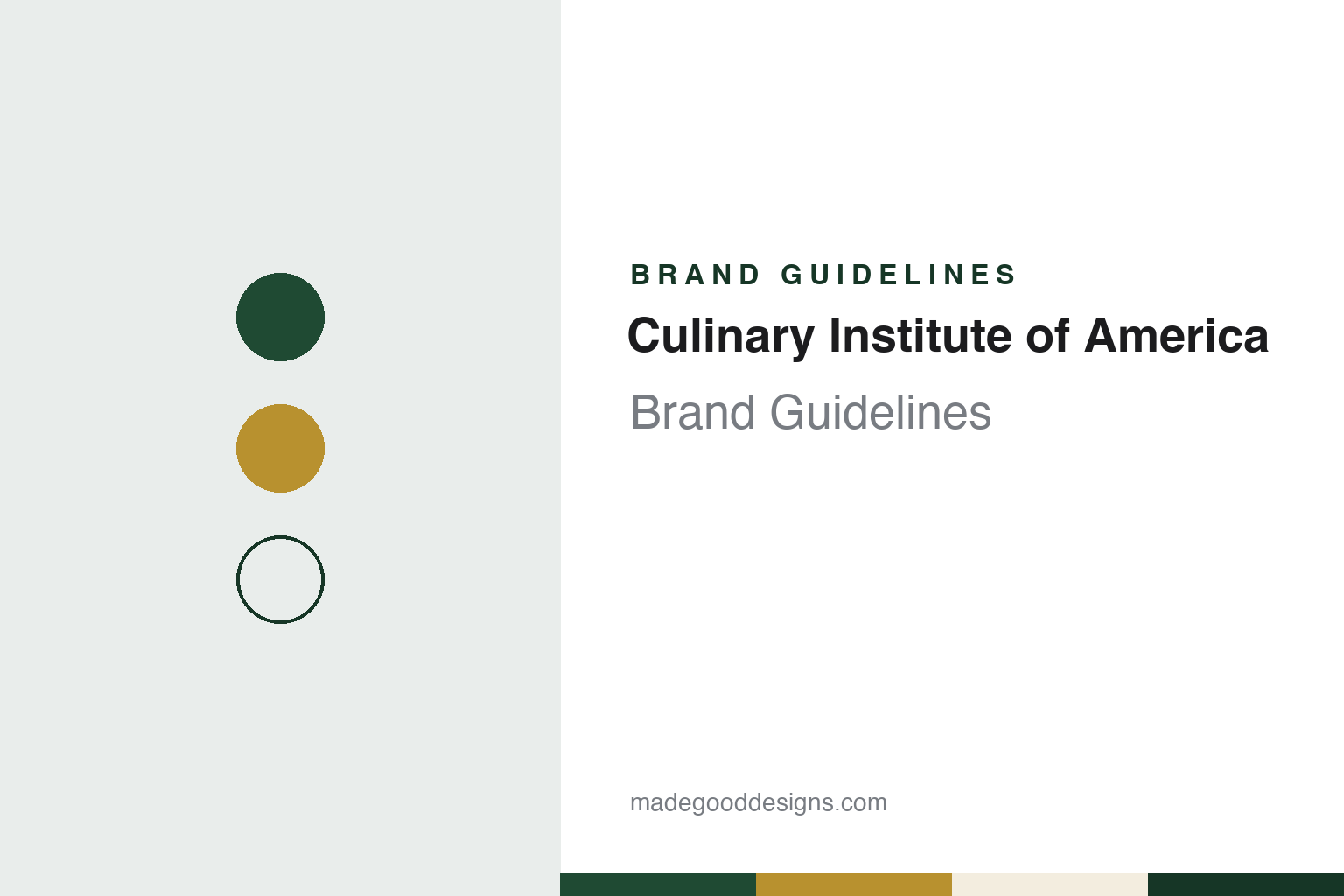
This guide’s Culinary Institute of America palette is Field green #1F4A33, Hudson pine #163626, Wheat gold #B8912F, Parchment #F3EDDF and Flour white #FAF8F3. The tones are the guide’s own unofficial interpretation, not official Culinary Institute of America hex codes.
When was Culinary Institute of America founded?
Culinary Institute of America was founded in 1946 (as New Haven Restaurant Institute), in New Haven, Connecticut.
Who founded Culinary Institute of America?
Culinary Institute of America was founded in 1946 (as New Haven Restaurant Institute) by New Haven Restaurant Association, with Frances Roth and Katharine Angell.