Lanxess Arena Brand Guidelines
Cologne’s 1998 Kölnarena under a 76-metre arch.
Aa
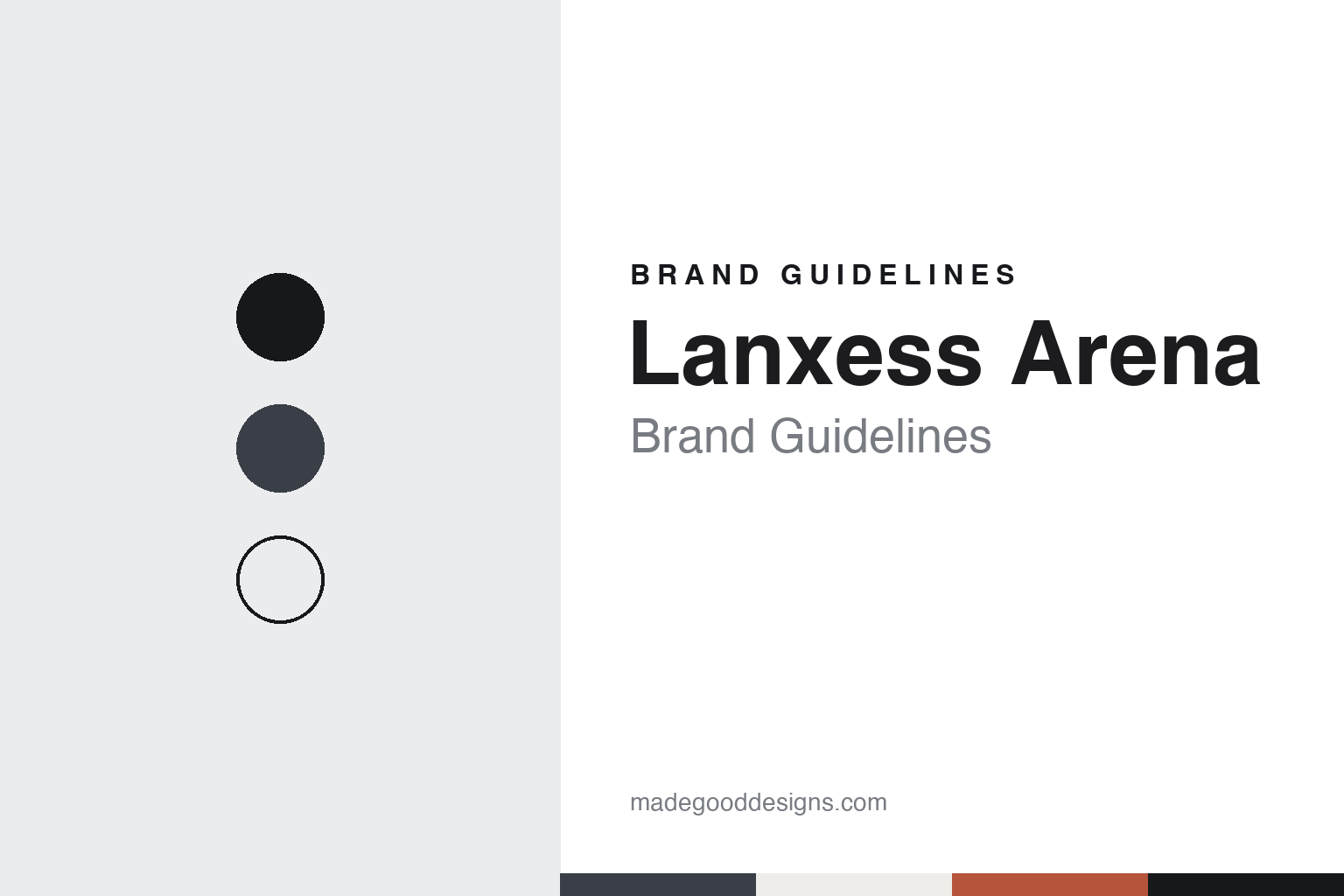
Two constants: an arch steel, night ink and ember palette and a condensed sans register. Abstract homage — not a Lanxess Arena asset or mark; no logo, sign or building image is reproduced.
Kölnarena
A hall for Cologne on the right bank of the Rhine.
The hall now called Lanxess Arena stands in Deutz, on the right bank of the Rhine in Cologne, next to the city’s trade-fair grounds. It opened in 1998 as the Kölnarena, German for “Cologne arena,” and replaced the older and smaller Kölner Sporthalle, which held its farewell event on 30 August 1998, German Wikipedia says. The arena’s own history page dates the soft opening to 11 September 1998, when events began, and the official opening to 17 October 1998, with a concert by Luciano Pavarotti. German Wikipedia records an earlier concert by the Swiss pop act DJ BoBo on 1 October 1998.
The planning took about a decade. The venue’s history says the city council initially backed a larger scheme called the “EuroPalast” in 1989; after that project stalled, the Frankfurt construction group Philipp Holzmann AG presented plans for a smaller hall. According to the arena, the Cologne architecture office of Böhm designed how an arena planned by the Friedrichshafen architect Wund would sit in the cityscape, setting the oval hall into an artificial hill on the former Deutz fairground. The building permit was issued on 28 June 1996, and German Wikipedia dates the ground-breaking to 31 July 1996, with about 26 months of construction.
Around the hall stand office buildings, car parks and a second, smaller arena. Kölnarena 2, opened in 2000, serves as the training and administrative centre of the ice hockey club Kölner Haie, the main tenant, the arena says. German Wikipedia lists the handball club VfL Gummersbach as a partial tenant between 2001 and 2012 and the basketball club RheinStars Köln between 2015 and 2018.
Colour
A chemicals group’s name on a city landmark.
The name changed in 2008. Since 2 June 2008 the hall has carried the name LANXESS arena, written by the venue with the sponsor in capitals and “arena” in lower case. Lanxess, a specialty chemicals group based in Cologne, initially took the naming rights for ten years and in 2017 extended them early to 31 December 2023, according to the arena’s history page. German Wikipedia says a further five-year extension to 2028 was announced in October 2023. The older name survives in some places: Kölnarena 2 kept it, and the carnival show Lachende Kölnarena still uses it, German Wikipedia says.
The building and the business that runs it have separate owners. The hall is operated by ARENA Management GmbH, a former subsidiary of Philipp Holzmann, which the arena says became a wholly owned subsidiary of the ticketing and live-entertainment group CTS Eventim in 2012. The real estate belonged to an investor fund, the Immobilienfonds Köln-Deutz Arena und Mantelbebauung. On 22 December 2015 the trade publication Institutional Real Estate reported that Junson Capital and Mirae Asset Global Investments were to buy the arena and the surrounding buildings from that fund; the arena’s history says Junson Capital, a Hong Kong company, acquired the hall and its training arena, while the operator stayed the same. German Wikipedia says the operator’s lease runs to 2032.
The programme mixes sport, concerts and local culture. German Wikipedia names the 2007 men’s handball world championship final, ice hockey world championships in 2001, 2010 and 2017, and the EHF Champions League Final Four, held in the hall every year since 2010. Cologne bands such as Bläck Fööss and Höhner play there regularly, and German Wikipedia records Metallica setting an attendance record in 2017. The arena says Helene Fischer played seven shows in a row there in 2023, its 25th anniversary year. Since 2015 it has also hosted the Counter-Strike tournament now called IEM Cologne, which English Wikipedia says gave the hall the nickname “The Cathedral.”
Typography
How arenas present themselves.
An arena presents itself through a small set of public pieces: its name, the wordmark its operator publishes, the building itself, the signs and screens that guide visitors inside, and the ticket that gets them through the door. Some names are older than the buildings that carry them. Madison Square Garden in New York is the fourth venue of that name, English Wikipedia says, and the current building, opened in February 1968, stands at 31st to 33rd streets, away from Madison Square itself, where the first two stood.
Other arenas take their names from a sponsor. The former Millennium Dome in London became The O2 under a naming-rights deal with the mobile network O2 that The Register reported in May 2005, and Music Week reported in 2017 that the agreement had been extended for a further ten years. A sponsor’s name can also be set aside: during the London 2012 Games the arena inside The O2 was called the North Greenwich Arena, because of the Games’ rules on corporate sponsorship.
The buildings carry much of the identity. Trade press and architects’ accounts describe them in material terms: Building with Steel in 1968 described Madison Square Garden as a circular drum faced in brown precast concrete under a cable-suspended roof, credited to Charles Luckman Associates, and Pollstar in 2022 described how Populous built The O2’s arena inside an existing tent with twelve yellow masts. The signage, wayfinding, digital screens, tickets and colour schemes that operators publish are part of the same picture.
Behind each venue sits a chain of owners, operators and sponsors, and those relationships change. This guide describes them plainly and with dates, as the sources give them, along with the renamings, the architects and the companies’ own pages on their history.
Aa
A condensed sans for a name set in capitals. (Specimen set in Barlow Semi Condensed, a sans STAND-IN; NOT the Lanxess Arena logo.)
Lanxess Arena
An arch the city gave a nickname.
The building’s most visible feature is structural. A steel arch rises 76 metres over the hall and carries the roof on hangers, German and English Wikipedia say. German Wikipedia describes it as made in Poland in ten sections and walkable for maintenance, with entrances at the roof edge and at its crown. Cologne residents call the arena the Henkelmännchen, German Wikipedia says, and the venue uses the nickname on its own history page.
Inside, the identity is carried by screens and light. The arena says it installed a new LED lighting system and sound system in 2017, and in the summer of 2019 replaced its central video cube with four movable “flying displays” of 36 square metres each, plus a 360-degree LED ring along the lower ring of boxes. The arena says the Kölner Haie and many visiting acts now use them for their show effects.
The building also carries a long list of measurements. German Wikipedia gives a total floor area of 83,700 square metres across all levels, an interior height of 42 metres at its highest point and a stage of up to 50 by 40 metres. It gives the capacity as about 20,000, with about 7,000 in the lower tier; English Wikipedia gives 18,500 for ice hockey. A footbridge links the hall to Köln Messe/Deutz station.
For a design guide, Lanxess Arena shows how a sponsor’s name can sit on a hall whose arch and nickname belong to the city. Compare Ziggo Dome, the Amsterdam arena that also carries a sponsor’s name, and Accor Arena, another European hall renamed after a sponsor. For this guide we use an arch steel, a night ink and an ember with a sans, an unofficial interpretation; no product or logo is reproduced.
Explore & save
Keep Lanxess Arena’s identity on hand — save it to a board in the Made Good inspiration library.
Lanxess Arena identity set
Pin the Lanxess Arena arch steel, night ink and ember palette and the condensed sans register to your own board.
Source & notes
Frequently Asked Questions
What font can I use to match the Lanxess Arena look?
This guide describes Lanxess Arena’s type as “A condensed sans for a name set in capitals”. Its type specimen is set in Barlow Semi Condensed from Google Fonts as a stand-in; Barlow Semi Condensed is not Lanxess Arena’s own lettering.
What colours are in the Lanxess Arena palette?
This guide’s Lanxess Arena palette is Arch steel #3A3F47, Night ink #16181C, Rhine mist #EEEDEA, Brick ember #B5543A and Paper #F7F6F3. The tones are the guide’s own unofficial interpretation, not official Lanxess Arena hex codes.
When did Lanxess Arena open?
Lanxess Arena opened on 17 October 1998 (as Kölnarena), in Deutz, Cologne.