Universal Design Studio Brand Guidelines
Barber and Osgerby’s London practice for interiors and architecture.
Aa
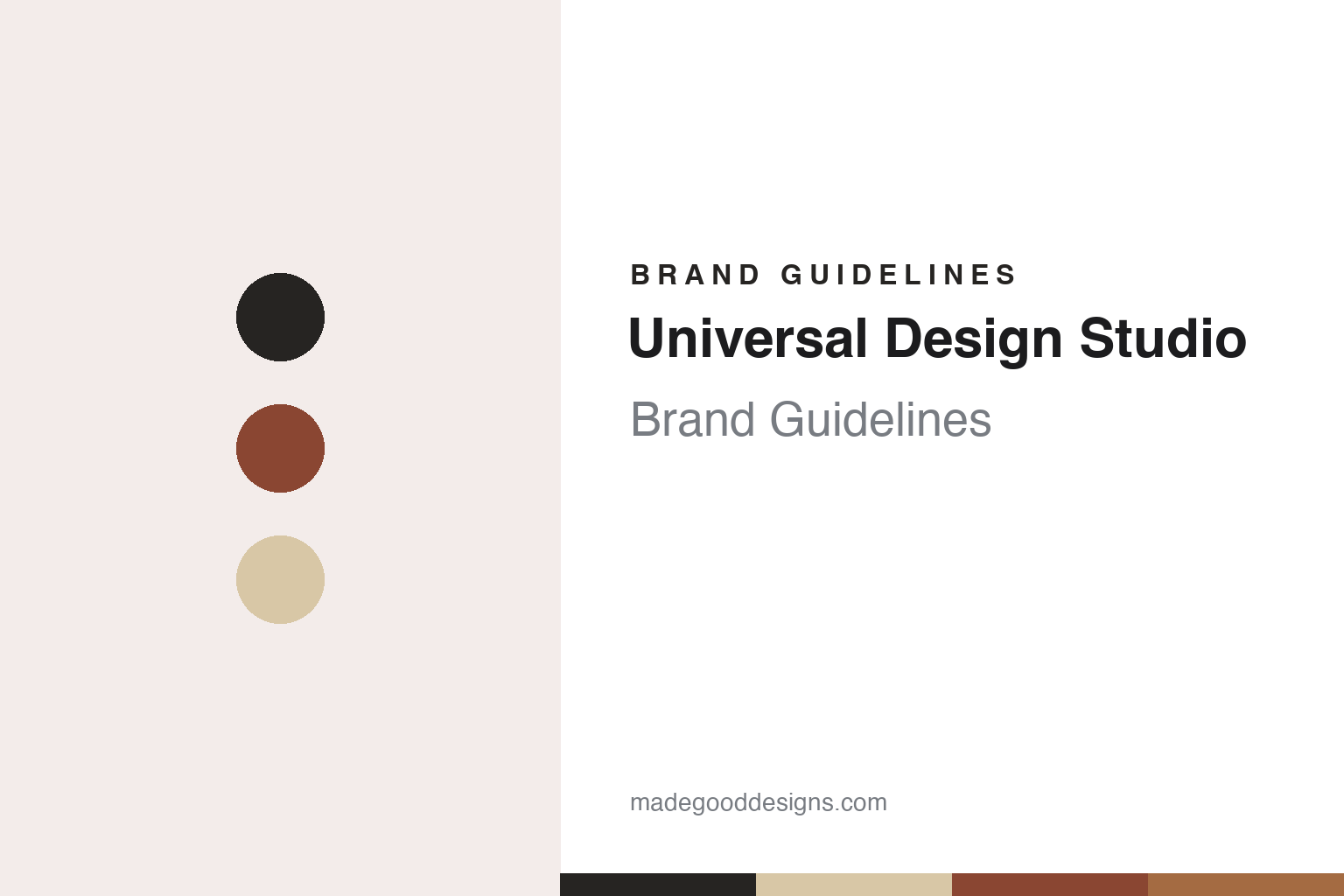
Two constants: a charcoal, birch, brick and copper palette and a workshop sans register. Abstract homage — not a Universal Design Studio project or mark; no interior, logo or photograph is reproduced.
Barber Osgerby Associates
One practice split in two in 2001.
Universal Design Studio is an architecture and interior design practice based in London and New York, according to its own website, which lists its services as architecture, interior design and creative strategy. It was founded in 2001 by the designers Edward Barber and Jay Osgerby, a date given by the studio and repeated by OnOffice in 2015, It’s Nice That in 2021 and Elle Decoration in 2022.
The studio grew out of an earlier partnership. English Wikipedia’s article on Barber Osgerby says the two met while studying architecture at the Royal College of Art in London and set up Barber Osgerby Associates in 1996, taking on hospitality, residential and office projects while they developed their early plywood furniture. By 2001, the article says, the practice was turning work away and was split in two: the architecture and interior design side was renamed Universal, and the furniture and industrial design side became Barber Osgerby. A third studio, Map Project Office, a London industrial design consultancy focused on design strategy, was also founded by the pair.
Osgerby explained the reasoning to Elle Decoration in January 2022. In the mid-to-late 1990s, he said, it was normal in Italy for architects to work across every kind of design, but in Britain the same breadth was considered odd, and the pair found it hard to explain what they did; a separate division for architecture and interiors made the work easier to describe. The magazine reported that Barber and Osgerby remain on the company’s board but are no longer part of the day-to-day running of the studio.
The studio’s own history page describes it as multidisciplinary from the start, working on interiors, architecture, industrial design and furniture, and says the founders wanted to merge the practices of art and design and to make furniture and objects as well as the spaces that contain them.
Colour
Shops, a gallery and a hotel.
Shops came early. OnOffice reported in October 2015 that the studio made its name with Stella McCartney’s stores in London and New York, and Elle Decoration dated those stores, on London’s Bruton Street and in New York’s Meatpacking District, to 2003, calling them early defining moments for the practice. Barber and Osgerby led that project themselves, the magazine said, and a custom tile they designed was used across the walls. OnOffice also reported that the studio had worked with the leather-goods brand Mulberry since 2008, designing its stores around the world and its London headquarters.
Museum work followed. According to OnOffice, the practice designed temporary exhibitions for several London museums and libraries before it designed a permanent installation, the Information Age gallery at the Science Museum, which opened in October 2014. Wood, rubber and copper were used there, the magazine said, to give a technology gallery a warm, natural feel. The studio also worked with its sister studio Map, and with outside digital designers, on an interactive exhibition at the same museum.
Hospitality came later. The Ace Hotel in Shoreditch, completed in 2013, was described by Elle Decoration as a pivotal moment for both the studio and the neighbourhood. Jason Holley, a director of the studio, told the magazine the team had not worked on a hotel before that project; OnOffice reported that its lobby was planned as a place to work as much as a place to stay. That hybrid of hotel and workspace, Elle Decoration said, led to a long collaboration with the co-working operator The Office Group, for which the studio has designed workspaces in heritage buildings.
The 2015 OnOffice profile traced the approach back to the founders’ furniture work. Holley told the magazine that making and materiality flow through every project, and that even a large building starts with the things people touch. Elle Decoration added that the practice often reuses and reprograms existing buildings rather than demolishing and rebuilding them.
Typography
How interior-design practices present themselves.
Interior-design practices rarely build their identity the way product brands do. Most trade under the names of their founders, either as a pair of surnames, as Yabu Pushelberg does, or as a single word that joins the studio and its founder, as Studioilse does. The name appears on the website, in press credits and on furniture collections, and it is usually set plainly, with the work itself left to carry the character.
Project photography does much of that work. The practices in this guide present hotels, restaurants, shops and homes through photographs credited to named photographers, with short project titles, a city and a year. Trade magazines such as Dezeen and Wallpaper* usually report a project when it opens, quoting the designers on materials, colours and the building they started from, and those dated reports are the main record of who designed what.
Many practices also design furniture, lighting and objects, often with established manufacturers, and show them at furniture fairs, in exhibitions or in their own studios. Some publish books on their work or write about design more widely. Founders and partners are presented in their professional roles: as designers, creative directors or teachers, and as the people quoted when a project is published.
Offices are described plainly, often as a city and a building, and some practices treat their own studio as a project in its own right. Pages on history and clients tend to be short. This guide sets out what dated sources say about each practice: when and where it was founded, who leads it, and which projects and collections are credited to it, leaving out award lists and private clients.
Aa
A plain workshop sans. (Specimen set in Work Sans, a sans STAND-IN; NOT the Universal Design Studio logo.)
Universal Design Studio
Many names on the team list.
The practice has not stayed independent. Universal Design Studio and Map Project Office joined the creative agency AKQA in 2018, It’s Nice That reported in December 2021, when AKQA took a majority stake in the branding studio Made Thought and the three studios came together as a new agency called The New Standard. Each studio was to keep its creative independence, the magazine said. The website of the advertising group WPP lists Universal Design Studio among its companies.
The way the studio presents itself follows from that history. Its website says the studio in Clerkenwell is shared with Map Project Office and, since 2021, with Made Thought, and that a workshop and materials library sit at the centre of the space. Its people page lists the whole current team by name rather than putting forward a single lead designer, and Osgerby told Elle Decoration in 2022 that the studio had never been about “that singular vision of a maestro.” The studio’s 20th year was marked by a book, Universal Design Studio: Inside Out, published by Phaidon in 2021, which opens with a list of everyone who has contributed to the practice, the magazine said. The online archive sorts work by type, from cultural and hospitality to retail, temporary and workspace, and by everyday activities such as eat, learn, play, sleep and work.
Day-to-day leadership sits with a group of directors. OnOffice named Hannah Carter Owers and Jason Holley as co-directors in 2015; Elle Decoration in 2022 quoted Holley as director and Paul Gulati as co-director, and Gulati appears on the studio’s current team list. In 2015 OnOffice described the studio’s building in Shoreditch, shared with Map, in an east London district with a long history of furniture making; the website now places the studio in Clerkenwell.
For a design guide, Universal Design Studio shows how an interiors practice can present itself through materials, a shared workshop and a long list of collaborators rather than one signature style. Compare Ace Hotel, the hotel brand whose Shoreditch hotel the studio designed, and Martin Brudnizki Design Studio, another London interiors practice. For this guide we use charcoal, birch, a brick red and copper with a sans, an unofficial interpretation; no product or logo is reproduced.
Explore & save
Keep Universal Design Studio’s identity on hand — save it to a board in the Made Good inspiration library.
Universal Design Studio identity set
Pin the Universal Design Studio charcoal, birch, brick and copper palette and the workshop sans register to your own board.
Source & notes
Frequently Asked Questions
What font can I use to match the Universal Design Studio look?
This guide describes Universal Design Studio’s type as “A plain workshop sans”. Its type specimen is set in Work Sans from Google Fonts as a stand-in; Work Sans is not Universal Design Studio’s own lettering.
What colours are in the Universal Design Studio palette?
This guide’s Universal Design Studio palette is Workshop charcoal #262422, Birch ply #D8C7A6, Brick red #8A4632, Copper #A46B42 and Studio paper #F5F2EC. The tones are the guide’s own unofficial interpretation, not official Universal Design Studio hex codes.
When was Universal Design Studio founded?
Universal Design Studio was founded in 2001, in London, United Kingdom.
Who founded Universal Design Studio?
Universal Design Studio was founded by Edward Barber and Jay Osgerby in 2001.
Who owns Universal Design Studio?
Universal Design Studio today: London and New York; part of AKQA since 2018.