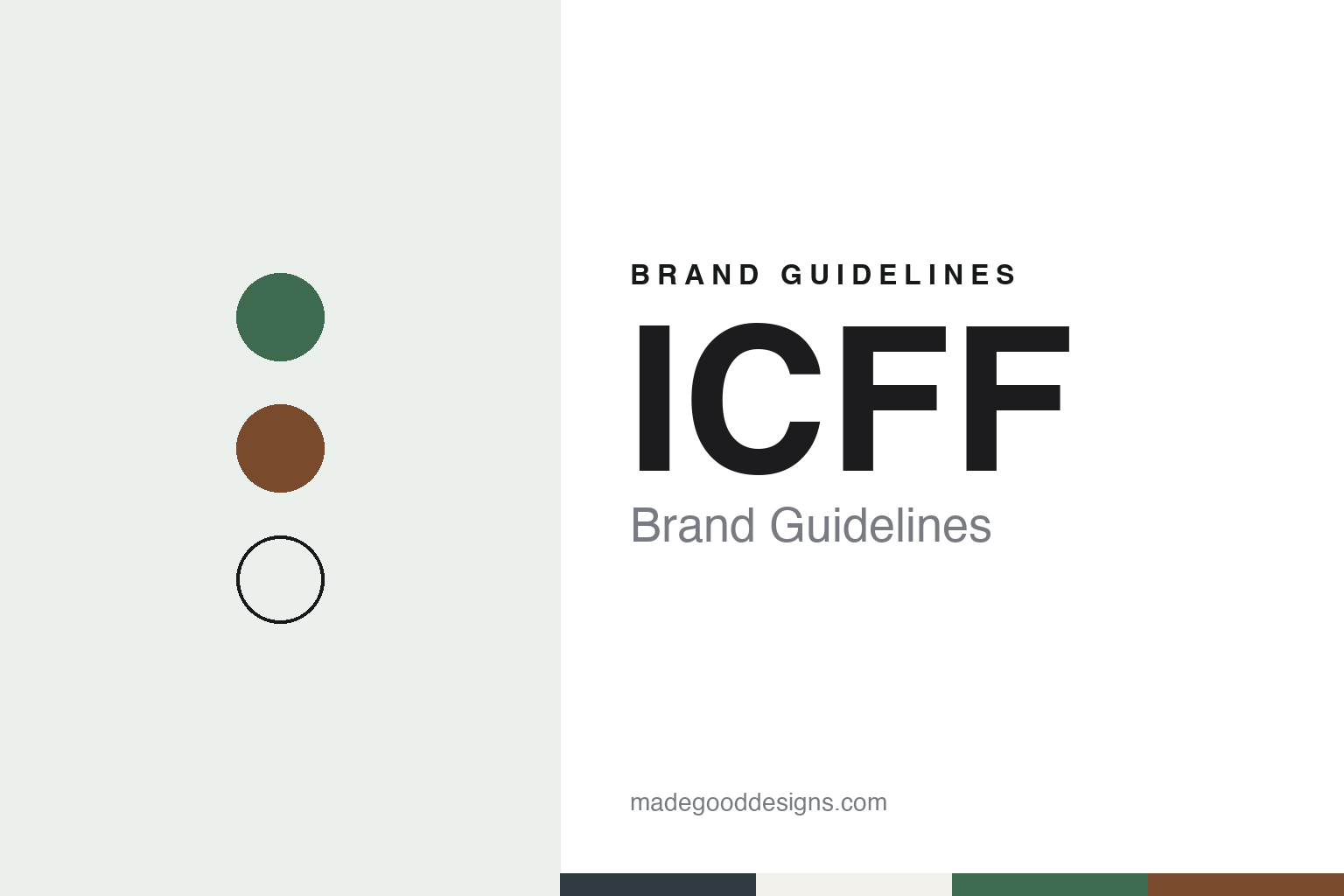
ICFF Brand Guidelines
New York’s contemporary furniture fair, held at the Javits Center since 1989.
Aa
Two constants: a green, steel and walnut palette and a soft display serif register. Abstract homage — not an ICFF asset; no logo, product or exhibit is reproduced.
Javits, May 1989
A furniture fair in a convention hall.
ICFF — the International Contemporary Furniture Fair — is a trade fair for contemporary furniture and design held at the Jacob K. Javits Convention Center in Manhattan. The opening edition was held there in May 1989, Metropolis recalled in an April 2008 article marking the fair’s twentieth year, describing a plate-glass chaise longue from England, a totemic media tower from the United States and a metal butterfly bench from Italy among the exhibits. English Wikipedia gives the same founding year, says the fair has been held at the Javits Center each May, and describes hundreds of international exhibitors each year, both established brands and emerging designers.
The Metropolis retrospective traces how the exhibitors changed. Many early participants worked in small studios, garages or cooperative spaces, often making one-off pieces. By the mid-1990s exhibitors were showing recycled and natural materials and knockdown furniture for flat-pack shipping, and Italian manufacturers, represented in earlier years by firms such as Kartell, arrived as a large group in 2000. National groups from Denmark, Spain and the Philippines also took space. By 2008, the magazine wrote, the fair reached out from the Javits into the city’s neighbourhoods, “for four days in May.” When Wallpaper* reviewed the 2013 week, it wrote that ICFF had again brought niche designers and makers into the Javits, while WantedDesign, then a separate show in Chelsea, drew exhibitors from as far as Turkey.
When New York launched its citywide design festival in 2013, ICFF became one of its anchors. A New York City Council release of February 2013 said the new NYCxDESIGN festival would be bookended by the Frieze art fair and by ICFF at the Javits Center, and Architectural Record listed the fair’s 2013 dates as 18 to 21 May. Ilene Shaw, by 2026 the executive director of NYCxDesign, told Business of Home in May 2026 that she had been “instrumental in its founding and formative first decade.”
Colour
A trade-show company, a younger show and a new parent.
ICFF is run by a trade-show company. By March 2015 Emerald Expositions, the US exhibitions business that now calls itself simply Emerald, listed ICFF among the shows of its Design Group, alongside HD Expo, GlobalShop and the Kitchen and Bath Industry Show, in a company announcement reprinted by Exhibitor. Emerald itself had been bought from Nielsen Holdings by the Toronto private equity firm Onex in 2013, the Orange County Business Journal reported in April 2017.
Emerald later folded a younger New York show into the fair. WantedDesign, co-founded in 2011 by Odile Hainaut and Claire Pijoulat, says its WantedDesign Manhattan show — now called WANTED — was acquired by Emerald in 2019 to become a feature of ICFF; Dezeen reported in May 2026 that the show had been founded by the pair before it was acquired. In December 2022 Emerald announced that Hainaut and Pijoulat would become brand directors of ICFF + WantedDesign Manhattan, and WantedDesign’s own page says they took up the role in 2023. The December 2022 announcement, published by Office Insight, said the pair had grown WantedDesign Manhattan at the Javits Center over the previous two years and would now curate exhibitors, programming and specially designed spaces across the whole fair. WANTED hosts the fair’s Schools Showcase, Launch Pad and Look Book programmes, which present student work, emerging designers and North American studios.
The parent company changed hands in 2026. Apollo announced an agreement in May 2026 for its funds to buy Emerald, Dezeen reported, and on 14 July 2026 Apollo said its funds had completed the acquisitions of Emerald Holding and of Questex, another events and media business. ICFF’s neighbour in Emerald’s portfolio, Boutique Design New York (BDNY), is a hospitality-focused trade show also held at the Javits Center, Business of Home reported.
Typography
How design weeks and fairs present themselves.
Design weeks and design fairs usually take one of two kinds of name. Some pair a city with the words “design week” or “design festival,” so that the place does most of the work; others use a short coined name or a set of initials, such as NYCxDesign, read aloud as “NYC by Design,” or ICFF, which stands for the International Contemporary Furniture Fair. In both cases the name tends to stay fixed from one year to the next while everything around it changes.
Behind the name there is usually an organiser, and often a trade-fair company. Some events began as city projects run by public agencies and later passed to private operators or not-for-profit bodies; others are trade shows owned by exhibition groups that run dozens of events across several industries, and those groups can themselves change hands. Smaller shows are sometimes absorbed into larger fairs and carry on as a named section inside them.
Most of these events are tied to places. A trade fair returns to the same convention hall or exhibition centre each year, while a citywide festival spreads across showrooms, galleries, studios and museums, linked by trails, maps, opening parties and late-night showroom evenings in particular neighbourhoods. Catalogues, printed and online calendars, and wayfinding inside large halls help visitors find their way through hundreds of exhibitors or events.
Visual identity therefore works on two levels. A logo or wordmark, sometimes designed by a named studio, stays constant, while posters, campaign images, floor plans and installations are commissioned again for each edition. This guide describes those identities only as dated sources describe them; the colours and typefaces shown here are our own interpretation, not the organisers’ own.
Aa
A soft display serif for a furniture fair. (Specimen set in Fraunces, a serif STAND-IN; NOT the ICFF logo.)
ICFF
Four letters for a long name.
The fair works under its initials. Business of Home introduced it in May 2026 as the International Contemporary Furniture Fair, “better known as ICFF,” and the show inside it has been shortened in the same way, from WantedDesign Manhattan to WANTED. Descriptions of the fair’s look mostly concern its floor: for 2026, ICFF said in a report published by ArchDaily in June 2026, the floor plan was conceived by RADS (Rodolfo Agrella Design Studio) to give visitors a clearer route through the hall.
The 2026 edition ran from 17 to 19 May at the Javits Center, Dezeen reported. In the report published by ArchDaily, ICFF said that WANTED’s Launch Pad showed more than 80 emerging designers, that its Look Book — presented with the media partner Dezeen — showed more than 60 North American studios, and that the Schools Showcase included 24 schools; a presentation by Rarify brought together original material from the Bauhaus Archive in Berlin with contemporary production by Tecta. International vendors make up roughly half of the fair’s exhibitors, Business of Home reported in May 2026.
For a design guide, ICFF shows how a fair’s initials can carry its identity while its programmes, partners and owners change around it. Compare NYCxDesign, the citywide festival it anchored for more than a decade, and Emerald, its parent company. For this guide we use a felt green, a steel grey and a walnut brown with a serif, an unofficial interpretation; no product or logo is reproduced.
Explore & save
Keep ICFF’s identity on hand — save it to a board in the Made Good inspiration library.
ICFF identity set
Pin the ICFF green, steel and walnut palette and the soft display serif register to your own board.
Source & notes
Frequently Asked Questions
What font can I use to match the ICFF look?
This guide describes ICFF’s type as “A soft display serif for a furniture fair”. Its type specimen is set in Fraunces from Google Fonts as a stand-in; Fraunces is not ICFF’s own lettering.
What colours are in the ICFF palette?
This guide’s ICFF palette is Felt green #3E6B4F, Hall steel #2F3B40, Walnut #7A4A2C, Gallery white #F2F0EB and Ink #16191A. The tones are the guide’s own unofficial interpretation, not official ICFF hex codes.
Who owns ICFF?
ICFF is owned by Emerald (Apollo funds, July 2026).