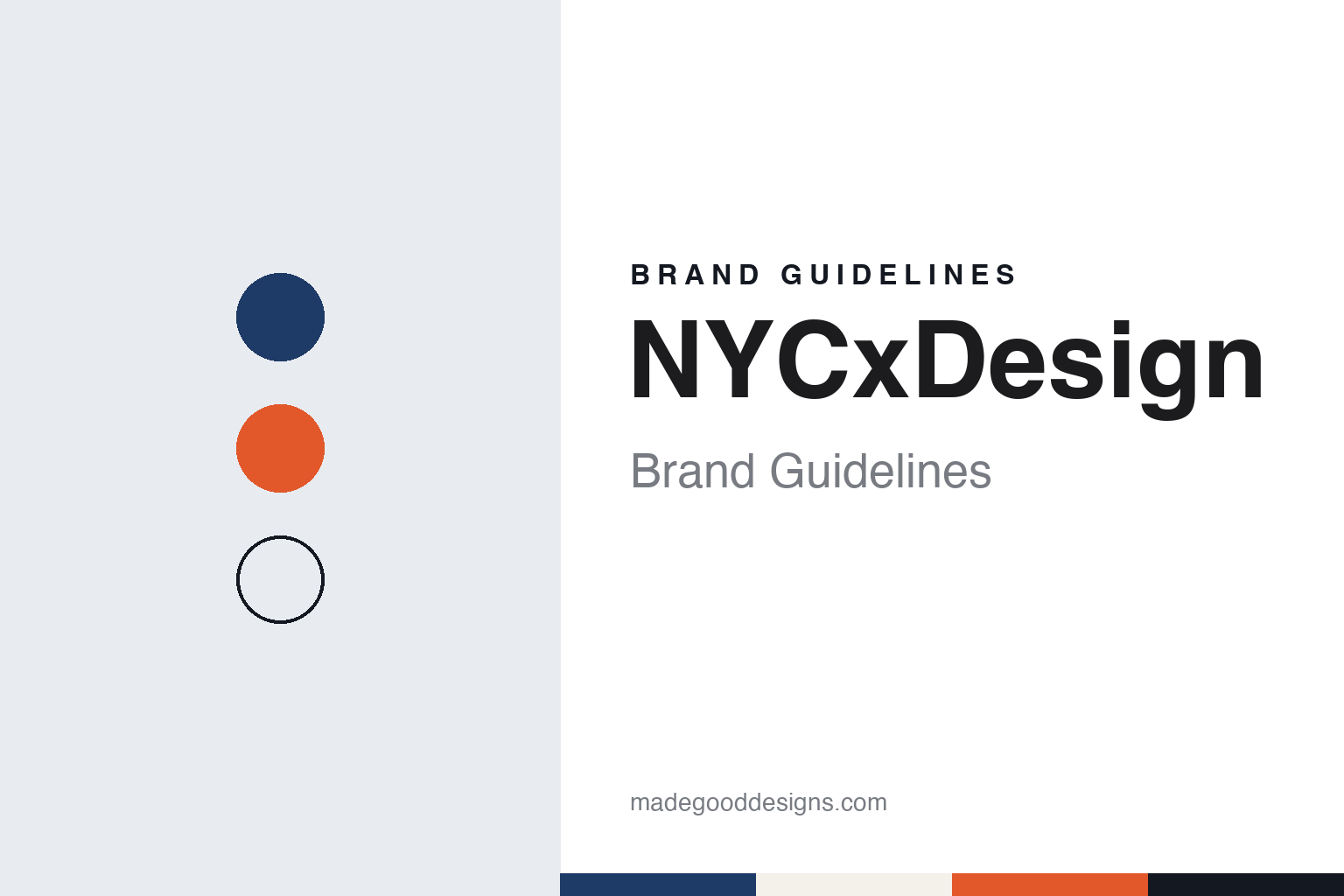
NYCxDesign Brand Guidelines
New York’s citywide design festival, spread across five boroughs every May.
Aa
Two constants: a blue, orange and paper palette and a grotesque sans register. Abstract homage — not an NYCxDesign asset; no logo, poster or campaign image is reproduced.
NYC by Design
A City Council project that became an annual festival.
NYCxDesign — the organisation writes it NYCxDESIGN, and it is pronounced “NYC by Design” — is New York City’s citywide design festival, held each May across the five boroughs. It began as a municipal project. A New York City Council press release of 14 February 2013 said the idea had first been announced in the Council Speaker’s State of the City address in February 2012, and set the dates of the opening edition: 10 to 21 May 2013. The event was produced by the City Council with a 33-member steering committee drawn from cultural institutions, design schools, design firms and city government.
From the start it was an umbrella rather than a fair. Architectural Record reported on 1 May 2013 that the festival would not create events so much as position existing ones under a new name, and that anyone planning a design-related happening could list it. The Council said in May 2013 that more than 200 events were scheduled, from free design classes for children at the Cooper-Hewitt to BKLYN Designs in DUMBO, WantedDesign in Chelsea and the International Contemporary Furniture Fair at the Javits Center; its February release had said the festival would be bookended by the Frieze art fair on Randall’s Island and by ICFF. Wallpaper*, writing on 22 May 2013, described “NYC x Design” as an umbrella title for ICFF, WantedDesign and the Noho Design District. At the May 2013 launch in Times Square, the Council also presented “Multifesto,” a communal design manifesto open to designers anywhere, alongside a mobile scheduling website and a photo app for the festival.
The festival’s own history page says the project followed a 2011 city survey of the design sector, and that NYC & Company, the city’s tourism agency, and the New York City Economic Development Corporation (NYCEDC) appointed Edward Hogikyan to lead it. That page dates the inauguration to May 2012; the Council’s releases from 2013 present the May 2013 edition as the opening one.
Colour
From city hall to a not-for-profit.
The city ran the festival for its first seven years. On 10 January 2019 NYCEDC announced that the media company SANDOW would take over operations from 2020, Business of Home reported that day. The move followed a public request for expressions of interest issued the previous summer; Hogikyan, then NYCEDC’s chief marketing officer, told the magazine that the agency had been “the incubator” for the programme. Sandow had worked with the festival since 2016, the same report said.
The arrangement changed again within two years. In November 2020 Metropolis reported that NYCxDESIGN had become a not-for-profit, then led by programme director Valerie Hoffman, and that it would keep working with NYCEDC and its steering committee while it formed a board and looked for an executive director. Metropolis is itself a Sandow title. The festival’s history page dates the change to September 2020 and says it was made with Sandow’s support; it describes a 501(c)(3) organisation governed by a board of directors, run by an executive director and a small team, and advised by a steering committee of industry, academic and community members. By May 2026 the executive director was Ilene Shaw, Business of Home reported.
Beside the May festival the organisation runs work through the year. Metropolis reported that in October 2020 its poster campaign “An Ode to NYC” placed graphic work by 21 local designers at sites around the five boroughs. English Wikipedia lists further strands, including an Emerging Designer Showcase, a podcast, and Design Pavilion, an outdoor exhibition of installations at public venues. It also records that in March 2024, marking the festival’s twelfth year, the organisation added a Keynote programme, with a talk by a designer or brand on each day of the festival week.
Typography
How design weeks and fairs present themselves.
Design weeks and design fairs usually take one of two kinds of name. Some pair a city with the words “design week” or “design festival,” so that the place does most of the work; others use a short coined name or a set of initials, such as NYCxDesign, read aloud as “NYC by Design,” or ICFF, which stands for the International Contemporary Furniture Fair. In both cases the name tends to stay fixed from one year to the next while everything around it changes.
Behind the name there is usually an organiser, and often a trade-fair company. Some events began as city projects run by public agencies and later passed to private operators or not-for-profit bodies; others are trade shows owned by exhibition groups that run dozens of events across several industries, and those groups can themselves change hands. Smaller shows are sometimes absorbed into larger fairs and carry on as a named section inside them.
Most of these events are tied to places. A trade fair returns to the same convention hall or exhibition centre each year, while a citywide festival spreads across showrooms, galleries, studios and museums, linked by trails, maps, opening parties and late-night showroom evenings in particular neighbourhoods. Catalogues, printed and online calendars, and wayfinding inside large halls help visitors find their way through hundreds of exhibitors or events.
Visual identity therefore works on two levels. A logo or wordmark, sometimes designed by a named studio, stays constant, while posters, campaign images, floor plans and installations are commissioned again for each edition. This guide describes those identities only as dated sources describe them; the colours and typefaces shown here are our own interpretation, not the organisers’ own.
Aa
A grotesque sans for a city label in capitals. (Specimen set in Archivo, a sans STAND-IN; NOT the NYCxDesign logo.)
NYCxDesign
A coined name over hundreds of events.
The festival’s look began with a commission. The Council’s February 2013 release said the studio Base New York created the event identity — the logo, branding, mark and visuals — and that the local interactive firm Cloudred designed the website. The name itself carries the format: the city’s initials, a lower-case x read aloud as “by,” and the word design, which the organisation sets in capitals.
The 2026 festival ran from 14 to 20 May, 6sqft reported on 14 May 2026, anchored by the trade fairs ICFF and WANTED and opening with a party at HALO 28 in downtown Manhattan. Around them the calendar mixed showroom evenings, open studios and tours: Soho Design Night on 15 May brought together showrooms and galleries including FLOS, Roll & Hill, Bang & Olufsen and Nordic Knots; an Atlantic Avenue Day of Design ran through Brooklyn Heights, Cobble Hill and Boerum Hill on 16 May; and the designers’ association AIGA NY led a tour of the New York Sign Museum and a working sign studio. In 2013 the Council had likewise described events in all five boroughs, spanning disciplines from architecture and graphic design to lighting, landscape and urban design.
For a design guide, NYCxDesign shows how a city festival can work as a label laid over many independent events, with a short coined name doing the job that a single venue does elsewhere. Compare ICFF, the furniture fair it was built around, and Cooper Hewitt, the city’s design museum, which ran children’s classes in the opening edition. For this guide we use a deep blue, a signal orange and a warm paper white with a sans, an unofficial interpretation; no product or logo is reproduced.
Explore & save
Keep NYCxDesign’s identity on hand — save it to a board in the Made Good inspiration library.
NYCxDesign identity set
Pin the NYCxDesign blue, orange and paper palette and the grotesque sans register to your own board.
Source & notes
Frequently Asked Questions
What font can I use to match the NYCxDesign look?
This guide describes NYCxDesign’s type as “A grotesque sans for a city label in capitals”. Its type specimen is set in Archivo from Google Fonts as a stand-in; Archivo is not NYCxDesign’s own lettering.
What colours are in the NYCxDesign palette?
This guide’s NYCxDesign palette is Five-borough blue #1E3A66, Night ink #141821, Signal orange #E2582B, Paper white #F4F1EA and Kerb grey #C9C6BE. The tones are the guide’s own unofficial interpretation, not official NYCxDesign hex codes.
When did the NYCxDesign logo change?
This guide dates a logo milestone for NYCxDesign to 2013: Base New York.