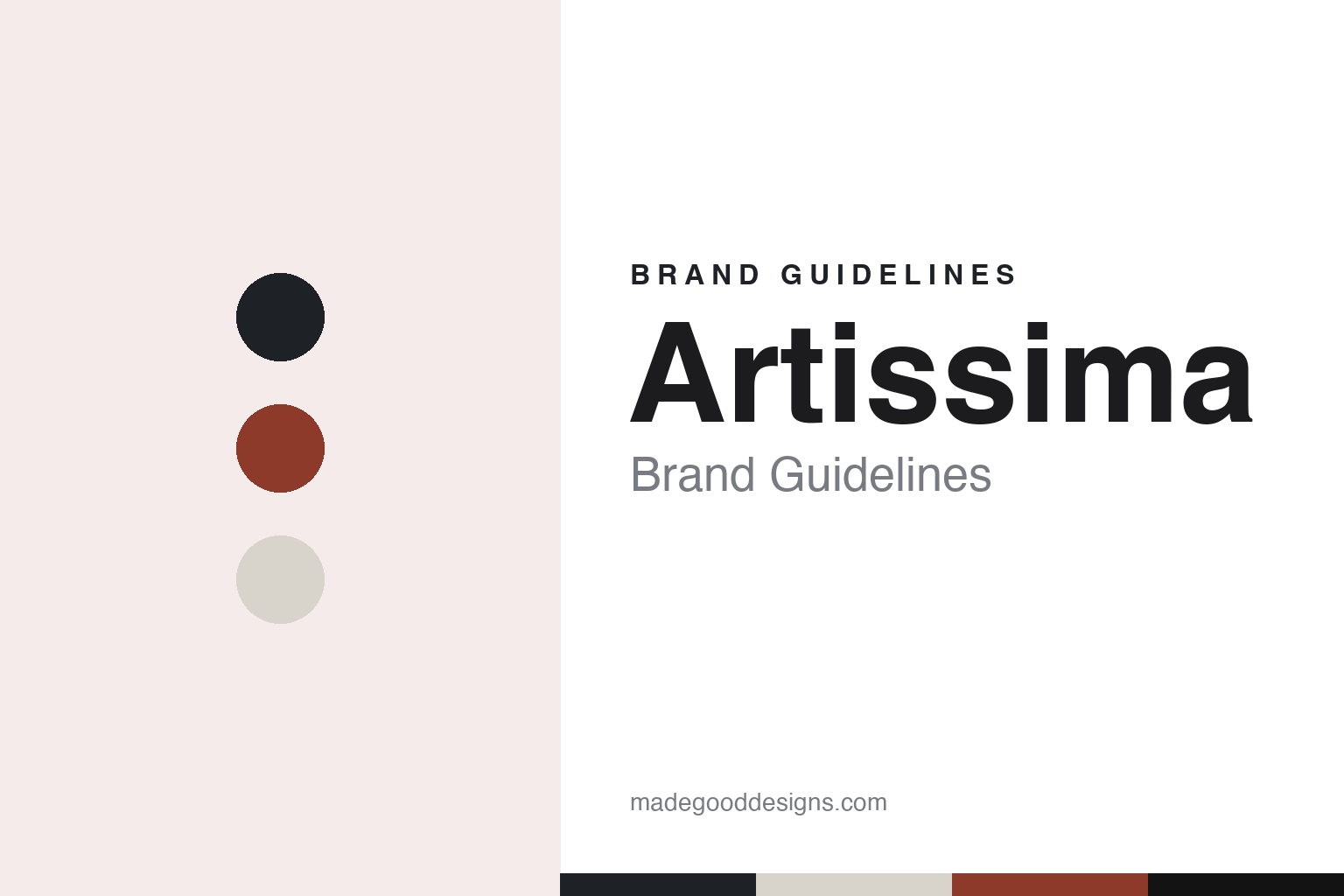
Artissima Brand Guidelines
Turin’s contemporary art fair at the Oval since 1994.
Aa
Two constants: a graphite, brick and concrete palette and a grotesque sans register. Abstract homage — not an Artissima asset; no logo, poster or artwork is reproduced.
ARTissima
A fair in Pavilion 3 at Lingotto, 1994.
Artissima opened in Turin on 29 September 1994, with the public admitted from 30 September until 3 October. The fair’s own history pages say it was founded by Roberto Casiraghi and Paola Rampini, that Casiraghi was its first director, and that the first edition filled Pavilion 3 of Lingotto Fiere, with 123 galleries from seven countries. In those early years the name was written “ARTissima”, with the first three letters in capitals, and the fair presented itself as an Italian fair of modern and contemporary art that was open to galleries from abroad.
From the start the programme leaned towards younger artists. A special section called “Vernice Fresca,” which ran until 1999, showed work by artists under 35, the fair’s history says.
The fair changed shape in 2001. That year it moved to Torino Esposizioni, shifted its dates to November and took the name “International Fair of Contemporary Art in Torino,” after official recognition of its international role by the Ministry of Industry and Trade, according to its own account. The 2001 edition had 137 galleries from 13 countries and the support of two bank foundations, the Compagnia di San Paolo and Fondazione CRT. It also launched Present Future, a section for emerging artists that the fair says became one of its mainstays.
By 2007 the fair was back at Lingotto Fiere. That year a curator succeeded Casiraghi as director, The Art Newspaper reported in 2023, and the fair adopted the phrase “Featuring the Future” and published its own magazine, Radio Sick, in two issues, its history says. In 2008 it hosted 146 galleries from 19 countries.
Colour
The Oval, curated sections and a theme each year.
In 2010 Artissima moved to the Oval, the large hall at Lingotto Fiere that has been its home since, and launched Back to the Future, a section for rediscovering artists of earlier decades, according to the fair’s history. Further sections followed: Art Editions, for art publishing, in 2012, and Disegni, devoted to drawing, in 2017. The 2017 edition had 206 galleries from 32 countries.
In 2020 the fair took place in what it called an “Unplugged” version: an online catalogue and a cross-media platform for the curated sections, together with exhibitions in three museums of Fondazione Torino Musei, the GAM, Palazzo Madama and the MAO Museo d’Arte Orientale, according to its edition page.
The Art Newspaper, writing on 1 November 2023, reported that the 30th edition, held at the Oval from 3 to 5 November, brought 181 galleries from 33 countries, 58 per cent of them from outside Italy, including 39 newcomers. It named the Paris gallery Jocelyn Wolff and the Milan gallery Lia Rumma among the longstanding participants. The paper noted that each edition usually carries a theme; that year’s was “Relations of Care.” In the same interview the director, Luigi Fassi, described the fair as an “accelerator” for galleries and artists, and pointed to an exhibition at the Gallerie d’Italia drawn from artists represented by Artissima’s galleries as an example of the fair working beyond the Oval.
The 2025 edition ran from 31 October to 2 November at the Oval with 176 galleries from 36 countries, according to the fair. It was organised in four main sections, Main Section, New Entries, Monologue/Dialogue and Art Spaces & Editions, alongside the three curated sections, Present Future, Back to the Future and Disegni, each with its own curators. Its theme, “Operating Manual for Spaceship Earth,” took its title from Richard Buckminster Fuller’s 1969 book. The 2026 edition was held from 30 October to 1 November, with an invitation-only preview on 29 October, the fair’s website says.
Typography
Fairs, halls and names.
Contemporary art fairs usually present themselves through a short name that does most of the work. Some take the city outright, as Art Cologne does; others join a coined word to the city, as ARCOmadrid does with ARCO and, for its Portuguese sibling, ARCOlisboa. The name stays fixed while much around it changes from one edition to the next, and editions are counted: ARCOmadrid held its 45th in March 2026 and Art Cologne its 59th in November 2026.
Behind many fairs stand trade-fair companies and galleries. ARCOmadrid is organised by IFEMA MADRID, and Art Cologne’s press releases come from Koelnmesse, while both fairs trace their beginnings to gallerists: Juana de Aizpuru in Madrid in 1982, and a Cologne dealers’ association in 1967. At both fairs the exhibitors are chosen by a committee or advisory board, and both are held in the exhibition halls of their organisers, IFEMA in Madrid and the fairgrounds at Cologne-Deutz, so the venue becomes part of the fair’s picture.
Inside the halls, fairs divide themselves into named sections. A main programme for established galleries sits beside sections for younger galleries, such as ARCOmadrid’s Opening, for galleries under eight years old, or Art Cologne’s NEUMARKT, and beside curated programmes with their own themes and curators. At these two fairs the section names are written in capitals or set off with punctuation — GALLERIES, ART + OBJECT, Profiles | Latin American Art — so that they read as titles in their own right.
The material the fairs publish follows a steady pattern: exhibitor lists by city and country, hall plans, programmes of talks and special exhibitions, and headline figures for each edition. Themed projects change from edition to edition — ARCOmadrid named its 2026 project ARCO2045 — while the name, the organiser and the city stay constant, which keeps a fair recognisable across decades.
Aa
A plain grotesque register for a fair whose name has been set in capitals and lower case. (Specimen set in Archivo, a sans STAND-IN; NOT the Artissima logo.)
Artissima
A public fair run through a company.
Artissima is not owned by a trade-fair company. An announcement published by the fair on 8 February 2022 stated that it is managed by Artissima Srl, a company affiliated with Fondazione Torino Musei, and that the Artissima trademark belongs to three public bodies: the Regione Piemonte, the Città Metropolitana di Torino and the Città di Torino. The same announcement said the fair is produced with their support, in collaboration with Fondazione CRT, the Fondazione per l’Arte Moderna e Contemporanea CRT, the Fondazione Compagnia di San Paolo and the Turin chamber of commerce.
Directors are appointed by that structure. In the 2022 announcement, the board of Fondazione Torino Musei said it had chosen Luigi Fassi after an international call, to lead the 2022, 2023 and 2024 editions, and noted that the public nature of the fair called for a new appointment after his predecessor’s five years. Fassi had been artistic director of MAN, the museum of art in Nuoro, from 2018 to 2022, and had curated and coordinated the fair’s Present Future section from 2010 to 2017, the announcement said. The Art Newspaper confirmed in 2023 that he had been appointed in 2022.
The fair’s identity rests less on a fixed image than on a set of recurring names. The edition pages repeat the same section titles from year to year, Present Future, Back to the Future and Disegni, and each edition adds a theme with its own title, from “Relations of Care” in 2023 to a title borrowed from Buckminster Fuller in 2025. The venue is constant too: since 2010 the fair has been held in the Oval, and its website gives the hall as the fair venue alongside its office in central Turin. The early spelling “ARTissima,” used in the fair’s own accounts of its first editions, has given way to the single word with one capital.
For a design guide, Artissima shows how a fair can hold one name, one hall and a fixed set of section titles while each edition changes its theme. Compare miart, the Milan fair organised by Fiera Milano, and Liste Art Fair Basel, another contemporary art fair in this series. For this guide we use graphite, a brick red and a concrete grey with a sans, an unofficial interpretation; no product or logo is reproduced.
Explore & save
Keep Artissima’s identity on hand — save it to a board in the Made Good inspiration library.
Artissima identity set
Pin the Artissima graphite, brick and concrete palette and the grotesque sans register to your own board.
Source & notes
Frequently Asked Questions
What font can I use to match the Artissima look?
This guide describes Artissima’s type as “A plain grotesque register for a fair whose name has been set in capitals and lower case”. Its type specimen is set in Archivo from Google Fonts as a stand-in; Archivo is not Artissima’s own lettering.
What colours are in the Artissima palette?
This guide’s Artissima palette is Oval graphite #1E2126, Turin brick #8E3A2B, Lingotto concrete #D8D4CC, Ink #131313 and Paper #F7F5F0. The tones are the guide’s own unofficial interpretation, not official Artissima hex codes.
When was Artissima founded?
Artissima was founded in 1994, in Turin, Italy.
Who founded Artissima?
Artissima was founded by Roberto Casiraghi and Paola Rampini in 1994.