Dallas Art Fair Brand Guidelines
The spring fair held at Fashion Industry Gallery since 2009.
Aa
Two constants: a brick red, limestone and sky blue palette and a sturdy sans register. Abstract homage — not a Dallas Art Fair asset or mark; no logo, campaign image or artwork is reproduced.
A developer, a curator and a fashion mart
How a spring fair began in downtown Dallas.
The Dallas Art Fair was founded in 2009 by the real-estate developer John Sughrue and the curator Chris Byrne, according to The Art Newspaper in October 2026 and the Texas Signal in April 2026. The fair’s own website also gives 2009 as its founding year. The Art Newspaper reported that Byrne left the organisation in 2017. A 2018 PaperCity report pictured Sughrue, as co-founder, alongside the director at the fair’s tenth edition.
From its first edition the fair has used a single building. The Art Newspaper describes Fashion Industry Gallery, known as FIG, as a wholesale fashion market venue in downtown Dallas, and reports that the building is owned by Sughrue. The Texas Signal likewise says the fair opened in Sughrue’s own Fashion Industry Gallery. PaperCity placed the building in the Dallas Arts District when it announced the 2026 exhibitors. Inside, exhibitors have been split across two floors, The Art Newspaper noted in 2026, with limited sight lines between them.
The Texas Signal wrote in April 2026 that the fair opened in 2009 as the recession arrived. It grew from about 35 galleries to a steady figure of more than 90, the same paper reported, and it described the event as a rare independently run regional fair. The Art Newspaper gave the usual size as around 90 galleries, with a total closer to 100 in the years before 2020.
The fair is a spring event. PaperCity covered the tenth edition in spring 2018, and the 2026 edition opened with a VIP preview on Thursday, 16 April, and closed on Sunday, 19 April, as The Art Newspaper and PaperCity reported.
Colour
A director who began as an intern.
In 2016 Kelly Cornell, who had started at the fair as an intern, became its director, the Texas Signal reported. She was still director in 2026, when she spoke to The Art Newspaper and to PaperCity. The Texas Signal credits her with building the fair’s ties to institutions in the city, naming the Dallas Museum of Art, the Nasher Sculpture Center and the Dallas Contemporary, and with securing sponsors, among them Bank of America.
The same year, the fair set up an acquisition fund for museums. PaperCity reported in January 2026 that the Dallas Art Fair Foundation’s Acquisition Fund was marking its tenth anniversary that year, and that more than 75 works had been acquired at the fair for the Dallas Museum of Art’s permanent collection to date. At the 2026 edition the museum acquired six works for its permanent collection through a combination of the foundation and its own acquisition fund, The Art Newspaper reported on 17 April 2026.
The 18th edition ran from 16 to 19 April 2026 at FIG, PaperCity reported. The exhibitor list mixed returning and new names. PaperCity listed Josh Lilley of London, OMR of Mexico City and Kerlin Gallery of Dublin among the international galleries returning that year, and Carpenters Workshop Gallery, a design gallery, among the first-time exhibitors; the magazine also listed a group of Dallas galleries taking part. The Texas Signal counted about 20 international galleries in 2026.
The Art Newspaper wrote that the fair appeared to be settling into a steadier rhythm after the disruptions of earlier years, with around 31 galleries not returning from the 2025 roster, compared with more than 40 in previous cycles, while the overall number of exhibitors held at around 90. Cornell told the paper at the VIP preview that the fair had a strong return rate. The paper described the local collector base as tight-knit and deliberate, and noted that museum directors, curators and board members from across the Dallas–Fort Worth area attend the fair. Collectors often return to the same stands several times over the four days, the paper wrote, so business at the fair tends to unfold slowly.
Typography
How mid-sized and city fairs present themselves.
A mid-sized or city art fair is usually organised in one of two ways. Some are set up by galleries themselves, or by a foundation or association that grew out of them: Melbourne Art Fair says it was founded by a group of galleries in 1988 and is now run by the nonprofit Melbourne Art Foundation. Others are run by an exhibition company or a private organiser: Newsis has described Art Busan, held at BEXCO, as a privately run fair. Either way, the organiser selects the galleries; Art Busan, for example, tightened its screening criteria for its 2025 edition, the Asia Business Daily reported.
The venue becomes part of how a fair is pictured. Convention halls offer open floors that can be divided into booths and rebuilt every year; some fairs instead use a tent, a former industrial site or a historic exhibition building, and several have moved between them. Melbourne Art Fair moved from the Royal Exhibition Building in the Carlton Gardens to a riverside convention centre, while Art Busan has stayed in the same exhibition centre since its first edition.
Each fair also holds a fixed place in the art calendar, usually the same month every year, and counts its editions rather than renaming them. Inside, the floor is divided into named sections: a main gallery section, a section for younger galleries or artists, curated areas for video, installation or design, and a programme of talks. These names are short, often set in capitals, and repeated on floor plans, in printed guides and on the website.
The visual identity follows the same split between what stays and what changes. The name, usually the word “Art” and a city, stays put, sometimes with a shortened form or a version in the local script. The campaign image, the colours of the season and the designed spaces inside the hall change from edition to edition, which lets a fair look new each year and still be recognised.
Aa
A sturdy sans for a plain, place-named title. (Specimen set in Libre Franklin, a sans STAND-IN; NOT the Dallas Art Fair logo.)
Dallas Art Fair
A city name, a building and a date in April.
The fair’s name does the work of a logo line: it states the city and the event and nothing else. In the press it is written out in full or shortened to DAF, as the Texas Signal did in April 2026. Its other fixed elements are the building and the season. Every edition from 2009 to 2026 took place at Fashion Industry Gallery, The Art Newspaper reported in October 2026, and the paper described a layout in which exhibitors were split across two floors of the wholesale fashion venue.
Around the fair, the programme reaches into the city. The fair’s website describes a programme of talks and events across Dallas alongside the gallery presentations, and the Texas Signal listed events around the fair that included a benefit gala and a satellite fair at a hotel. PaperCity illustrated its January 2026 report on the exhibitor list with photographs of the fair floor and its visitors.
The museum link is part of the same picture. The acquisition fund ties each April edition to the Dallas Museum of Art’s collection, and the works chosen each year are reported in the press alongside the fair itself, as The Art Newspaper did in 2026.
For a design guide, the Dallas Art Fair shows how a regional fair builds recognition from a plain city name, one long-standing venue and a spring date. Compare EXPO Chicago and The Armory Show, two other fairs in the United States. For this guide we use a brick red, a pale limestone and a sky-blue accent with a sans, an unofficial interpretation; no product or logo is reproduced.
Explore & save
Keep Dallas Art Fair’s identity on hand — save it to a board in the Made Good inspiration library.
Dallas Art Fair identity set
Pin the Dallas Art Fair brick red, limestone and sky blue palette and the sturdy sans register to your own board.
Source & notes
Frequently Asked Questions
What font can I use to match the Dallas Art Fair look?
This guide describes Dallas Art Fair’s type as “A sturdy sans for a plain, place-named title”. Its type specimen is set in Libre Franklin from Google Fonts as a stand-in; Libre Franklin is not Dallas Art Fair’s own lettering.
What colours are in the Dallas Art Fair palette?
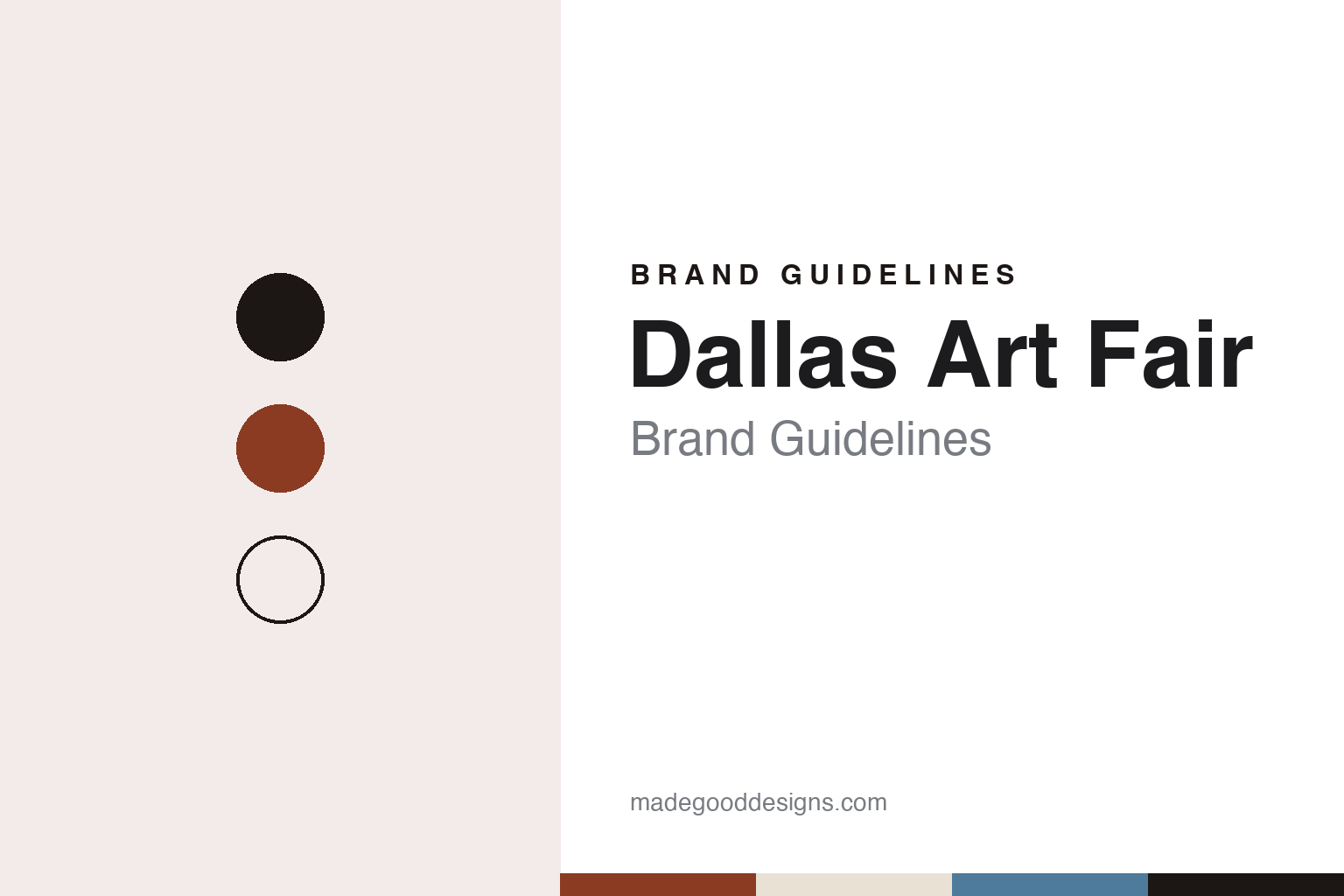
This guide’s Dallas Art Fair palette is Brick red #8A3B22, Ink #1C1714, Limestone #E9E1D3, Big-sky blue #4E7A9B and Paper #F8F5EF. The tones are the guide’s own unofficial interpretation, not official Dallas Art Fair hex codes.
When was Dallas Art Fair founded?
Dallas Art Fair was founded in 2009, in Dallas, Texas.
Who founded Dallas Art Fair?
Dallas Art Fair was founded by John Sughrue and Chris Byrne in 2009.