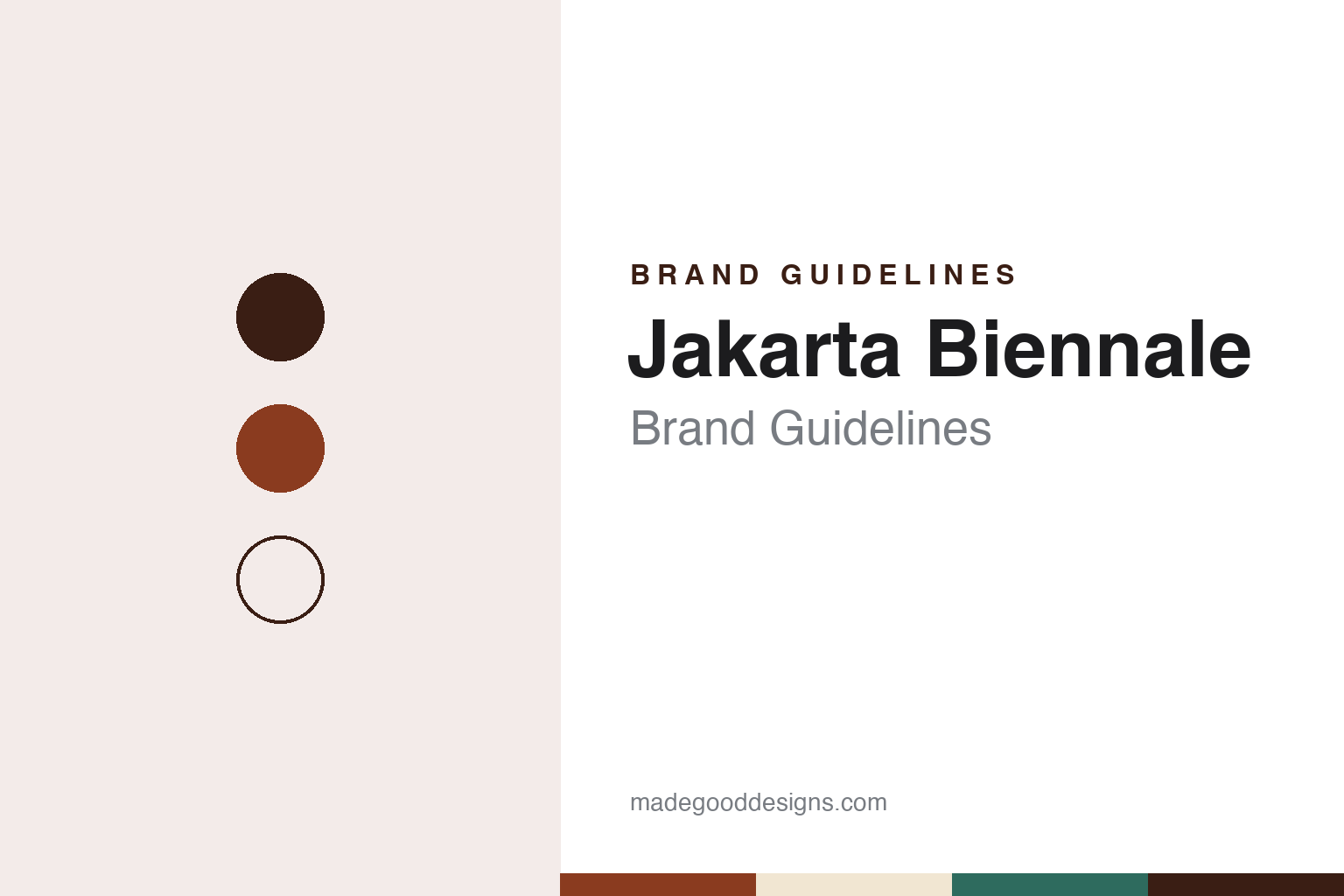
Jakarta Biennale Brand Guidelines
From a national painting show to a biennale made by the city’s collectives.
Aa
Two constants: a terracotta, rice paper and teal palette and a sturdy grotesque register. Abstract homage — not a Jakarta Biennale asset; no logo, poster or artwork is reproduced.
A painting show
From the Pameran Besar to a biennale.
Jakarta Biennale traces its start to 1974, when the Dewan Kesenian Jakarta, the Jakarta Arts Council, set up the Pameran Besar Seni Lukis Indonesia, the Great Exhibition of Indonesian Painting. The Indonesian news site detik reported in October 2024 that the event had been held in Jakarta since 1974, starting under that name as an initiative of the arts council, and the biennale marked its fiftieth year in 2024.
The early format changed several times. According to the history published on the biennale’s 2021 website, the Great Exhibition took a biennial format after 1974, held every two years, and was renamed the Biennale of Painting in the following year. It took the name Jakarta Biennale in 1993, for the ninth edition, whose main curator was Jim Supangkat; that edition included installation works alongside painting. The tenth and eleventh editions followed in 1996 and 1998, with painting again dominant, the same history says.
After 1998 there was a long gap. The biennale returned in 2006 as Jakarta Biennale 2006, made up of three exhibitions titled “Beyond,” “Milestone” and “The Others.” The 2009 edition, “Arena,” invited artists from abroad and added larger public programmes, the organisers’ history says, and moved its main exhibition hall from Taman Ismail Marzuki to the National Gallery of Indonesia, where the 2011 edition, “Maximum City,” was also held.
Throughout, the biennale has been linked with Taman Ismail Marzuki, the arts centre in Central Jakarta. The 2013 edition, “Siasat,” returned there, but instead of the centre’s Cipta Gallery it used the underground car park of the Jakarta Theater as its main hall, which the organisers describe as using the city’s public space as exhibition space.
Colour
A foundation, new venues and a collective model.
In the mid-2010s the biennale gained a second organising body. The biennale’s 2021 history says the Jakarta Biennale Foundation was founded in 2015 as the arts council’s organising partner; a December 2024 review on e-flux dates its establishment to 2014. The 2015 edition, titled “Neither Forward nor Back: Acting in the Present,” moved its main exhibition to Gudang Sarinah Ecosystem in South Jakarta and presented a range of cultural activities about the city as a place in constant change, according to the organisers.
Two years later, “Jiwa,” the 2017 Jakarta Biennale, was held again at Gudang Sarinah Ecosystem from November to December 2017. Its theme, as the organisers put it, was the basic human impulses that stir the senses, emotions and understanding. The next edition was held in 2021, the e-flux review notes, and the biennale’s 2021 website gave its theme as “Tomorrow: Building History Together.”
The 2024 edition, titled “50 Tahun Jakarta Biennale 1974–2024,” ran from 1 October to 15 November 2024. The e-flux review lists four venues: the main exhibition space at Taman Ismail Marzuki, Gudskul, Komunitas Salihara and Subo. detik reported that the edition had no theme, no curatorial team and no strict selection of works; instead it was run on the lumbung method of shared resources by the Majelis Jakarta, or Jakarta Assembly, a group of 20 collectives that included Gudskul Ekosistem, PannaFoto Institute and Sanggar Anak Akar. Bambang Prihadi, the arts council’s executive chair, told detik that lumbung “is not a theme, but a way of working.”
Within the 2024 edition, a programme called “Topography of Mirror Cities,” led by the Taiwanese curator Sandy Hsuchiu Lo, showed collaborative work by 60 artists and collectives from six cities: Kuala Lumpur, Taipei, Phnom Penh, Bangkok, Jakarta and Dhaka, detik reported.
Typography
Biennials and triennials across regions.
Some biennials are defined less by a city or a theme than by a single commitment: one medium, one format or one host. A biennial of moving image, a photography meeting, an assembly or a summit, or an exhibition run by a museum each sets a rule that stays put while everything else changes. That rule becomes the steadiest part of the identity, more lasting than any poster, title or curator.
Numbering is the simplest tool these events use. An edition count turns a series of separate exhibitions into a sequence, and the way the number is written can carry character of its own: spelled out, set as a numeral, or folded into the name itself. A recurring host institution plays a similar role. When the same museum, arts centre or foundation stages every edition, its building and its name give visitors a fixed point to return to, even when the curatorial team is new each time.
Publications often outlast the exhibitions. Catalogues, readers, companion books and printed handouts record what each edition argued and who took part, and some events present them as part of the edition rather than as souvenirs. A consistent format for these books, or a deliberate change from one edition to the next, says as much about the event as its signage does.
Finding the work is the other half of the identity. A moving-image biennial needs screening schedules and running times; a programme spread over several weekends needs a clear calendar; an exhibition spread across a city needs a map and a route from one venue to the next. For a designer, these practical documents are where the event’s rule becomes visible: in how a timetable is set, how venues are numbered and how a visitor is led from one room to the next.
Aa
A sturdy grotesque for a biennale with fifty years of names. (Specimen set in Archivo, a sans STAND-IN; NOT the Jakarta Biennale logo.)
Jakarta Biennale
Fifty years, several names.
The biennale’s name tells part of its story. It began as a national painting exhibition, became a biennale of painting and, from 1993, the Jakarta Biennale, a name it has kept through changes of venue, format and organiser. The 2024 edition put that history on show: the e-flux review describes a wall text and timeline at Taman Ismail Marzuki dedicated to the artists and art workers who have organised the biennale over the years.
Its venues have moved between institutions and the city. The main hall has been at Taman Ismail Marzuki, at the National Gallery of Indonesia in 2009 and 2011, in a theatre car park in 2013 and at Gudang Sarinah Ecosystem in 2015 and 2017, before the 2024 edition spread across four sites, including Gudskul and Komunitas Salihara.
The 2024 edition also changed who makes the biennale. Rather than one artistic director, it was organised by collectives working together, with the arts council among the members of the Majelis Jakarta, and the review describes an exhibition without fixed sections or a set route through the rooms. Bambang Prihadi told detik that the anniversary mattered because an event that started as a competition had, over time, come to belong to Jakarta’s art community.
The biennale sits within a wider Indonesian scene that includes the Biennale Jogja in Yogyakarta and the Art Jakarta fair in the same city. On the visual side, its graphics change with each edition, and no fixed logo designer, palette or typeface is documented in the sources used here.
For a design guide, Jakarta Biennale shows how an event can keep one name while its format, venues and organisers change around it. Compare Biennale Jogja, another long-running Indonesian biennale, and Art Jakarta. For this guide we use a terracotta, a rice-paper cream and a deep teal with a sans, an unofficial interpretation; no product or logo is reproduced.
Explore & save
Keep Jakarta Biennale’s identity on hand — save it to a board in the Made Good inspiration library.
Jakarta Biennale identity set
Pin the Jakarta Biennale terracotta, rice paper and teal palette and the sturdy grotesque register to your own board.
Source & notes
Frequently Asked Questions
What font can I use to match the Jakarta Biennale look?
This guide describes Jakarta Biennale’s type as “A sturdy grotesque for a biennale with fifty years of names”. Its type specimen is set in Archivo from Google Fonts as a stand-in; Archivo is not Jakarta Biennale’s own lettering.
What colours are in the Jakarta Biennale palette?
This guide’s Jakarta Biennale palette is Terracotta #8A3B1F, Teak brown #3A1E14, Rice paper #F1E6D2, Canal teal #2E6B5E and Paper #FAF6EE. The tones are the guide’s own unofficial interpretation, not official Jakarta Biennale hex codes.
When was Jakarta Biennale founded?
Jakarta Biennale was founded in 1974 (as Pameran Besar Seni Lukis Indonesia), in Jakarta, Indonesia.