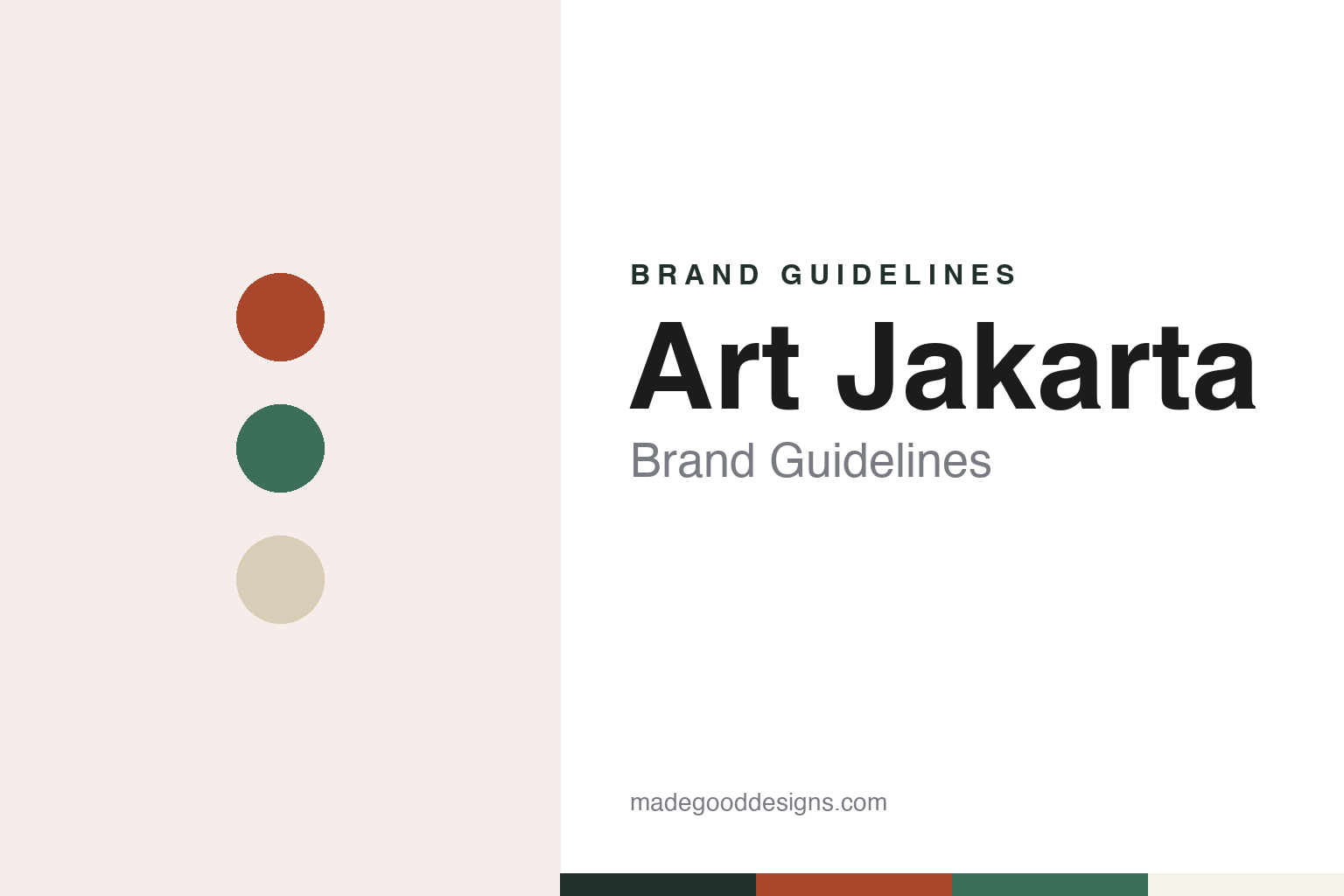
Art Jakarta Brand Guidelines
From a hotel ballroom fair to three halls at JIExpo.
Aa
Two constants: a teak ink, terracotta and banyan green palette of our own and a rounded city sans register. Abstract homage — not an Art Jakarta asset; no logo, campaign image or artwork is reproduced.
Bazaar Art Jakarta
A fair that grew up in a hotel ballroom.
Art Jakarta started under another name. English Wikipedia says the fair was known as Bazaar Art Jakarta from its first edition in 2009 until 2016, and that it was held at The Ritz-Carlton Pacific Place. The name pointed to its link with a magazine: when The Jakarta Post covered the 2018 edition, it quoted the editor-in-chief of Harper’s Bazaar Indonesia in her role as deputy head of the fair’s organising committee.
The last editions under the old name were already sizeable. The Jakarta Post reported in August 2016 that Bazaar Art Jakarta was showing more than 1,500 works at the Ritz-Carlton, from 19 Indonesian galleries and 23 galleries from abroad, with galleries from the United States, Taiwan, Singapore, South Korea, Japan and Spain among those taking part. That year’s theme was “Food for Soul #IndonesianPride,” and the fair director, Vivi Yip, opened it with a programme that spread beyond the stands: art installations in the shopping mall, workshops and talks with practitioners. The paper gave those programmes the names MALLart, EDUart and TALKart.
The fair changed its name in 2017. The Jakarta Post described that year’s fair, which closed on 30 July, as the inaugural edition of Art Jakarta and noted that the event had previously been known as Bazaar Art. Visitors entered through the Pacific Place shopping mall, where a large installation by the artistic pair Indieguerillas rose from the ground to the ceiling, and the stands featured galleries from Jakarta, Bandung and Singapore with a strong focus on young and emerging Indonesian artists.
A year later the fair marked its tenth anniversary in the same building. The Jakarta Post reported in August 2018 that the edition ran from 2 to 5 August in the Ritz-Carlton Pacific Place ballroom, which it called the fair’s home since its conception, with more than 1,000 works by more than 300 local and international artists. According to the organisers, the 2017 fair had drawn more than 47,000 visitors over four days.
Colour
New organiser, bigger halls.
The 2019 edition changed the fair’s footprint. English Wikipedia says that from 2019 the fair has been organised by PT Artindo Jakarta Seni Kini, with a new team led by fair director Tom Tandio and artistic director Enin Supriyanto, and that it moved that year to the Jakarta Convention Center in Senayan, where it stayed until 2023. The Jakarta Post reported in September 2019 that the 11th edition ran from 30 August to 1 September at the convention centre, with 70 galleries from 14 countries and more than 39,000 visitors over three days. About 30 per cent of the galleries were taking part for the first time, and among the participants the paper named Jakarta’s Edwin’s Gallery and Mizuma Gallery, which has spaces in Tokyo, Singapore and New York. The auction house Phillips Asia also took a stand.
The same report described a section called Jakarta Scene, a designated space for artist collectives and artist-run initiatives selling artworks, objects, clothing, toys and publications. Tandio told the paper that the community spirit known in Indonesian as “gotong-royong” gave the fair its Indonesian identity. Exhibitors quoted by the paper said the convention centre made loading and unloading easier than the hotel, and that the audience was more focused on art than the shopping-mall crowd had been.
Since 2024 the fair has been held at JIExpo, the Jakarta International Expo in Kemayoran, English Wikipedia says. In 2025 it ran from 3 to 5 October with 75 galleries from 16 countries, and introduced Korea Focus, a group of 12 Korean galleries presented with the Korean Ministry of Culture, Sports and Tourism and the Korea Arts Management Service. The fair’s sections that year included Art Jakarta Spot for large site-specific solo projects, Art Jakarta Scene for collectives and AJX for collaborations with institutions.
The 2026 edition ran from 2 to 4 October across three halls at JIExpo Kemayoran. The Jakarta Post reported on 9 October 2026 that it brought together 75 galleries, 42 from Indonesia and 33 from abroad, with 19 taking part for the first time. It also described a new section, AJScope, which brought independent art-market initiatives from cities such as Malang, Pekanbaru, Gorontalo and Yogyakarta into the fair through a programme supported by the culture ministry’s national talent-management scheme. Tokyo Art Beat reported on 16 October 2026 that Korea Focus had grown from 12 to 14 galleries, and that companies including Julius Baer, BCA and Treasury had presented installations made with artists.
Typography
How satellite, regional and newer fairs build an identity.
Many newer art fairs choose their dates in one of two ways. Some open in the same week as a larger fair in the same city, so that collectors and curators who are already in town can walk from one to the other: VOLTA was founded in Basel in 2005 as an alternative fair during the week of Art Basel, and Paris Internationale runs in Paris each October alongside what is now Art Basel Paris. Others take a slot of their own in the calendar and build an audience around it, without a larger neighbour to draw on.
Either way, the name is what holds steady. The city, the building and the edition number change, while the wordmark carries over. VOLTA writes its name in capitals and adds the city, as in VOLTA Basel and VOLTA New York; Paris Internationale kept its Paris name when it held its first edition in Milan in 2026, adding only Milano. A short name travels easily from one city to another and from one building to the next.
Who takes part is decided before the doors open. Some fairs invite their exhibitors; others take applications and pass them to a selection committee, often made up of gallerists, which chooses galleries for the projects they propose as well as for their programmes. The resulting exhibitor list, with each gallery’s city, is published ahead of each edition, as both VOLTA and Paris Internationale do.
The visit itself is designed. Floor plans and maps tell visitors how to move through a hall, a tent or a building of several floors; signage, printed guides, websites and apps carry the exhibitor list, the sections and the programme of talks and tours. At a fair that changes buildings, the signage and stand walls may be reused from year to year, while the campaign image and the venue give each edition its own look.
Aa
A rounded city sans for a two-word place name. (Specimen set in Plus Jakarta Sans, a sans STAND-IN; NOT the Art Jakarta logo.)
Art Jakarta
A city name that outgrew its magazine title.
The identity rests on a simple rename. For eight years the fair carried a magazine’s name, Bazaar Art Jakarta; since 2017 it has used only the art form and the city. The two words now cover a family of events: the fair’s own sections are named Art Jakarta Spot, Art Jakarta Scene and AJX, and its website footer carries the name of the organising company, PT Artindo Jakarta Seni Kini. The initials AJ also appear in the names of two sections, AJX and AJScope.
The venues tell the rest of the story. The fair moved from a hotel ballroom reached through a shopping mall, to a convention centre in Senayan in 2019, and then to the exhibition halls at Kemayoran in 2024. English Wikipedia describes both moves as moves to bigger venues, and exhibitors quoted in 2019 said the convention centre brought an audience that came specifically for art. The sections for collectives and independent initiatives, first Jakarta Scene and in 2026 AJScope, put small-scale merchandise, publications and regional art markets beside the gallery stands; the 2019 report listed clothing, toys and publications among what the collectives offered.
Partnerships shape the floor as well. Tokyo Art Beat described in October 2026 how the fair’s corporate partners present their own installations made with artists, and the Korea Focus section has given a single national group of galleries its own identifiable area for two years running.
For a design guide, Art Jakarta shows how a fair can drop a borrowed title, keep the city in its name and let short prefixes carry its sections from a ballroom to three exhibition halls. Compare ART SG, another Southeast Asian fair, and Art Central in Hong Kong, where an Indonesian gallery presented an artist in a curated section in 2026. For this guide we use a teak ink, a terracotta and a banyan green on paper with a rounded sans, an unofficial interpretation; no product or logo is reproduced.
Explore & save
Keep Art Jakarta’s identity on hand — save it to a board in the Made Good inspiration library.
Art Jakarta identity set
Pin the Art Jakarta teak ink, terracotta and banyan green palette and the rounded city sans register to your own board.
Source & notes
Frequently Asked Questions
What font can I use to match the Art Jakarta look?
This guide describes Art Jakarta’s type as “A rounded city sans for a two-word place name”. Its type specimen is set in Plus Jakarta Sans from Google Fonts as a stand-in; Plus Jakarta Sans is not Art Jakarta’s own lettering.
What colours are in the Art Jakarta palette?
This guide’s Art Jakarta palette is Teak ink #22302B, Terracotta #A8472B, Banyan green #3C6E5A, Rattan sand #D9CDB8 and Paper #F6F2EA. The tones are the guide’s own unofficial interpretation, not official Art Jakarta hex codes.
When was Art Jakarta founded?
Art Jakarta was founded in 2009 (as Bazaar Art Jakarta), in Jakarta, Indonesia.