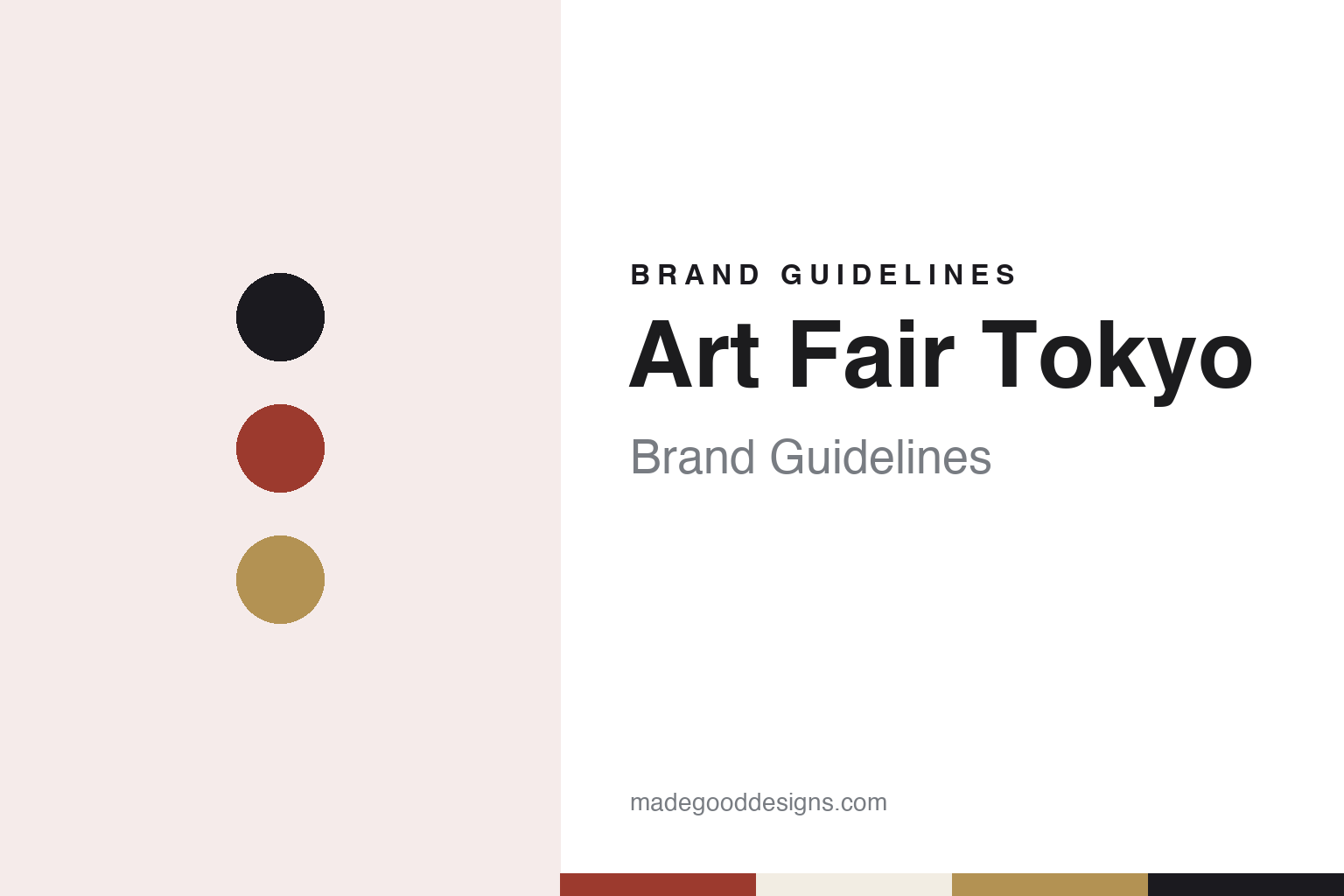
Art Fair Tokyo Brand Guidelines
The Tokyo International Forum fair that mixes antique, modern and contemporary art.
Aa
Two constants: a lacquer red, washi and old gold palette and a calm mincho serif register. Abstract homage — not an Art Fair Tokyo asset or mark; no logo, campaign image or artwork is reproduced.
From NICAF to Art Fair Tokyo
How a contemporary fair of the 1990s became a fair of four genres.
Art Fair Tokyo was first held in 2005, the Japanese art magazine Bijutsu Techo reported in December 2025, and it takes place at the Tokyo International Forum in Marunouchi, close to Tokyo Station. The fair grew out of an earlier event. In a 2008 interview published by Tokyo Art Beat, the fair’s then executive director Misa Shin said that it began in 1992 as the Nippon International Contemporary Art Fair, known as NICAF, which at that time showed contemporary art only. Time Out Tokyo likewise described Art Fair Tokyo in December 2025 as founded in 2005 and rooted in the legacy of the former NICAF.
Shin told the interviewer that NICAF struggled to fill its booths through the 1990s and lost momentum towards the end of the decade. A group of Tokyo gallerists, among them Tomio Koyama, then met to work out how to revive it. Because the market for Japanese contemporary art was still small, she said, they chose to open the fair to yōga (Western-style painting), nihonga (Japanese-style painting) and antiques. The word “contemporary” in the old name had tied the fair to a single genre, so in 2005 it was relaunched as Art Fair Tokyo.
Shin herself had worked in public relations and development at the Mori Art Museum before she was appointed executive director in 2005, Tokyo Art Beat noted. In the same interview she explained the mix of genres by comparison with TEFAF in Maastricht, where modern and antique dealers also show side by side, and she said that putting all these fields together created a single market of its own.
The fair has kept to the same building. Tokyo Art Beat described the 2008 edition, held from 3 to 6 April 2008 at the International Forum in Yurakucho, as the fair’s third. The 20th edition, in March 2026, was again held at the Forum, in Hall E and the Lobby Gallery.
Colour
A twentieth edition in March 2026.
A press release dated 1 December 2025 names aTOKYO Co., Ltd., a company based in Chiyoda, Tokyo, as the organiser of the 20th edition, and the fair’s website carries the same company name. That edition, titled ART FAIR TOKYO 20, ran from 13 to 15 March 2026, Bijutsu Techo and Time Out Tokyo reported. It brought together 141 exhibitors, ten of them new to the fair.
Bijutsu Techo set out how that total was made up: 75 contemporary art galleries, 25 modern art galleries, 17 antique dealers and 13 craft galleries, together with four galleries from abroad and seven exhibitors that sit outside the usual gallery categories, among them the Ishikawa Prefectural Wajima Institute of Lacquer Art. Tokyo Art Beat listed Tomio Koyama Gallery and TARO NASU among the exhibitors in December 2025, and Time Out Tokyo added ShugoArts and Kaikai Kiki as regular participants.
The fair is organised in sections. Its website describes Galleries as the main section for galleries and dealers with a continuing programme, Crossing as a section for organisations and exhibitors beyond commercial galleries, and Projects as a section for focused presentations of one or two artists. Time Out Tokyo counted five core sections for 2026, adding Encounters and Films. According to Tokyo Art Beat, the Films section for moving-image work was created in 2025 and expanded in 2026, with its programme directed by the group non-syntax. The fair’s website also lists a talks programme called Dialogues.
The 2026 edition reached beyond the Forum as well. Bijutsu Techo reported a tie-up with three museums in and around Tokyo, the Ueno Royal Museum, the SOMPO Museum of Art and the Toguri Museum of Art, which offered fair ticket holders discounted entry to their exhibitions.
Typography
How satellite, regional and newer fairs build an identity.
Many newer art fairs choose their dates in one of two ways. Some open in the same week as a larger fair in the same city, so that collectors and curators who are already in town can walk from one to the other: VOLTA was founded in Basel in 2005 as an alternative fair during the week of Art Basel, and Paris Internationale runs in Paris each October alongside what is now Art Basel Paris. Others take a slot of their own in the calendar and build an audience around it, without a larger neighbour to draw on.
Either way, the name is what holds steady. The city, the building and the edition number change, while the wordmark carries over. VOLTA writes its name in capitals and adds the city, as in VOLTA Basel and VOLTA New York; Paris Internationale kept its Paris name when it held its first edition in Milan in 2026, adding only Milano. A short name travels easily from one city to another and from one building to the next.
Who takes part is decided before the doors open. Some fairs invite their exhibitors; others take applications and pass them to a selection committee, often made up of gallerists, which chooses galleries for the projects they propose as well as for their programmes. The resulting exhibitor list, with each gallery’s city, is published ahead of each edition, as both VOLTA and Paris Internationale do.
The visit itself is designed. Floor plans and maps tell visitors how to move through a hall, a tent or a building of several floors; signage, printed guides, websites and apps carry the exhibitor list, the sections and the programme of talks and tours. At a fair that changes buildings, the signage and stand walls may be reused from year to year, while the campaign image and the venue give each edition its own look.
Aa
A calm mincho serif for a bilingual, edition-numbered title. (Specimen set in Shippori Mincho, a serif STAND-IN; NOT the Art Fair Tokyo logo.)
Art Fair Tokyo
A plain city name, two scripts and an edition number.
The fair’s name is as plain as a title can be: the words for an art fair and the city, written in English as ART FAIR TOKYO and in Japanese as アートフェア東京. The website sets the English name in capital letters. How each edition is labelled has changed over time. Tokyo Art Beat wrote of “Art Fair Tokyo 2008”, and Bijutsu Techo headlined its reports “Art Fair Tokyo 2023” and “Art Fair Tokyo 2024” before switching to edition numbers, with “Art Fair Tokyo 19” in March 2025 and ART FAIR TOKYO 20 for the anniversary fair in 2026.
Each edition also carries a main visual drawn from an artist’s work. For the 20th edition, Tokyo Art Beat and Bijutsu Techo reported, the fair chose a 2007 work by Tatsuo Miyajima. The venue gives the fair a third constant. The Tokyo International Forum has hosted the fair from the 2008 edition reported by Tokyo Art Beat to the 20th edition in 2026, and the fair’s website stresses its location in the Marunouchi and Yurakucho business district beside Tokyo Station.
The mix of genres is part of the identity too. Contemporary, modern, antique and craft galleries share the same halls, as the 2026 exhibitor count shows, and the section names, Galleries, Crossing and Projects, sort exhibitors by format rather than by period. Tokyo Art Beat quoted the fair’s managing director in December 2025 as saying that the organisers had tried not to lean towards any one genre while keeping the standard high, so that the fair could show a cross-section of the many fields of Japanese art.
For a design guide, Art Fair Tokyo shows how a fair can carry a long lineage through a plain bilingual name, a fixed venue and a numbered edition. Compare Tokyo Gendai, another fair in the same city, and TEFAF, which also places antique and modern dealers together. For this guide we use a lacquer red, a warm washi white and an old-gold accent with a serif, an unofficial interpretation; no product or logo is reproduced.
Explore & save
Keep Art Fair Tokyo’s identity on hand — save it to a board in the Made Good inspiration library.
Art Fair Tokyo identity set
Pin the Art Fair Tokyo lacquer red, washi and old gold palette and the calm mincho serif register to your own board.
Source & notes
Frequently Asked Questions
What font can I use to match the Art Fair Tokyo look?
This guide describes Art Fair Tokyo’s type as “A calm mincho serif for a bilingual, edition-numbered title”. Its type specimen is set in Shippori Mincho from Google Fonts as a stand-in; Shippori Mincho is not Art Fair Tokyo’s own lettering.
What colours are in the Art Fair Tokyo palette?
This guide’s Art Fair Tokyo palette is Lacquer red #9C3A2E, Sumi ink #1B1A1F, Washi #F2EDE3, Old gold #B39253 and Slate #4C5866. The tones are the guide’s own unofficial interpretation, not official Art Fair Tokyo hex codes.