Art Central Brand Guidelines
Hong Kong’s harbourfront fair since 2015.
Aa
Two constants: a harbour night, Victoria teal and ferry red palette of our own and a grotesque harbour sans register. Abstract homage — not an Art Central asset; no logo, campaign image or artwork is reproduced.
A tent on the harbour
A satellite fair opposite the convention centre.
Art Central opened in March 2015 as the first satellite event of Art Basel’s Hong Kong fair, The Art Newspaper reported that spring. It ran from 14 to 16 March 2015 on the Central Harbourfront, a day ahead of the main fair at the Hong Kong Convention and Exhibition Centre, and its 10,000 sq m tent was visible from the convention centre’s windows. Of the 77 galleries exhibiting, 17 had started out in Hong Kong, and the paper quoted co-founder Tim Etchells as saying the fair would be strong on local artists. Works on show included an eleven-metre site-specific mural by a Hong Kong graffiti artist.
The founders already knew the city’s fair calendar. ARTnews reported on 16 March 2015 that Etchells had sold his three-year-old fair, Art HK, to Basel in 2011. The fair’s own about page says that Etchells, Sandy Angus and Will Ramsay co-founded Art Central in 2015 as a joint venture, that Etchells and Angus launched ART HK in 2008 before Art Basel acquired it in 2011, and that the two men are also co-owners of Sydney Contemporary, Taipei Dangdai and ART SG.
The first edition’s setting was part of its character. ARTnews placed the tent about a twenty-minute walk along the harbourfront from the convention centre and described its decent lighting, wide carpeted aisles and a street-food court with picnic tables, and noted that those aisles were well populated on the Saturday.
The second edition followed in March 2016, from 23 to 26 March at the Central Harbourfront Event Space. The Art Newspaper reported that more than 100 galleries were taking part, 30 of them new to Hong Kong, and that more than 70 per cent of exhibitors came from Asia. The fair’s director at the time told the paper that the programme put more weight on talks: a series presented by the Asia Society Hong Kong Center, and round-table discussions with Sydney’s 4A Centre for Contemporary Asian Art, at which visitors could sit at a communal table with curators, collectors, artists and museum directors.
Colour
Neo, Projects and Central Stage.
By 2019 the fair had settled into a pattern. The Art Newspaper reported that March that 107 galleries were taking part, 75 per cent of them from Asia, with Hong Kong, Japan, Korea and Australia the most represented and 32 galleries new to the fair, among them Manila’s Art Underground. The collaboration with the 4A Centre for Contemporary Asian Art was in its fourth year of performance pieces, and a guest curator organised the Projects section of large installations by six artists for a second year.
The fair’s return to the waterfront was itself news in 2024. Hong Kong Free Press reported on 28 March 2024 that the ninth edition marked Art Central’s return to the Central Harbourfront for the first time since 2019. It showed 98 galleries and works by some 500 artists; 70 per cent of the galleries came from the Asia-Pacific region, nearly a third had spaces in Hong Kong and more than a third were joining for the first time. The paper listed an education programme of talks, tours and workshops.
The 10th edition, in March 2025, had 108 galleries and more than 500 artists from over 40 countries and territories, Hong Kong Free Press reported on 27 March 2025. Quoting the fair’s press release, it named a large-scale commissioned installation by the Hong Kong artist Nadim Abbas, a new format for performances and lecture-performances, and a video art programme drawn from the Akeroyd Collection. The fair’s website says its current fair director joined in 2019 and that the fair is presented in partnership with United Overseas Bank.
The 11th edition ran until 29 March 2026 with 117 galleries, The Art Newspaper reported on 24 March 2026, and added a curated section, Central Stage, for mid-career artists who had recently had major institutional exhibitions or commissions. In its announcement on e-flux, the fair said the edition ran from 25 to 29 March with a preview on 24 March, that the gallery programme was under the direction of a Hong Kong artist-curator, and that Central Stage sat alongside Neo, a sector for galleries in their early years, and the Yi Tai Sculpture and Installation Projects. Among the six Central Stage presentations, the fair listed the Jakarta gallery ISA Art Gallery and Tokyo’s wamono art.
Typography
How satellite, regional and newer fairs build an identity.
Many newer art fairs choose their dates in one of two ways. Some open in the same week as a larger fair in the same city, so that collectors and curators who are already in town can walk from one to the other: VOLTA was founded in Basel in 2005 as an alternative fair during the week of Art Basel, and Paris Internationale runs in Paris each October alongside what is now Art Basel Paris. Others take a slot of their own in the calendar and build an audience around it, without a larger neighbour to draw on.
Either way, the name is what holds steady. The city, the building and the edition number change, while the wordmark carries over. VOLTA writes its name in capitals and adds the city, as in VOLTA Basel and VOLTA New York; Paris Internationale kept its Paris name when it held its first edition in Milan in 2026, adding only Milano. A short name travels easily from one city to another and from one building to the next.
Who takes part is decided before the doors open. Some fairs invite their exhibitors; others take applications and pass them to a selection committee, often made up of gallerists, which chooses galleries for the projects they propose as well as for their programmes. The resulting exhibitor list, with each gallery’s city, is published ahead of each edition, as both VOLTA and Paris Internationale do.
The visit itself is designed. Floor plans and maps tell visitors how to move through a hall, a tent or a building of several floors; signage, printed guides, websites and apps carry the exhibitor list, the sections and the programme of talks and tours. At a fair that changes buildings, the signage and stand walls may be reused from year to year, while the campaign image and the venue give each edition its own look.
Aa
A grotesque sans for a two-word name tied to a district. (Specimen set in Archivo, a sans STAND-IN; NOT the Art Central logo.)
Art Central
A district name on the water’s edge.
The name does double work. “Central” is the district where the fair stands, on the waterfront in front of the city’s business towers, and it also describes the fair’s place in the week: The Art Newspaper called it a cornerstone of Hong Kong Art Week in 2026, and the fair’s about page uses the same phrase. The website header leads with the dates, the preview day and the words Central Harbourfront Hong Kong, so the venue sits next to the name at every touchpoint.
The building is part of the identity. On the harbourfront the fair uses a temporary structure rather than a permanent hall; The Art Newspaper gave the first tent’s size as 10,000 square metres, and the fair’s own site now describes an architect-designed, purpose-built structure overlooking Victoria Harbour, within walking distance of Art Basel at the convention centre and a short ferry ride from M+. ARTnews described the 2015 tent’s wide carpeted aisles and its food court with picnic tables.
Inside, the structure is organised by named sectors rather than by gallery size alone. Over the years the press has described Projects for large installations, talks and performances programmed with partners, Neo for younger galleries and, from 2026, Central Stage. The sector names are short, plain English words, set beside the unchanged two-word title.
For a design guide, Art Central shows how a satellite fair can turn a district name and a temporary building into a steady identity across eleven editions. Compare Art Basel, whose Hong Kong week it has joined since 2015, and Taipei Dangdai, which shares two of its co-owners. For this guide we use a harbour night, a Victoria teal and a ferry red on paper with a grotesque sans, an unofficial interpretation; no product or logo is reproduced.
Explore & save
Keep Art Central’s identity on hand — save it to a board in the Made Good inspiration library.
Art Central identity set
Pin the Art Central harbour night, Victoria teal and ferry red palette and the grotesque harbour sans register to your own board.
Source & notes
Frequently Asked Questions
What font can I use to match the Art Central look?
This guide describes Art Central’s type as “A grotesque sans for a two-word name tied to a district”. Its type specimen is set in Archivo from Google Fonts as a stand-in; Archivo is not Art Central’s own lettering.
What colours are in the Art Central palette?
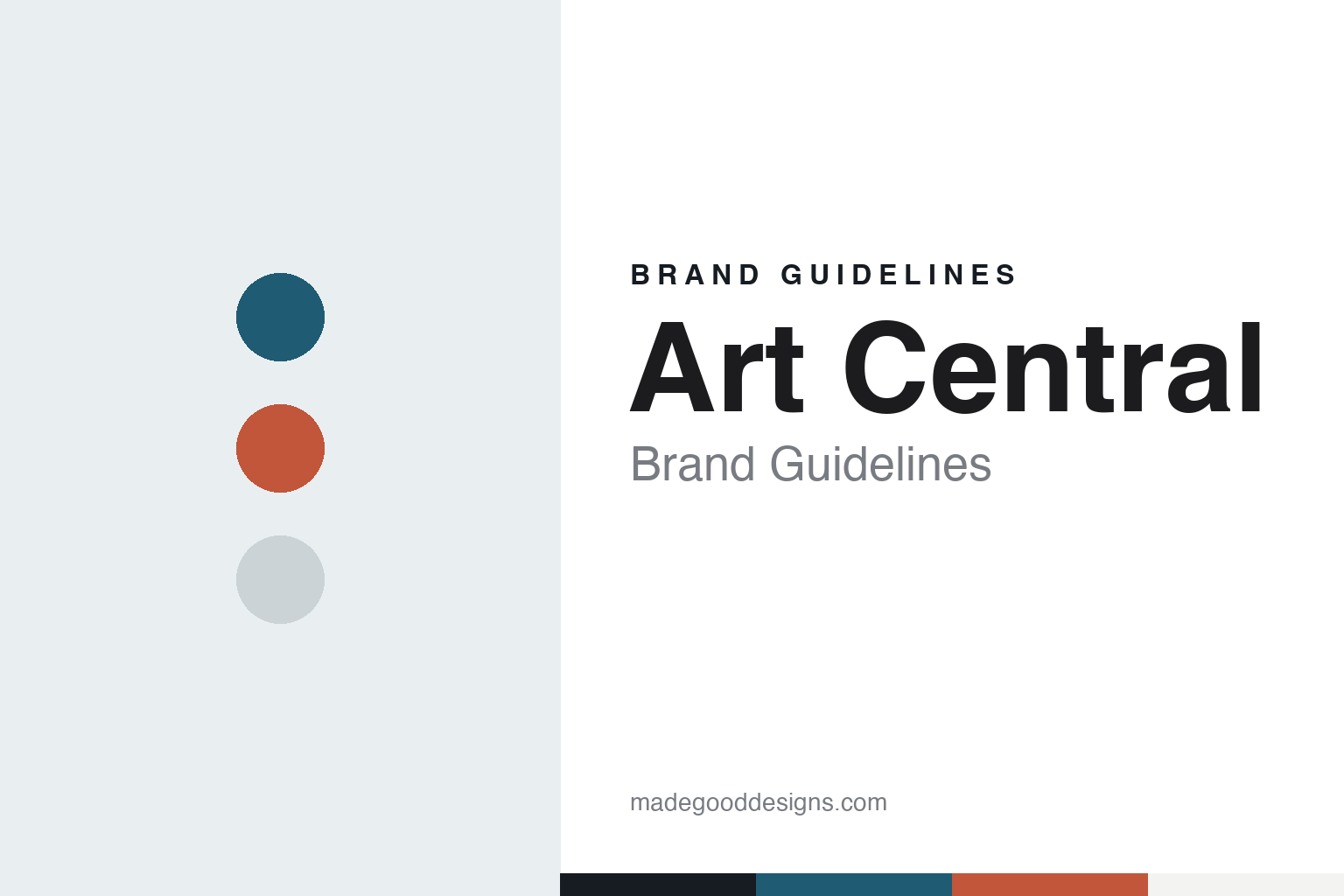
This guide’s Art Central palette is Harbour night #161C22, Victoria teal #1F5C73, Ferry red #C2563A, Sailcloth grey #CBD3D6 and Paper #F3F4F1. The tones are the guide’s own unofficial interpretation, not official Art Central hex codes.
When was Art Central founded?
Art Central was founded in 2015, in Hong Kong.