Newport Jazz Festival Brand Guidelines
Fort Adams, three stages and a name since 1954.
Aa
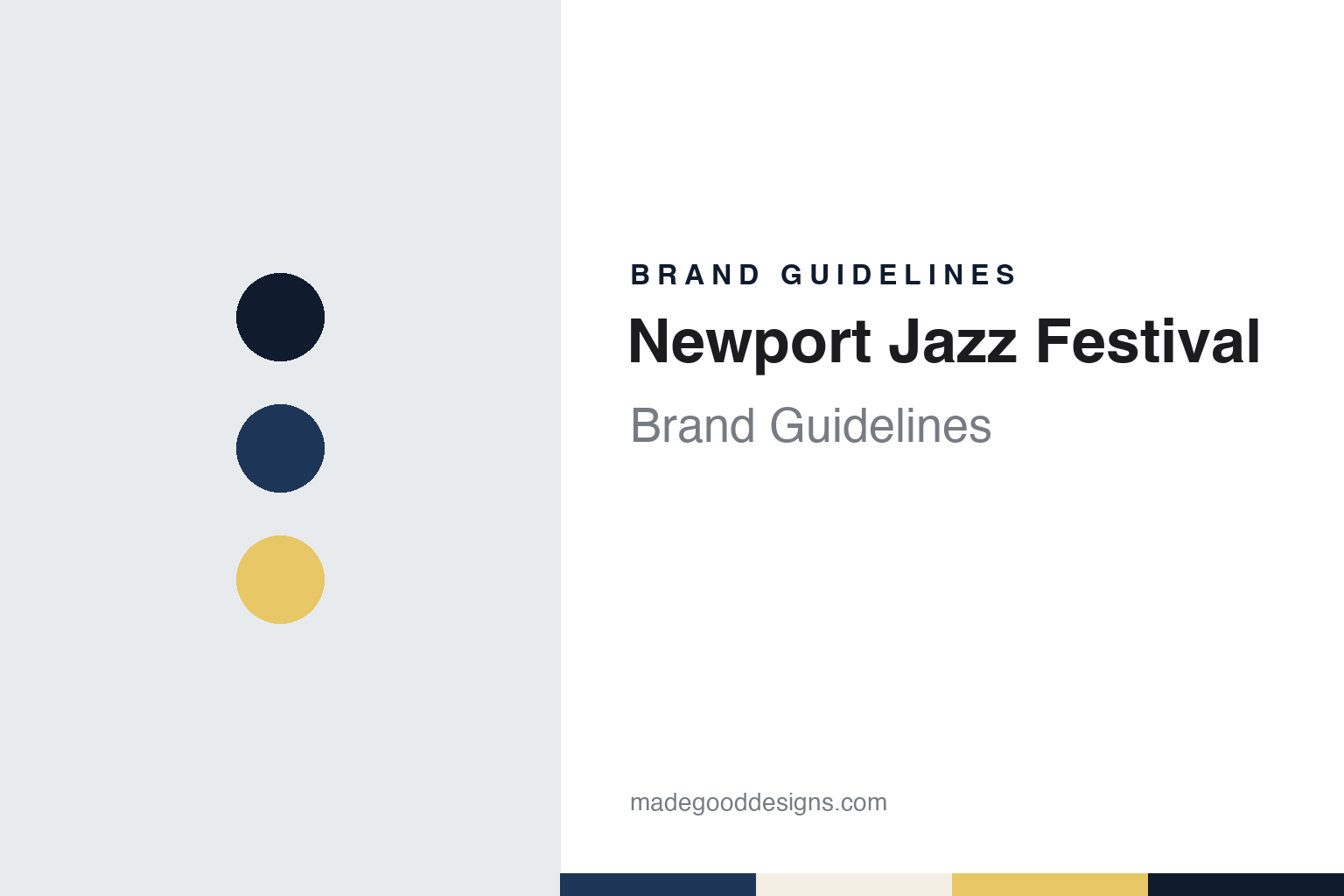
Two constants: a Newport harbour navy and brass palette and a Harbour serif register. Abstract homage — not a Newport Jazz Festival poster or mark; no logo, artwork or photograph is reproduced.
Newport, 1954
A lawn, a promoter and a summer season.
The Newport Jazz Festival began in 1954 in Newport, Rhode Island. The Associated Press, writing in January 2011, said it started after Elaine Lorillard hired George Wein to put together a series of performances for the town’s summer season. English Wikipedia adds that she and her husband financed the festival for many years, and that Wein was engaged to organise that first edition and bring jazz to Rhode Island.
The first festival was billed as the “First Annual American Jazz Festival,” English Wikipedia says, and was held at the Newport Casino, in the Bellevue Avenue district of the town. It mixed academic panel discussions with concerts on an outdoor lawn, and English Wikipedia puts attendance across its two days at about 13,000. The AP named Billie Holiday and Dizzy Gillespie among the musicians who played that year.
The festival moved within the town as it grew. In 1955, according to English Wikipedia, the music was presented at Freebody Park, a sports arena a block behind the casino, while workshops and receptions were held at the Belcourt estate; from 1965 the concerts moved to a field outside the town centre that became known as Festival Field. From 1972 the festival was presented in New York City as the Newport Jazz Festival-New York, across venues that included Radio City Music Hall, and in 1981 it returned to Newport, English Wikipedia says.
Since that return the festival has been held at Fort Adams State Park, where it has remained, English Wikipedia says. The early festivals were broadcast on Voice of America radio, and many performances were recorded and issued as albums. From 1988 the festival also returned to its first home, hosting annual concerts at the Newport Casino, English Wikipedia records.
Colour
Title names, a company and a foundation.
The festival’s name has changed with its sponsors. English Wikipedia records that the audio-visual equipment company JVC became the main sponsor in 1984, when the event was renamed the JVC Jazz Festival, and that the name was used until 2008; in 2009 CareFusion took JVC’s place as sponsor. The website today uses the plain name, Newport Jazz Festival, with a registered-trademark sign.
Ownership changed too. In early 2007, English Wikipedia says, citing The New York Times, Wein sold his company, Festival Productions, to Festival Network, and stayed on in a senior role. The AP reported in January 2011 that Wein had resumed running the festivals in 2009, and that he had now set up a new non-profit group, the Newport Festivals Foundation, as an umbrella organisation for the summer events. The same report noted that Wein had founded the Newport Folk Festival in 1959; the foundation’s website names both festivals as its productions.
The festival’s website now describes the event as a production of Newport Festivals Foundation, Inc., a 501(c)(3) non-profit corporation, and signs itself “A Newport Festivals Production.” The 2020 edition was not held, and booked artists were invited to return in 2021, according to English Wikipedia.
The programme is curated by the bassist Christian McBride, whom The Arts Fuse called the festival’s artistic director in its review of August 2025; English Wikipedia dates his appointment to 2016. Glide Magazine reported that the 71st festival ran from 1 to 3 August 2025 at Fort Adams, with about sixty performers on three stages, and that it had sold out for the second year running, meaning about 10,000 people each day. The Arts Fuse named the stages: the Fort stage as the main stage, the mid-sized Quad stage and the Harbor stage. Glide described the 2025 bill as mixing jazz with R&B, pop and hip-hop performers, and The Arts Fuse noted that the Newport Folk Festival had been held the weekend before.
Typography
How jazz festivals build an identity.
A jazz festival changes its line-up every year, so the parts of its identity that last tend to sit elsewhere. Many began with one person or one small group: a promoter, a publisher, a club owner or a city-centre association that put a name on a weekend and kept booking it. That origin often stays in the festival’s own telling, in the name of a prize, a hall or a history page, long after the organisation has passed to a foundation, a non-profit society or a concert company.
Place does much of the remaining work. Some festivals are tied to one town or one site, an amphitheatre, a fairground, a park or a congress centre, and audiences come to know the building as well as the music. Others spread across a whole city, using clubs, concert halls, squares and harbour fronts at once, so that the city itself becomes the venue. In both cases the stage names matter: a hall named after a river, a stage named after a founder or a square known by its street name becomes part of the vocabulary that returning visitors use.
The annual poster is the object people take home. Many festivals commission a different artist or designer each year, or run a competition among art students, and the run of posters becomes a record of the festival’s history that people collect and museums sometimes keep. Names change too: a title sponsor’s name can be attached to the front of a festival’s name for a period of years and later removed, while the core name stays.
Then there is the practical layer that audiences handle every day of the festival: the printed programme or app, the day schedule laid out stage by stage, wristbands and passes, maps and venue signage. With many concerts running at once, this material is how most visitors actually meet the festival’s typography and colours, and, like the poster, it is often redesigned from one edition to the next.
Aa
A harbour serif — a festival name kept since 1954. (Specimen set in Fraunces, a serif STAND-IN; NOT the Newport Jazz Festival logo.)
Newport Jazz Festival
Recordings, posters and a production line.
Much of the festival’s public image comes from records. English Wikipedia names Duke Ellington’s 1956 performance, issued as Ellington at Newport, and records that Verve Records documented the 1957 festival on twelve albums. A 1962 film of the festival was released by Storyville, the label associated with Wein, English Wikipedia says; the festival’s website today runs a video series called Storyville Sessions.
The name has also travelled. English Wikipedia records a Newport Jazz Festival-Saratoga, at the Saratoga Performing Arts Center in New York State, from 1978, and a Newport Jazz Festival in Madarao, Japan, from 1982 to 2004.
The website for the 2026 festival is organised around the practical layer audiences use: tickets, the line-up, a day-by-day schedule, a poster for the line-up, travel and accessibility pages, and a list of opening times for the box office, gates, food and music at Fort Adams. Its visitor pages note that the Fort Adams Visitors Center sits inside the festival gates, that there is no camping at the park and that there is no re-entry once a visitor leaves the grounds. The festival’s address is newportjazz.org; the foundation’s is newportfestivals.org.
For a design guide, Newport Jazz Festival shows how a town’s name, a single site and a set of plainly named stages can carry a festival through changes of sponsor and organiser. Compare Monterey Jazz Festival, whose founders took encouragement from Newport’s 1954 edition, and Verve Records, which recorded the 1957 festival. For this guide we use a harbour navy, a sail-canvas cream and a brass yellow with a serif, an unofficial interpretation; no product or logo is reproduced.
Explore & save
Keep Newport Jazz Festival’s identity on hand — save it to a board in the Made Good inspiration library.
Newport Jazz Festival identity set
Pin the Newport harbour navy and brass palette and the Harbour serif register to your own board.
Source & notes
Frequently Asked Questions
What font can I use to match the Newport Jazz Festival look?
This guide describes Newport Jazz Festival’s type as “A harbour serif — a festival name kept since 1954”. Its type specimen is set in Fraunces from Google Fonts as a stand-in; Fraunces is not Newport Jazz Festival’s own lettering.
What colours are in the Newport Jazz Festival palette?
This guide’s Newport Jazz Festival palette is Harbour navy #1D3557, Night ink #101B2D, Sail canvas #F3EFE4, Brass sun #E8C766 and Sea glass #9FC2B8. The tones are the guide’s own unofficial interpretation, not official Newport Jazz Festival hex codes.
When was Newport Jazz Festival founded?
Newport Jazz Festival was founded in 1954 (Newport Casino), in Newport, Rhode Island.
Who founded Newport Jazz Festival?
Newport Jazz Festival was founded by Elaine Lorillard; producer George Wein in 1954 (Newport Casino).