Jazzaldia Brand Guidelines
San Sebastián’s July jazz festival, from Trinidad to Zurriola.
Aa
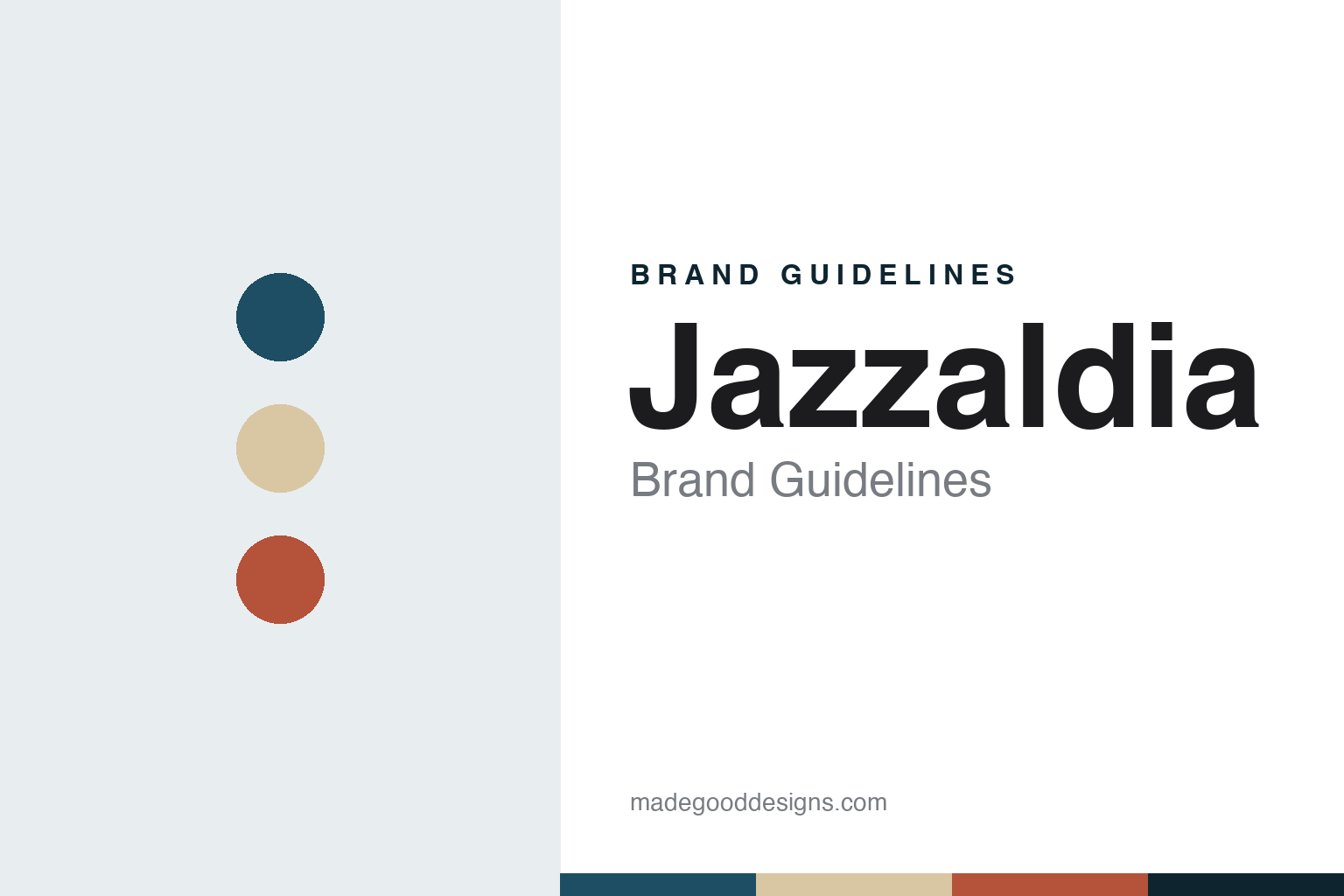
Two constants: a Jazzaldia bay blue, sand and old-town red palette and a Coastal sans register. Abstract homage — not a Jazzaldia poster or mark; no logo or artwork is reproduced.
A square in the old town
From a contest to a July week.
Jazzaldia is the short name of the Festival de Jazz de San Sebastián, in Basque Donostiako Jazzaldia, after Donostia, the city’s Basque name. Spanish Wikipedia says it is held every year in the third week of July, and that it was founded in 1966.
The first edition took place on 10 and 11 September 1966, according to English and Spanish Wikipedia, both citing the Madrid newspaper ABC of that date. From the following year the festival moved to July, where it has stayed. Its early identity was a contest: Spanish Wikipedia says it began with an international competition for amateur groups, which remained its signature for many editions, and with a single professional act, the guitarist Mickey Baker.
That format was still in place in the 1970s. El País, reporting from San Sebastián on 21 July 1977, described the opening of the 12th Festival de Jazz de San Sebastián, begun by the blues singer Muddy Waters, with fourteen amateur groups competing over two days and professional acts each evening; the closing night belonged to Charles Mingus. The same report noted a new feature that year: traditional jazz bands playing in the streets of the city.
The festival’s home from the start was the Plaza de la Trinidad, a square in the Parte Vieja, the old town, at the foot of Mount Urgull. Spanish Wikipedia says the square was built in 1963 to a design by the architect Peña Ganchegui, and sits between the San Telmo museum building, the Basilica of Santa María and the old town’s houses. As audiences grew in the mid-1970s, the festival moved its main concerts first to the city’s sports hall and then to the Anoeta velodrome, the same source says. In 1992 the organisers left the velodrome and returned to the Plaza de la Trinidad, and the festival then began to spread to other stages around the city.
Colour
A dozen stages, paid and free.
Today Jazzaldia combines ticketed concerts indoors with free concerts outdoors. Spanish Wikipedia puts the total at around a hundred concerts on about a dozen stages across San Sebastián.
The Plaza de la Trinidad remains its historic centre, a small enclosed square where the audience sits close to the stage. The Kursaal auditorium, designed by the architect Rafael Moneo, seats about 1,800, according to Spanish Wikipedia, and is used for solo recitals and small groups as well as larger ensembles. The Victoria Eugenia theatre, an Italian-style house restored between 2001 and 2007, seats 888, and a smaller club space beneath its stage holds about 150, the same source says. The San Telmo Museum, reopened in 2011 after a restoration that added a modern wing, hosts concerts in its church and Renaissance cloister.
The free stages face the sea. The stage on Zurriola beach has no fixed capacity and, Spanish Wikipedia says, is the stage most popular with young audiences; three further stages stand on the Kursaal terraces, facing the sea beside the beach, where emerging artists and local groups often play; and a stage called Nauticool sits on the terrace of the Club Náutico, above the harbour and La Concha bay. Other venues used by the festival include Kutxa Kultur, Tabakalera and the gardens of Chillida Leku, according to the same source.
Attendance is counted by stage type. At the close of the 60th edition in July 2025, the Basque public broadcaster EITB reported that the festival’s 52 free concerts had drawn 158,700 people and its paid concerts 20,480, with 17 paid concerts full. The same report gave the dates of the 61st edition as 22 to 26 July 2026.
Since 1994, English and Spanish Wikipedia say, the festival has given its own prize, the Premio Donostiako Jazzaldia, to an artist appearing at the festival; the award takes the form of a plaque showing the Plaza de la Trinidad.
Typography
Design and documentation.
A jazz festival changes its line-up every year, so the parts of its identity that last tend to sit elsewhere. Many began with one person or one small group: a promoter, a publisher, a club owner or a city-centre association that put a name on a weekend and kept booking it. That origin often stays in the festival’s own telling, in the name of a prize, a hall or a history page, long after the organisation has passed to a foundation, a non-profit society or a concert company.
Place does much of the remaining work. Some festivals are tied to one town or one site, an amphitheatre, a fairground, a park or a congress centre, and audiences come to know the building as well as the music. Others spread across a whole city, using clubs, concert halls, squares and harbour fronts at once, so that the city itself becomes the venue. In both cases the stage names matter: a hall named after a river, a stage named after a founder or a square known by its street name becomes part of the vocabulary that returning visitors use.
The annual poster is the object people take home. Many festivals commission a different artist or designer each year, or run a competition among art students, and the run of posters becomes a record of the festival’s history that people collect and museums sometimes keep. Names change too: a title sponsor’s name can be attached to the front of a festival’s name for a period of years and later removed, while the core name stays.
Then there is the practical layer that audiences handle every day of the festival: the printed programme or app, the day schedule laid out stage by stage, wristbands and passes, maps and venue signage. With many concerts running at once, this material is how most visitors actually meet the festival’s typography and colours, and, like the poster, it is often redesigned from one edition to the next.
Aa
A coastal sans — from Trinidad to Zurriola. (Specimen set in Archivo, a sans STAND-IN; NOT the Jazzaldia logo.)
Jazzaldia
A city festival with two names.
Jazzaldia is a municipal festival. EITB’s 2025 report said the festival director’s post is tied to the musical direction of Donostia Kultura, the city’s public culture body, and that the mayor of San Sebastián presented the results of the 60th edition alongside the director. Miguel Martín directed that edition, which EITB reported was his last as director; he said he would remain linked to the festival and complete the programme of the 61st edition. A fiftieth-anniversary history, Jazzaldia 50, was published in 2015 by Victoria Eugenia Antzokia, the company behind the city’s Victoria Eugenia theatre, Spanish Wikipedia records.
The festival’s two names work side by side. The Spanish title, Festival de Jazz de San Sebastián, is the one El País used in 1977; the Basque name, Jazzaldia, is the one used for the festival’s prize and its web address, jazzaldia.eus. In a 2025 listing of the 60th edition, the music site Musicalia named its main ticketed venues as the Plaza de la Trinidad, the Kursaal, the Victoria Eugenia theatre and the San Telmo Museum.
For a designer, the city does much of the work. The festival’s stages run from an enclosed 1960s square in the old town to a modern auditorium and an open beach,. Each stage has its own audience and its own scale: a seated hall, a stone square, a crowd on the sand. A visual identity has to hold all three together under one name, in two languages.
For a design guide, Jazzaldia shows how a festival can grow from one square into a whole seafront without losing its first address. Compare San Sebastián Film Festival, the city’s other international festival, and Umbria Jazz, another European July festival that mixes free open-air stages with ticketed halls. For this guide we use a bay blue, a sand and an old-town red with a sans, an unofficial interpretation; no product or logo is reproduced.
Explore & save
Keep Jazzaldia’s identity on hand — save it to a board in the Made Good inspiration library.
Jazzaldia identity set
Pin the Jazzaldia bay blue, sand and old-town red palette and the Coastal sans register to your own board.
Source & notes
Frequently Asked Questions
What font can I use to match the Jazzaldia look?
This guide describes Jazzaldia’s type as “A coastal sans — from Trinidad to Zurriola”. Its type specimen is set in Archivo from Google Fonts as a stand-in; Archivo is not Jazzaldia’s own lettering.
What colours are in the Jazzaldia palette?
This guide’s Jazzaldia palette is Bay blue #1D4E63, Deep harbour #0E2530, Zurriola sand #D9C7A3, Old-town red #B5523A and Paper #F6F4EF. The tones are the guide’s own unofficial interpretation, not official Jazzaldia hex codes.
When was Jazzaldia founded?
Jazzaldia was founded in 1966 (first edition 10–11 September), in San Sebastián (Donostia).